The short answer: an ETG test for college students checks recent drinking, not impairment
An ETG test for college students is a urine test for ethyl glucuronide, a direct metabolite of alcohol. It answers one question: has this student drunk alcohol in roughly the past one to three days? It does not measure impairment, it does not say someone was drunk in class, and it does not diagnose an alcohol problem.
Campuses use it because a breath test can only show intoxication right now. EtG looks back about 80 hours, so it catches drinking a breath test would miss — a student who drank on Friday can blow zero on Monday and still test positive.
Most students never face one. Testing is not routine for the general student body — it shows up in four specific situations, and the rules are set by the university, not by any national standard.
When campuses order an ETG test for college students
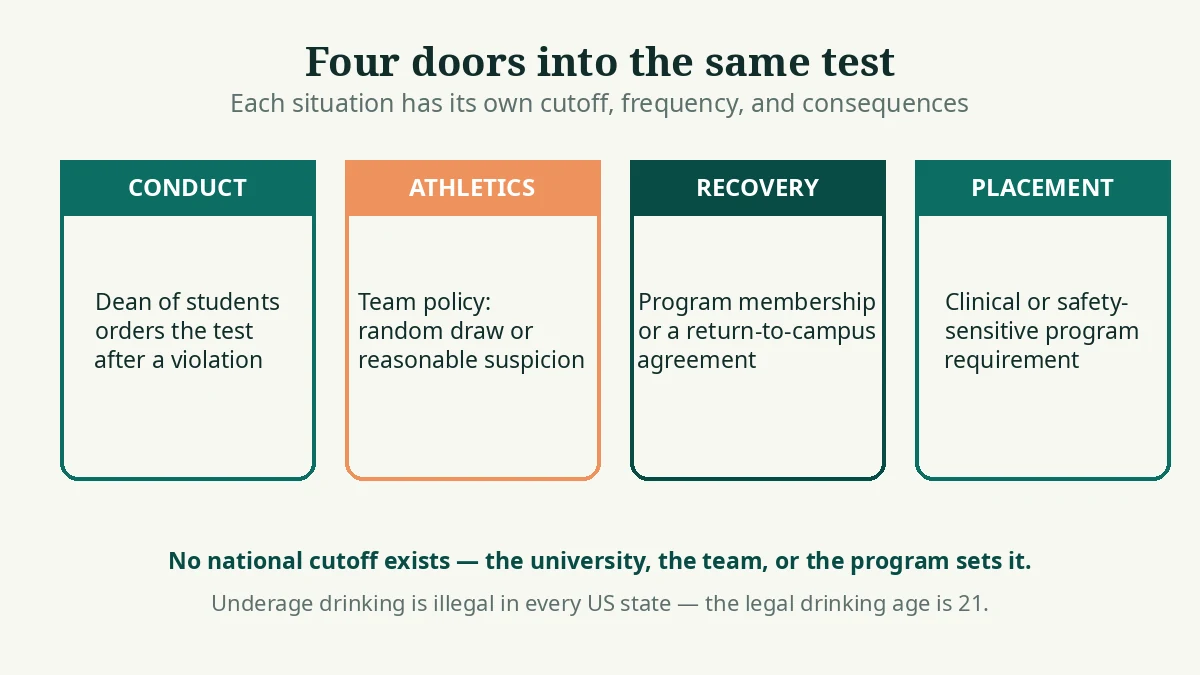
University alcohol testing is policy-set, and the policy depends on the context.
| Situation | Who orders it | Typical trigger | What is at stake |
|---|---|---|---|
| Student conduct | Dean of students / conduct office | Alcohol violation, dorm incident, hospital transport | Warning up to suspension |
| Student athletics | Athletics department | Team policy, random draw, reasonable suspicion | Playing time, eligibility, scholarship |
| Collegiate recovery program | Recovery program staff | Program membership or return-to-campus agreement | Program standing, recovery housing |
| Clinical or safety-sensitive placement | Academic program or clinical site | Nursing, medical, or technical program requirement | Placement, program standing |
Underage drinking is illegal in every US state — the legal drinking age is 21 — so most campus testing starts from a conduct violation by a student under 21. But students over 21 are tested too: athletes can be tested even when they can drink legally, and students in recovery programs or clinical placements agree to abstinence as a condition of the program.
Student conduct: from violation to test result
The process follows a fixed chain: the conduct office orders the test and names the terms; the student gives a urine sample at campus health or a certified lab, with photo ID checked and a chain-of-custody form started; the lab screens by immunoassay at the set cutoff; any positive is confirmed by LC-MS/MS with EtS measured; results go back to the conduct office, which decides the sanction.
Consequences in conduct cases are usually educational first. The University of Delaware requires students who violate alcohol policies to complete its BASICS program — a brief screening and intervention built on personalized feedback and motivational interviewing. A first violation often ends with education and a warning; repeat violations, or drinking that put someone in the hospital, escalate to probation, housing loss, or suspension. Technical colleges can be stricter: Mitchell Technical College removes a student who tests at 0.02 breath alcohol or higher from classes until a follow-up test is negative, and a second positive means referral to a substance abuse professional with follow-up testing to stay enrolled.

Student athletes and ETG testing
Athletics is the one place on campus where testing is routine rather than reactive — and it is also where students are most confused about the rules. The NCAA does not routinely test for alcohol: alcohol is on the NCAA banned-substances list only for rifle, and the NCAA's drug-testing program focuses on performance-enhancing drugs and street drugs.
The testing that actually touches athletes is institutional. Universities write their own athletics drug policies, and alcohol is usually on the list. The University of Minnesota's 2025 student-athlete policy requires every athlete to sign a consent form agreeing to drug and alcohol testing, and runs both random testing and testing on reasonable suspicion. The University of Wisconsin–Madison's screening guidelines list alcohol among the mood-altering substances its athletes can be tested for, with random and reasonable-suspicion testing run through an independent agency. Loyola University Chicago goes further: its policy prohibits athletes from having alcohol in their bloodstream during trainings, practices, competitions, and university-sponsored events — even if they are over 21 and can drink legally.
The consequences are also institutional: suspension from participation pending further negative tests is the common pattern, and refusal to test usually means losing the right to compete — and can cost financial aid. Junior-college athletics is different again: the NJCAA does not include alcohol in its drug tests, because alcohol clears the body quickly, so a junior-college athlete is far less likely to face an EtG test than a Division I athlete. Our employment testing guide covers the same consent-and-consequence pattern in the workplace, and our DUI testing guide covers what happens when drinking meets the law instead of a campus policy.
Cutoffs: what level counts as a positive on campus
There is no national EtG cutoff for colleges. The cutoff is set by the university, the team, or the program, and it changes what the test catches: a lower cutoff catches lighter and older drinking but also more incidental exposure; a higher one misses light drinking but rarely flags anything but real drinking. Our 100 vs 500 ng/mL cutoff guide explains how the three standard levels compare.
| Cutoff | What it catches | What it misses | Where it shows up |
|---|---|---|---|
| 100 ng/mL | Light drinking and drinking up to about 80 hours back | Almost nothing recent | Strict or zero-tolerance programs |
| 200 ng/mL | Moderate drinking over roughly two to three days | One drink more than about a day earlier | Middle-ground conduct and team policies |
| 500 ng/mL | Heavier or recent drinking | Light drinking and anything older than about two days | Standard lab screens |
The same drinking can be a positive under one policy and a negative under another: four drinks on Friday can still top 100 ng/mL on Monday morning and fall under 500 ng/mL by Sunday. The cutoff, not the drinking, decides the result — so the first question after any testing order is always which cutoff applies.
SAMHSA's advisory carries a warning for every campus case: EtG is "scientifically unsupportable as the sole basis for legal or disciplinary action." A single EtG number should not decide a student's standing.
How long EtG stays detectable before a campus test
Detection windows are ranges, not dates, because weight, drinking speed, hydration, and liver function all move them. The table below uses the same modeled ranges our EtG calculator uses — honest ranges for a typical adult, never a promise for one person.
| Drinking | At 100 ng/mL | At 200 ng/mL | At 500 ng/mL |
|---|---|---|---|
| 1–2 drinks | 23–53 hours | 19–44 hours | 15–36 hours |
| 3–4 drinks | 30–68 hours | 26–59 hours | 20–46 hours |
| 5–7 drinks | 38–85 hours | 32–72 hours | 26–58 hours |
Two patterns matter. Heavier drinking stretches the window by roughly a day at every cutoff — two drinks versus six is the difference between clearing on Sunday and still testing positive on Monday. And the cutoff moves the window by about a day too: at 500 ng/mL each window closes roughly a day sooner than at 100 ng/mL.

Real-world scenario: four drinks Friday, a conduct test Monday
A sophomore has four drinks at a Friday party, finishing around 10 p.m. The conduct office orders a test for Monday at 10 a.m. — 60 hours later. The question is only what the test shows.
At 100 ng/mL the window for three to four drinks is 30 to 68 hours, so 60 hours is inside it: likely positive. At 200 ng/mL the window is 26 to 59 hours, so the same sample is past it by about one hour: likely negative. At 500 ng/mL the window is 20 to 46 hours, so it is past by fourteen hours: negative. One Friday night, three different answers — and none says anything about how that student was in class on Monday morning. EtG measures recent drinking, not academic performance on a given day.
Timing games fail for the same reason: at the strict cutoff the window runs to Monday, so there is no safe day to aim for.

What a positive result can change
A positive EtG test does not automatically end a student's college career. What it usually does is change the conditions: a warning and an alcohol-education program for a first violation; disciplinary probation, loss of campus housing, or suspension for repeat violations; suspension from the team and loss of playing time for athletes; loss of a clinical placement for students in health programs. The result is evidence the conduct office weighs, not a switch that flips enrollment by itself.
What weighs heaviest is the pattern around the positive. A student who discloses drinking before the test, completes the education program, and then produces a run of clean tests is in a very different position from one who denies drinking, tests positive repeatedly, and misses tests.
Students also worry about the record. A conduct case is an education record under FERPA, the federal student-privacy law: the university cannot share it outside the school without the student's consent except in narrow exceptions, but inside the university it follows the student from the conduct office to housing and athletics. Our recovery programs guide covers what testing looks like when the goal is support rather than punishment, and our monitoring programs guide covers the same screen-then-confirm pattern in professional programs.
Incidental exposure comes up on campus too: at 100 ng/mL, heavy use of alcohol-based mouthwash or hand sanitizer can push EtG over the line; at 500 ng/mL it is unlikely. The defense is procedural: disclose the exposure before the sample, not after the result, and ask for LC-MS/MS confirmation with EtS.
What to do if you are facing a campus EtG test
Read the policy first — the student handbook or code of conduct, the team handbook, or the program agreement. It names the test, the cutoff, the frequency, and what follows a positive. If it does not name the cutoff, ask before you give a sample: which test, which cutoff, and what happens with the result.
Tell the conduct office or the coach before the sample if you drank. The result then confirms what they already know, instead of arriving as a surprise that also damages your credibility. Ask for LC-MS/MS confirmation of any positive screen, and whether EtS was measured too.
Use the support the campus already offers. More than 100 US colleges run collegiate recovery programs — the Association of Recovery in Higher Education counts around 180 nationwide — offering peer support, sober housing, and counseling for students in recovery. This article is educational only — not legal or medical advice. Rules, cutoffs, and consequences vary by university, team, and program; talk to your conduct office or a student legal-services office about a live case.
Using the EtG calculator before a test
The EtG calculator estimates the same windows the table above uses. Read the result as a range, never a pass date. Run your numbers through the calculator.
Frequently asked questions
Can a college drug test for alcohol with an EtG test?+
Yes. Universities can include EtG in their testing when a policy allows it — most often after a student conduct violation, under an athletics team policy, in a collegiate recovery program, or as a condition of a clinical placement. There is no national rule: each university, team, or program sets its own cutoff, frequency, and consequences, so read the policy that applies to you.
Does the NCAA test for alcohol?+
Not routinely. Alcohol is on the NCAA banned-substances list only for rifle, and the NCAA's drug-testing program focuses on performance-enhancing drugs and street drugs. The testing athletes actually face is institutional — universities write their own athletics policies, and most include alcohol, with random and reasonable-suspicion testing and consequences set by the school.
How long after drinking will a college EtG test be positive?+
Roughly one to three days, depending on how much you drank and the cutoff. Modeled ranges: 1-2 drinks, 23-53 hours at 100 ng/mL and 15-36 hours at 500 ng/mL; 3-4 drinks, 30-68 hours at 100 ng/mL and 20-46 hours at 500 ng/mL; 5-7 drinks, 38-85 hours at 100 ng/mL. SAMHSA's advisory puts the window at up to about 80 hours after heavy drinking. These are ranges, not promises for one person.
Can mouthwash or hand sanitizer cause a positive on a college EtG test?+
At a low cutoff such as 100 ng/mL, heavy use of alcohol-based mouthwash or hand sanitizer can push EtG over the line; at 500 ng/mL it is unlikely. Disclose any exposure before the sample, not after the result, and ask for LC-MS/MS confirmation with EtS measured — confirmation separates real drinking from incidental exposure.
What happens if a college student fails an EtG test?+
It depends on the policy and whether it is a first violation. A first conduct violation often ends with a warning and an alcohol-education program; repeat violations can mean disciplinary probation, loss of campus housing, or suspension. Athletes can lose playing time or eligibility, and students in clinical placements can lose the placement. A missed or refused test is commonly counted against the student.
Can a student refuse a campus EtG test?+
A student can refuse, but refusal usually carries the same consequence as a positive. Athletes sign a consent form agreeing to testing as a condition of participation, and refusing can mean losing the right to compete and financial aid. In conduct cases, refusing can be treated as non-compliance with the outcome and count against the student.
Does a college EtG result go on your academic record?+
Usually not on your transcript, but a conduct case is an education record under FERPA, the federal student-privacy law. The university cannot share it outside the school without your consent except in narrow exceptions, but inside the university it follows you from the conduct office to housing and athletics — and a suspension or expulsion can appear on a transcript.
Evidence and limitations
This article summarizes published guidance and research on EtG testing in college and university settings, plus the science of alcohol biomarkers. Group-level findings cannot predict one person’s result, and this article is educational only — it is not legal or medical advice. Testing rules vary by university, team, and program; talk to your conduct office or a student legal-services office about a live case.
- NIAAA — Alcohol and Young Adults Ages 18 to 25 (2024 NSDUH): 46.6% of full-time college students 18–25 drank in the past month; 25.0% binge drank; 1,519 college students 18–24 die each year from alcohol-related unintentional injuries
- SAMHSA Advisory: The Role of Biomarkers in the Treatment of Alcohol Use Disorders (2006, revised 2012) — EtG detectable up to ~80 hours; EtG “scientifically unsupportable as the sole basis for legal or disciplinary action”
- University of Minnesota — Student-Athlete Alcohol and Drug Education and Drug Testing Program (2025): consent form, random and reasonable-suspicion testing
- University of Wisconsin–Madison — Alcohol and Drug Screening Guidelines (UW-614): alcohol among the substances student-athletes can be tested for
- University of Texas at Dallas — Drug Education & Drug Testing Policy (July 2025): alcohol and tobacco added to the testable list
- Loyola University Chicago — Substance Abuse Education Program: alcohol prohibited in athletes’ bloodstream during trainings, practices, and competitions, even if over 21
- University of Chicago — NCAA Banned Substances & Alcohol: alcohol banned for rifle only
- Mitchell Technical College — Drug and Alcohol Conduct Guidelines: breath alcohol 0.02 or higher, removal from classes, SAP referral
- University of Delaware — Alcohol and Substance Use / BASICS: students who violate alcohol policies are required to attend the BASICS program
- Campus Drug Prevention — Collegiate Recovery: the Association of Recovery in Higher Education lists nearly 100 member institutions; around 180 collegiate recovery programs nationwide
- McDonell et al. (2015) — EtG immunoassay cutoff sensitivity in alcohol-dependent outpatients (1,589 samples)
- Mackus et al. (2017) — EtG detection and elimination kinetics after controlled alcohol intake
- Jatlow et al. — EtG and EtS in urine after controlled alcohol administration
- EtG Calculator Pro — ETG Testing in Recovery Programs: testing when the goal is support, not punishment
- EtG Calculator Pro — ETG Testing in Monitoring Programs: the same screen-then-confirm pattern in professional programs
- EtG Calculator Pro — ETG Testing for Employment: consent and consequences in the workplace
- EtG Calculator Pro — How EtG Testing Works in DUI/DWI Cases: when drinking meets the law instead of a campus policy