ETG test calculator: the short answer
An ETG test calculator estimates how long ethyl glucuronide — the alcohol metabolite urine tests look for — stays detectable after you drink. You enter what you drank, when you drank it, and the cutoff your test uses, and the calculator returns a window of hours, for example 20 to 46 hours, rather than a single number. That range is the honest answer: the research supports a window that wide, and no calculator can narrow it to one hour for one person.
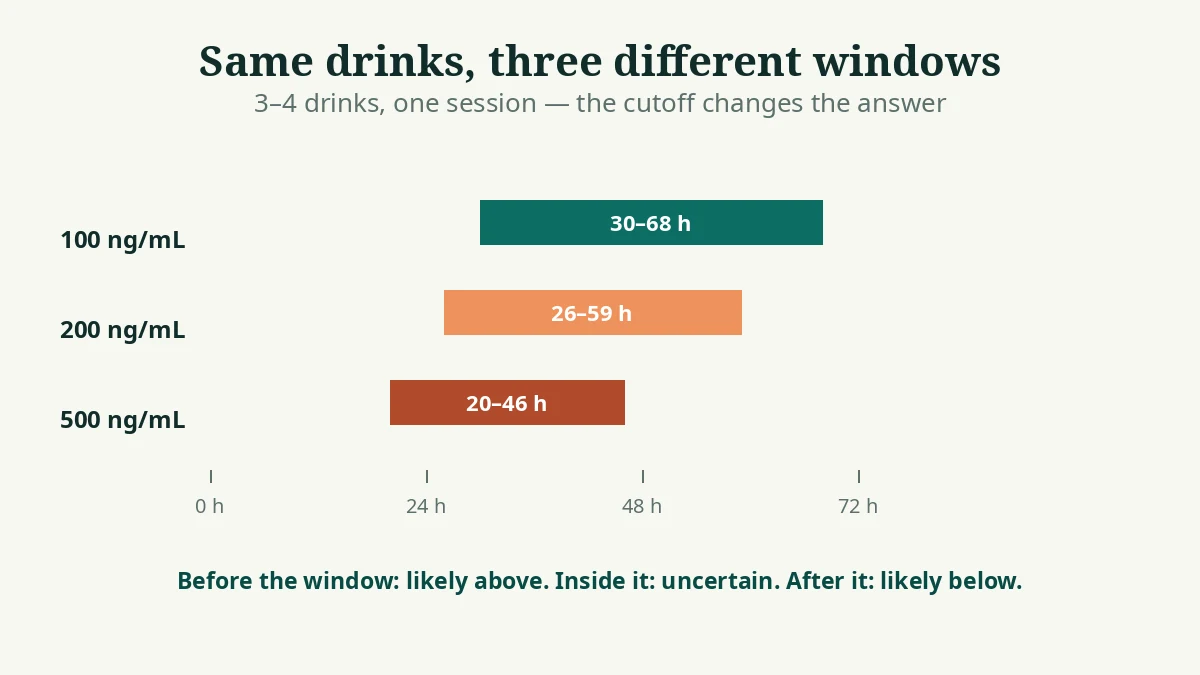
The result usually comes in three rows, one for each common cutoff: 100, 200, and 500 ng/mL. The same drinking history produces three different windows, because a stricter cutoff catches EtG for longer. A test at 100 ng/mL, the level many probation and court programs use, will read positive days after a 500 ng/mL workplace test has gone negative.
This guide walks through the calculator the way you would actually use it: each input in turn, how to read the output, two worked examples you can check against your own numbers, and the five mistakes that make estimates wrong. The examples use the same detection model as our EtG calculator chart and the realistic detection times page, so the numbers here match the numbers the calculator itself produces.
The five inputs, one by one
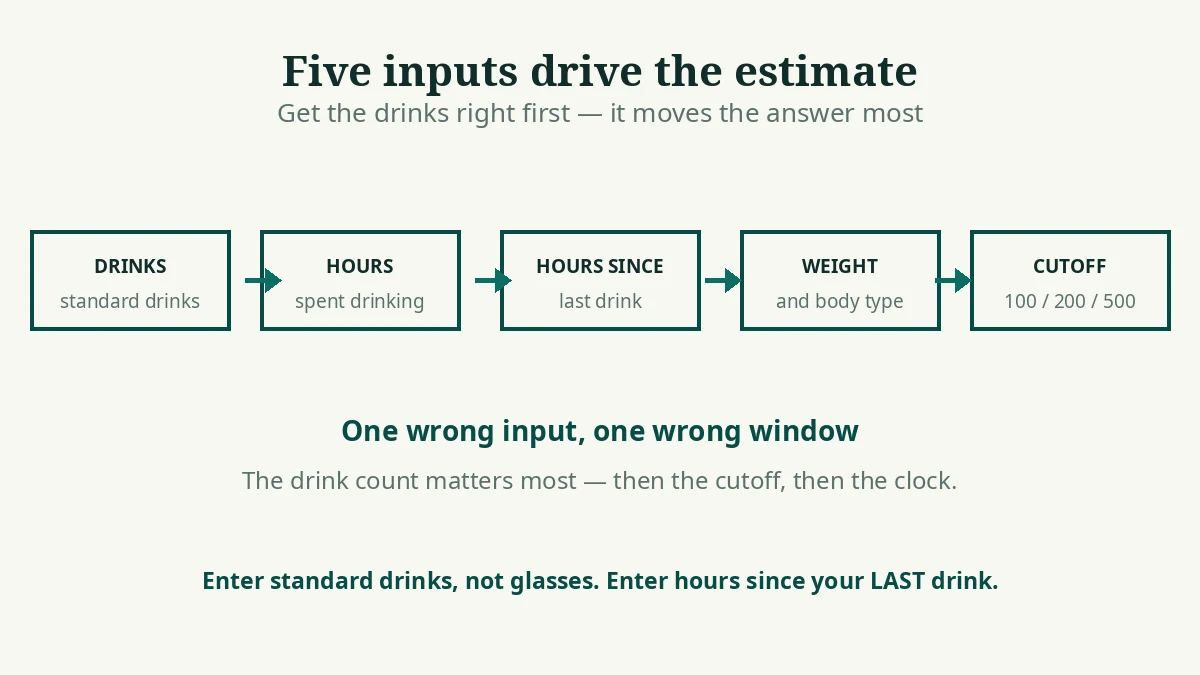
Every ETG test calculator asks for the same five things. Each one changes the answer, and each one has a specific way to enter it correctly.
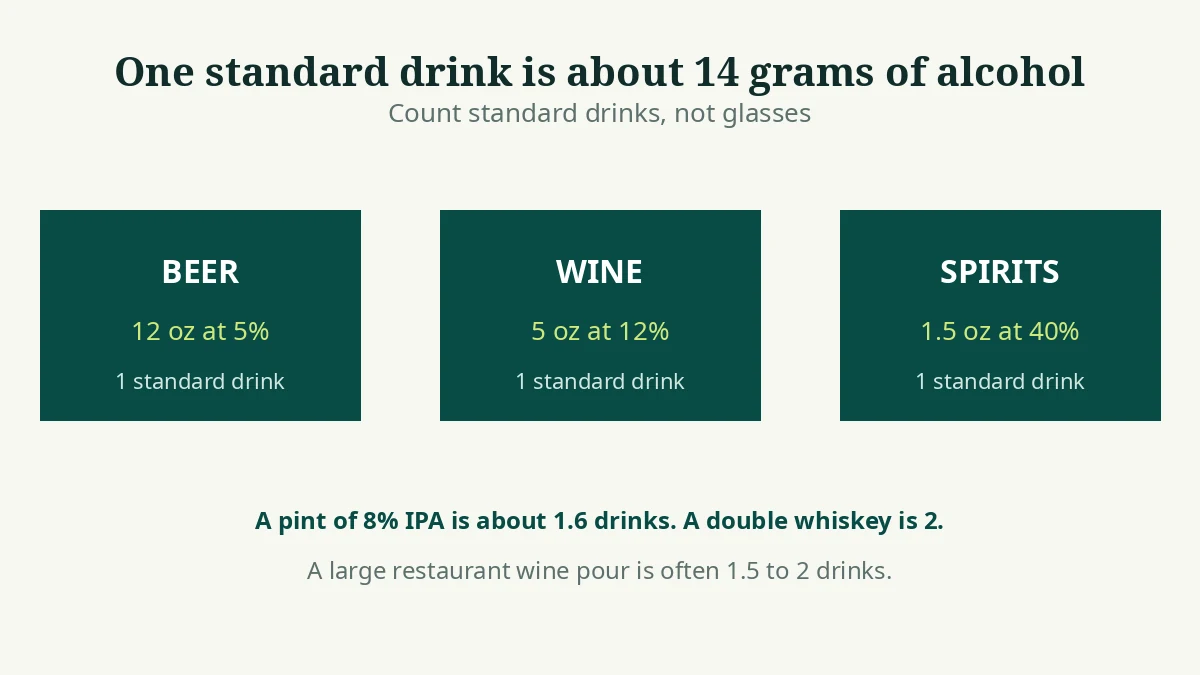
1. Standard drinks. This is the input people get wrong most often, and it moves the result more than any other. A calculator does not want the number of glasses, cans, or rounds — it wants U.S. standard drinks, and one standard drink always contains about 14 grams of pure alcohol. A 12 oz beer at 5% is one standard drink. So is 5 oz of wine at 12%, and 1.5 oz of spirits at 40% (80 proof). If you drank four pints of strong beer, entering "4 drinks" understates the dose by more than half — and the window comes out far too short.
| Drink | One standard drink | What counts as more than one |
|---|---|---|
| Beer | 12 fl oz (355 mL) at 5% ABV | A pint of 8% IPA is about 1.6 drinks; a 16 oz can at 5% is about 1.3 |
| Wine | 5 fl oz (148 mL) at 12% ABV | A large restaurant pour (8–9 oz) is about 1.5 to 2 drinks |
| Distilled spirits | 1.5 fl oz (44 mL) at 40% ABV | A double (3 oz) is 2 drinks; a long island iced tea can be 3 or more |
| Malt liquor / cider | 8–9 fl oz at 7% ABV | A 40 oz bottle at 8% is about 5 standard drinks |
2. Hours spent drinking. How long the drinking session lasted matters because EtG is still forming while you are still drinking. The calculator's model adds time for longer sessions — roughly an extra hour of window for each hour beyond four. Enter the span from your first drink to your last, not the time you started.
3. Hours since your last drink. This is the clock the whole estimate runs on, and it starts when you finished your last drink — not when you started drinking, and not when you went to bed. If your last drink was at midnight and your test is Monday at 10 a.m., that is 34 hours, even if you started drinking Saturday evening. Entering the start of the session instead of the end is the second most common mistake, and it can shorten the estimate by an entire evening.
4. Weight and body composition. Body weight changes how much EtG a given amount of alcohol produces, because the same dose is diluted into a different volume. Body composition matters too: alcohol distributes into body water, not fat, so two people at the same weight can have different peaks. Most calculators ask for weight and a rough body-composition band; entering your real weight rather than a guess keeps the peak estimate honest.
5. The cutoff. The cutoff is the level the laboratory calls positive, and it is set by the program testing you, not by the calculator. Probation and court-ordered programs commonly test at 100 ng/mL. Many treatment programs use 200 ng/mL. Workplaces and DOT-style programs commonly use 500 ng/mL, the level SAMHSA's 2012 advisory recommends to reduce false positives from incidental exposure. If you do not know your cutoff, the 100 ng/mL row is the conservative one to plan around. Guessing 500 when your program tests at 100 is how people get surprised.
How to read the result
The calculator returns a window for each cutoff, and the window is the answer — not its midpoint, not its low end. Take the table below, which is the same model our chart page publishes for a single drinking session of about four hours. Find your drink count in the left column, then read across to your cutoff.
| Drinking (one session) | 100 ng/mL | 200 ng/mL | 500 ng/mL |
|---|---|---|---|
| 1–2 drinks | 23–53 hours | 20–46 hours | 15–36 hours |
| 3–4 drinks | 30–68 hours | 26–59 hours | 20–46 hours |
| 5–7 drinks | 38–85 hours | 33–75 hours | 26–58 hours |
| 8–12 drinks | 50–105 hours | 44–92 hours | 34–71 hours |
| 13 or more drinks | 65–130 hours | 57–114 hours | 44–88 hours |
Read each cell as three zones. Before the window opens — say, 12 hours after three drinks at a 500 ng/mL cutoff — the model says EtG is likely still above the cutoff. Inside the window, the result is genuinely uncertain: the research supports both outcomes, and your personal half-life, hydration, and body composition decide which one you get. After the window closes — past 46 hours for that same case — the model says EtG is likely below the cutoff. The window is wide because EtG's half-life varies between people, roughly 2 to 3 hours, and a small difference in half-life compounds over two days into a large difference in clearance time. Our half-life explainer shows the decay math behind this.
Some calculators also show a likelihood label — "likely above", "transition zone", "likely below" — for the hour you enter: a restatement of the same three zones. Most show all three cutoff rows at once, which is the most useful view when your cutoff is unknown.
Real-world scenarios: checking your own estimate
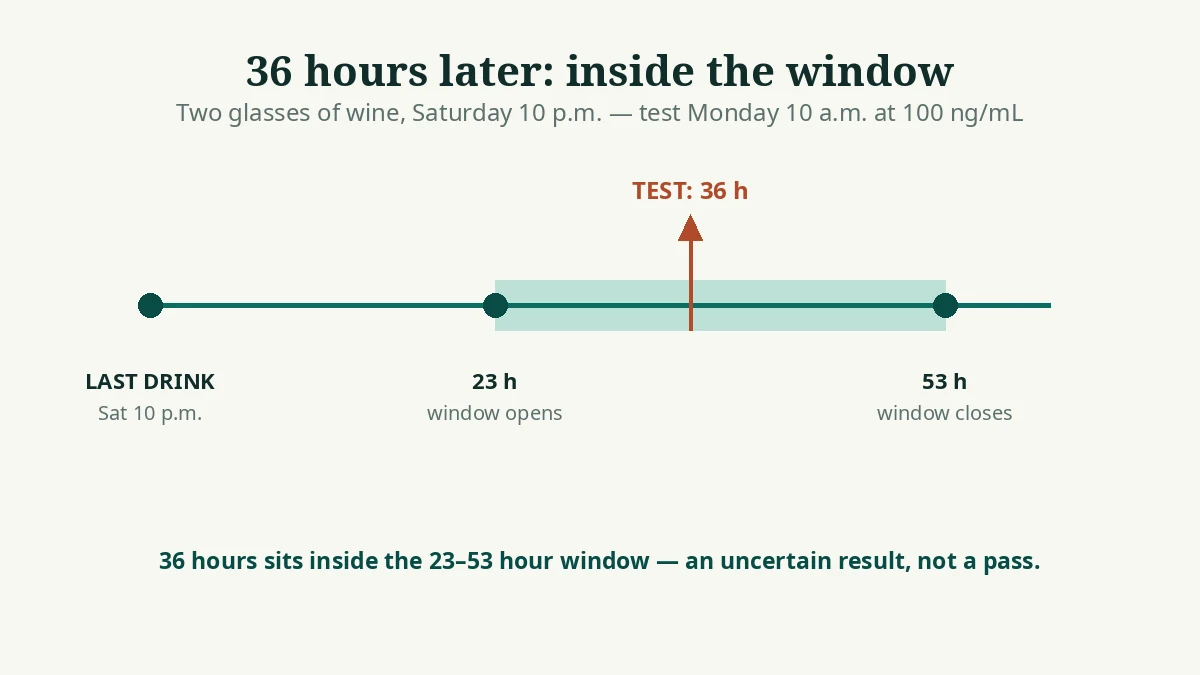
Scenario 1 — two glasses of wine, test on Monday morning. You have two glasses of wine with dinner on Saturday at 10 p.m. and a probation test on Monday at 10 a.m. — 36 hours later, at a 100 ng/mL cutoff. The 1–2 drink row at 100 ng/mL reads 23–53 hours, so 36 hours sits inside the window: the result is uncertain, and the test could go either way. At a 500 ng/mL cutoff the same row reads 15–36 hours, so 36 hours is right at the edge of the window.
Scenario 2 — six beers on Friday, test on Sunday evening. You drink six beers between 8 p.m. and midnight on Friday and face a workplace test on Sunday at 8 p.m. — 44 hours after your last drink, at a 500 ng/mL cutoff. The 5–7 drink row at 500 ng/mL reads 26–58 hours, so 44 hours is inside the window. At 200 ng/mL the row reads 33–75 hours, and at 100 ng/mL it reads 38–85 hours — also inside. At every cutoff this test lands in the uncertain zone.
Scenario 3 — three nights in a row. You drink three drinks each night on Friday, Saturday, and Sunday, and test on Tuesday morning. A single-session estimate for three drinks understates this, because EtG accumulates across the three nights. The calculator's "repeated drinking" pattern extends the top end of the window — by roughly 16 hours in our model — so the 3–4 drink row at 100 ng/mL stretches from 30–68 hours toward 30–84 hours. Always choose the repeated pattern when drinking spanned more than one day.
Five mistakes that give wrong estimates
Counting glasses instead of standard drinks. Four pints of 8% IPA is about six and a half standard drinks, not four. Enter the standard-drink count or the window comes out a full day too short.
Starting the clock at your first drink. The clock starts at your last drink. A session that ran from 6 p.m. to midnight ends at midnight — entering 6 p.m. adds six phantom hours of clearance that never happened.
Ignoring how long you drank. A ten-hour session clears more slowly than a two-hour one with the same drink count, because EtG is still being formed late in the session. Enter the real duration.
Reading the low end as a pass date. The low end of the range is the earliest hour the research can support, not the hour you clear. Planning a test for the low end is planning to be inside the uncertain zone on purpose.
Using the wrong cutoff. A 500 ng/mL estimate for a program that tests at 100 ng/mL is not a small error — it can understate the window by more than a day. If your program's cutoff is unknown, read the 100 ng/mL row.
What the calculator cannot tell you
An ETG test calculator estimates a window from population research; it cannot measure your body. It cannot tell you your exact EtG level in ng/mL — only a laboratory test can do that — and it cannot tell you whether you will pass, because "pass" is the laboratory's decision against your program's cutoff, and your personal half-life sits somewhere in a range, not at a fixed point. It cannot tell you when you last drank from a result, either: a positive EtG only proves drinking happened inside the window, not on which day. And it cannot account for liver function, medications, or a diluted sample. Our calculator versus lab test comparison explains where the estimate ends and the laboratory begins, and our who should use a calculator guide covers when an estimate is not enough and a real test is the only answer. Used the right way — inputs entered honestly, the range read as a range, the strictest cutoff assumed when in doubt — the calculator is a planning tool. Used as a pass predictor, it will eventually be wrong.
Frequently asked questions
How accurate is an ETG test calculator?+
An ETG test calculator gives a research-based window, not an exact result. The model is built from published studies of EtG half-life and detection times, so the window is honest — but your personal half-life, body composition, hydration, and drinking pattern sit somewhere inside a range. Treat the output as a planning estimate: a time before the window is likely above the cutoff, a time after it is likely below, and a time inside it is genuinely uncertain.
What is a standard drink for an ETG calculator?+
One U.S. standard drink contains about 14 grams of pure alcohol: 12 fl oz of beer at 5% ABV, 5 fl oz of wine at 12% ABV, or 1.5 fl oz of distilled spirits at 40% ABV (80 proof). Count standard drinks, not glasses — a pint of 8% IPA is about 1.6 standard drinks, a double whiskey is 2, and a large restaurant wine pour is often 1.5 to 2.
Which cutoff should I choose in the calculator?+
Use the cutoff your program tests at: 100 ng/mL is common for probation and court-ordered programs, 200 ng/mL for many treatment programs, and 500 ng/mL for workplaces, following SAMHSA's 2012 advisory. If you do not know your cutoff, read the 100 ng/mL row — it gives the longest window and is the conservative choice. A 500 ng/mL estimate for a program testing at 100 can understate the window by more than a day.
Why does the calculator give a range instead of one number?+
Because EtG clearance varies between people. EtG's half-life is roughly 2 to 3 hours, but that small difference compounds over two days into a large difference in clearance time, and peak EtG levels vary with weight, body composition, and how fast you drank. A calculator that returned a single hour would be pretending to know your personal half-life — the range is the honest form of the answer.
Does the calculator work for drinking over several days?+
Yes, if you choose the repeated-drinking pattern. A single-session estimate understates multi-day drinking because EtG accumulates across nights. In our model the repeated pattern extends the top end of the window by roughly 16 hours. Use the single-session row only when all the drinking happened in one evening.
Can the calculator tell me if I will pass my test?+
No. The calculator estimates a detection window from population research; it cannot measure your EtG level, predict your personal half-life, or decide what a laboratory will report. Only a lab result against your program's cutoff decides a pass. A time inside the window is uncertain, and the low end of the range is the earliest plausible clear time — never a pass date.
How many hours after drinking should I enter?+
Enter the hours since your last drink, not your first. If your last drink was at midnight and your test is Monday at 10 a.m., that is 34 hours — even if you started drinking Saturday evening. Starting the clock at your first drink adds phantom clearance hours that never happened and shortens the estimate by the length of the session.
Evidence and limitations
This article summarizes published research on EtG detection windows, cutoffs, and half-life, and explains how the site’s calculator model turns those findings into an estimate. Group-level findings cannot predict one person’s result, and this article is educational only — it is not medical or legal advice.
- SAMHSA Advisory: The Role of Biomarkers in the Treatment of Alcohol Use Disorders (2006, revised 2012)
- National Institute on Alcohol Abuse and Alcoholism — What Is a Standard Drink? (12 oz beer at 5%, 5 oz wine at 12%, 1.5 oz spirits at 40%)
- Dahl et al. (2002) — EtG detectable 22.5–31.5 h after ~0.5 g/kg ethanol, half-life ~2.5 h
- McDonell et al. (2015) — EtG immunoassay cutoff sensitivity in alcohol-dependent outpatients (1,589 samples)
- Mackus et al. (2017) — EtG detection and elimination kinetics after controlled alcohol intake
- Jatlow et al. (2014) — EtG/EtS sensitivity and specificity at low cutoffs