The short answer: estimate versus measurement
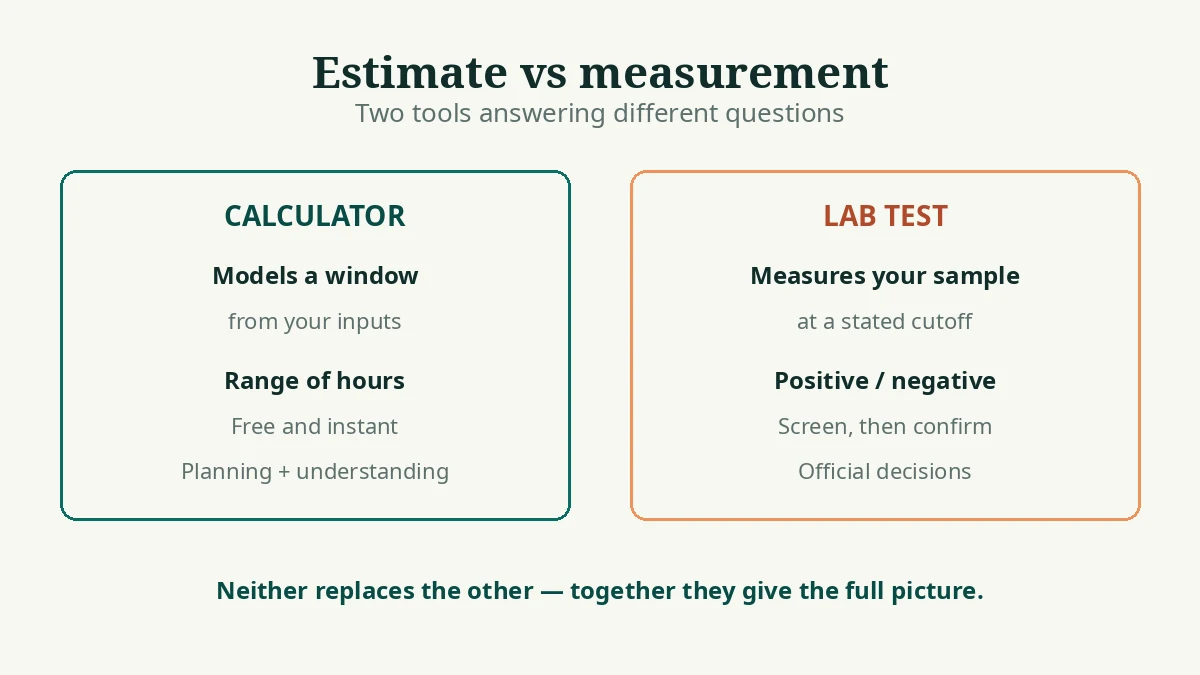
If you are weighing an ETG calculator vs a lab test, start with what each one actually is. A calculator takes what you enter — how much you drank, when you stopped, your body weight, and the cutoff — and runs it through a model of how EtG forms and leaves the body. Its output is a predicted window: a range of hours during which EtG is likely to remain above a chosen cutoff. A lab test instead takes a urine sample and chemically checks whether EtG is present above a cutoff, and at what concentration.
That distinction explains almost every disagreement between the two. A calculator can be right about the typical pattern and still wrong about one person, because it cannot see your enzymes, exact drink sizes, or sample dilution. A lab test can be right about your sample and still be misread, because a screening result at one cutoff says nothing about what a confirmation test would show. Neither tool is useless, and neither is the whole story. Used together — calculator for planning and understanding, lab test for an official answer — they complement each other.
This article compares the two honestly: what a calculator gets right, where it drifts, how screening and confirmation differ, and what happens when they seem to disagree. For the practical side first, our EtG calculator gives an estimated window in seconds, and our calculation method page shows the model behind it.
ETG calculator vs lab test: what "accuracy" means for each
Accuracy means something different for a model than for a measurement, and confusing the two is where most frustration comes from. For a calculator, accuracy means: how often does the real window fall inside the predicted range? For a lab test, it means: how reliably does the method identify EtG, and only EtG, at the stated cutoff? A calculator can be well-built and still miss an individual case, because biology varies. A lab method can be extremely precise and still produce a misleading first result, because screening trades specificity for speed.
| ETG calculator estimate | Immunoassay screen | LC-MS/MS confirmation | |
|---|---|---|---|
| What it does | Models a detection window from your inputs | Antibody-based screen for EtG in urine | Separates and measures EtG molecules directly |
| What you get | A range of hours, per cutoff | Positive or negative at one cutoff | A measured concentration in ng/mL |
| Accuracy | Good as a range; uncertain for one person | Good sensitivity; cross-reactivity possible | Very high specificity — the reference standard |
| Typical cutoff | 100, 200, or 500 ng/mL (you choose) | Usually 100 or 500 ng/mL | Confirms at the program's cutoff, often lower |
| Cost and turnaround | Free, instant | Lower cost, often same-day to a few days | Higher cost, typically several days |
| False-positive risk | Not applicable — it is not a test | Highest of the three; confirmation resolves it | Lowest; the result programs act on |
| Best use | Planning, understanding, education | Fast first-pass screening | Official, disputed, or high-stakes decisions |
The table makes the key point plainly: there is no single "most accurate" option in the abstract. A calculator answers "roughly when," a screen answers "quickly, probably," and confirmation answers "exactly, reliably."
How accurate is an ETG calculator?
A well-built ETG calculator is accurate in the same way a weather forecast is accurate: it describes the likely outcome for typical conditions, with a range that widens as uncertainty grows. The science is solid: EtG formation and excretion follow a known pathway, and published studies give consistent ranges. Our calculator uses those published ranges rather than a single invented constant, which is why it reports a window instead of one clean hour. That honesty is a feature, not a weakness: any calculator that promises an exact hour is pretending to know things no model can know about you.
What calculators get right
Calculators get the big picture right. More alcohol means a longer window. A lower cutoff means a longer window. Time since the last drink is the dominant variable, and repeated drinking restarts the clock. These relationships hold across studies, and they are why a calculator is genuinely useful for understanding your situation. Our EtG calculator chart shows the same relationships visually, across drinks and cutoffs.
Where calculators drift
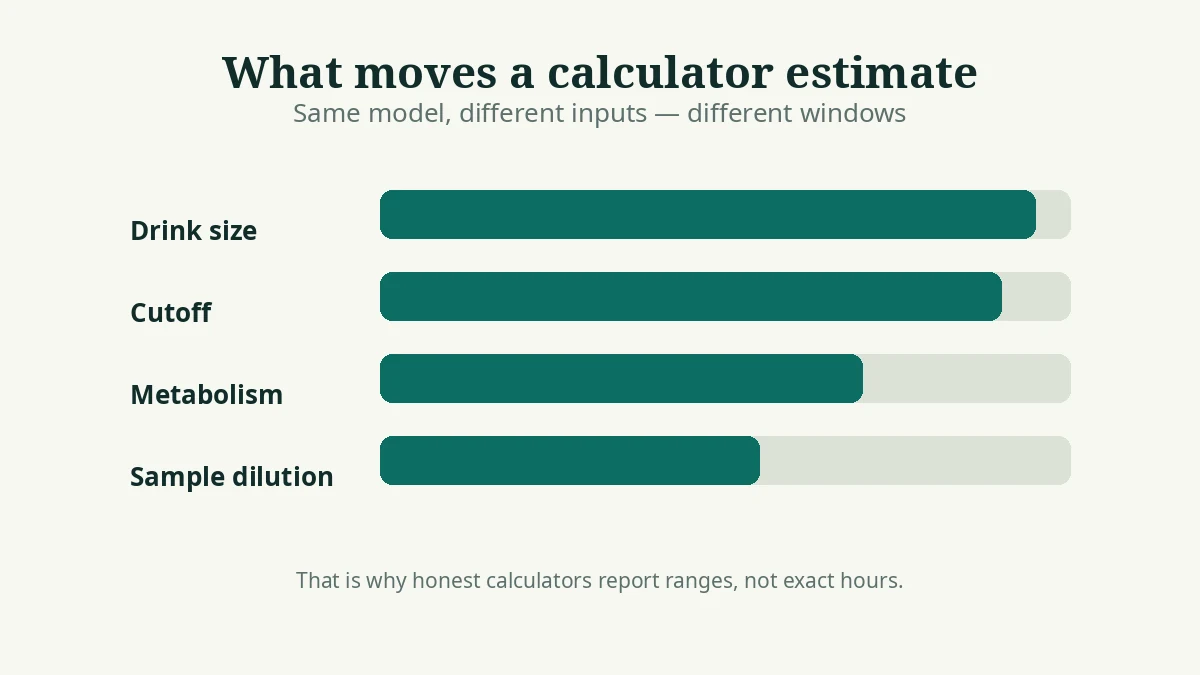
Calculators drift in four places. First, inputs are self-reported, and drink sizes vary: a "drink" poured at home is often larger than a standard drink, and an evening's count is easy to understate. Second, the model assumes typical metabolism, but enzyme variants, liver health, age, and body composition shift formation and clearance between people. Third, the model works in averages, while your body works in specifics. Fourth, a calculator cannot see your sample: it cannot know whether it was dilute, which changes the measured concentration even though the total EtG in your body is unchanged. Each factor can shift the real window by hours, and together they can shift it by a day or more in unusual cases.
The practical rule: treat a calculator's window as a planning range, and plan around its late end, not its early end. If a calculator says EtG may remain detectable for 48 to 80 hours at your cutoff, the honest reading is "possibly until around 80 hours," not "clear at 48." Any calculator promising a precise clearance hour claims certainty the science does not support.
How the lab works: screen first, confirmation second
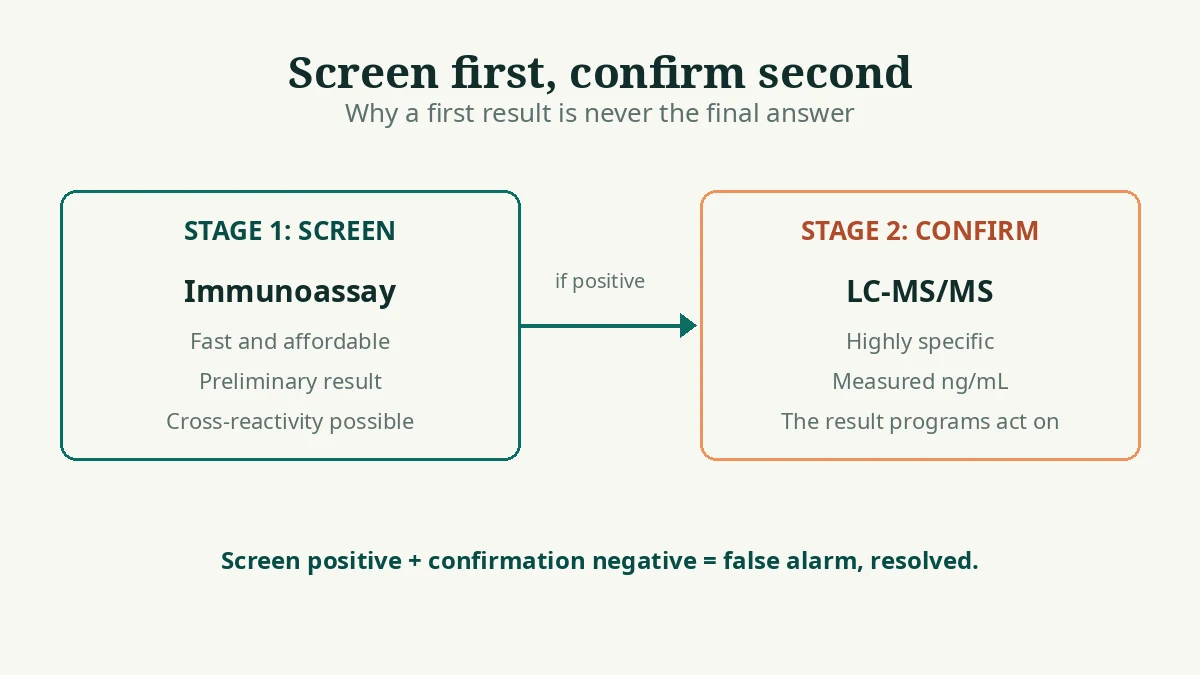
Most laboratory EtG testing runs in two stages. A program rarely pays for the expensive method first: it screens cheaply and quickly, then confirms only the positives. That two-stage design is standard in workplace, probation, and treatment testing — and it is why a first result and a final result can differ.
Stage 1: the immunoassay screen
An immunoassay uses antibodies designed to bind to EtG. If enough EtG is present at the program's cutoff, the screen reports positive. Immunoassays are fast, automated, and affordable, which is why they handle high volumes. Their weakness is specificity: antibodies can cross-react with similar molecules, and incidental exposure — heavy hand sanitizer use, certain mouthwashes — can push a screen above a low cutoff even without drinking. That is why a positive screen is never, on its own, a final answer. Our research page on immunoassay vs LC-MS/MS explains the chemistry in more detail.
Stage 2: LC-MS/MS confirmation
LC-MS/MS — liquid chromatography with tandem mass spectrometry — separates the molecules in a sample and identifies EtG by its exact mass signature. It is far more specific than an immunoassay: it distinguishes EtG from look-alike compounds, measures concentration precisely, and can also measure ethyl sulfate (EtS) and creatinine. Confirmation takes longer and costs more, which is why it is reserved for positive screens. When a screen says positive and confirmation says negative, the confirmation governs. When both agree, the result is as solid as laboratory testing gets.
Why the two can disagree
A calculator estimate and a lab result can disagree without either being "broken." The most common reasons: the cutoff — an estimate at 500 ng/mL and a result at 100 ng/mL answer different questions, so always check which cutoff applies before comparing anything. Timing near the edge — if your true window ends at 60 hours and you test at 58, a calculator that predicted 48 to 72 hours was right, even if it feels like a miss. Dilution — drinking large amounts of water before a test lowers the measured EtG concentration, while the EtG-to-creatinine ratio stays roughly unchanged, which is why labs measure creatinine, as our guide on drinking water and EtG levels explains. Incidental exposure — a positive screen after heavy sanitizer or mouthwash use can vanish on confirmation. And input error: the calculator can only model the drinking you report, not the drinking you forgot.
None of this makes calculators pointless or labs untrustworthy. It makes them complementary: the calculator tells you what to expect and what could move the result; the lab tells you what is actually in the sample, at a stated cutoff. When they disagree, the lab's confirmed result is the one that counts.
Real-world scenario: four drinks Saturday night, test Monday morning
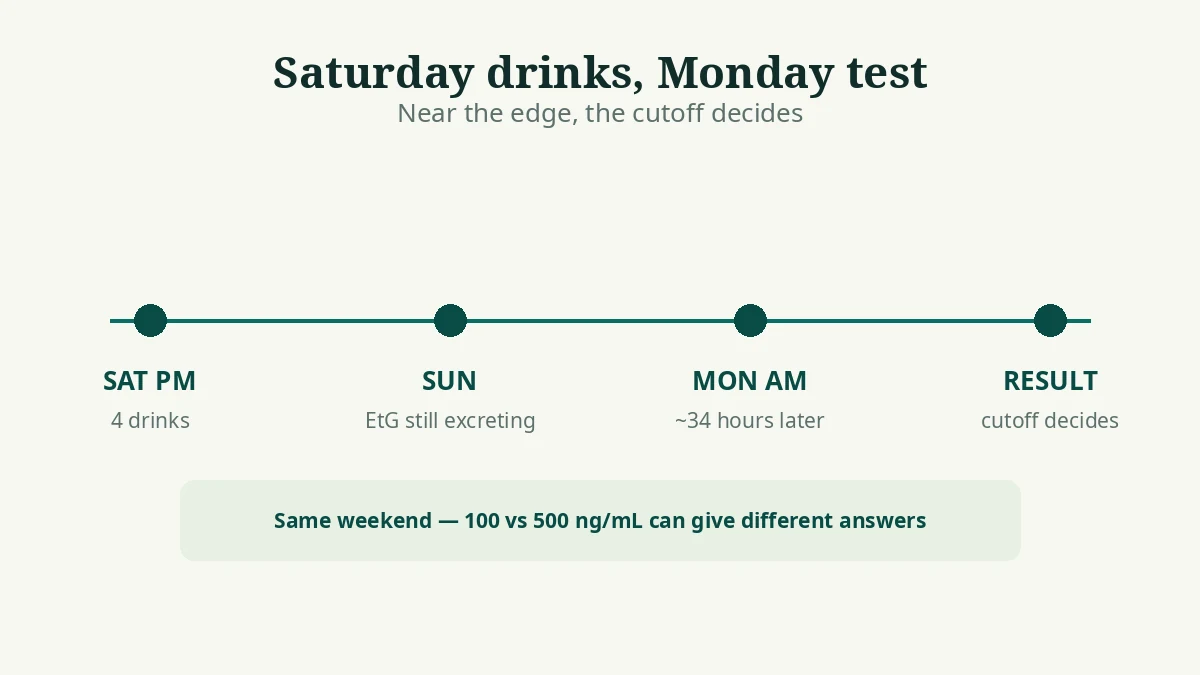
Consider four standard drinks on Saturday night, finishing around 11 p.m., and a urine EtG test on Monday morning at 9 a.m. — about 34 hours later. What does each tool say?
A calculator, given four drinks and a Saturday 11 p.m. finish, would typically estimate a window that depends sharply on the cutoff: roughly one to two days at 500 ng/mL, and longer at 100 ng/mL. Read honestly, that says the Monday test sits near the edge — not comfortably clear, not certainly positive, with the cutoff deciding the result. The calculator cannot narrow it further, because this person's metabolism, exact drink sizes, and sample dilution are unknown to it.
The lab, meanwhile, reports only what it measures. At a 500 ng/mL screening cutoff, this person might well screen negative by Monday morning, and the process would stop there. At a 100 ng/mL cutoff, the same person on the same Monday morning might screen positive, triggering LC-MS/MS confirmation, which would then measure the actual concentration and decide the final result. Same body, same weekend, same Monday — two different outcomes, decided by the cutoff and the method.
That is the scenario in miniature: the calculator warns you that Monday is near the edge, the screen gives a fast first answer, and confirmation settles it when the stakes require certainty. If your test matters for employment, probation, or treatment, the final confirmed result — not any estimate — is the one to plan around. For the biology behind the window, our guide on how the body metabolizes alcohol into EtG walks the pathway step by step, and our biomarkers research page compares EtG with EtS and PEth.
Which one should you use, and when?
Use a calculator when you want to understand a situation: how long EtG might remain detectable, or how the cutoff changes the answer. It is free, instant, private, and good at showing ranges and trade-offs. Use a lab test when you need an answer that counts: an employer's requirement, a program's monitoring rule, or a disputed result. And when a lab screen comes back positive and the result matters, ask whether confirmation testing was performed — a screen alone is preliminary by design.
One caution applies to both tools. No calculator estimate and no screening result should be treated as proof about a specific person on a specific day. Estimates are ranges, screens are preliminary, and only a confirmed laboratory measurement settles an individual case. Used with that humility, the two together give you a realistic expectation and a reliable answer.
Frequently asked questions
How accurate is an EtG calculator?+
An EtG calculator is accurate as a range, not as a single hour. It models the typical detection window from published research — roughly 24 to 80 hours after heavier drinking, about 13 to 20 hours after a small amount — but individual metabolism, exact drink sizes, and sample dilution can shift one person's real window by hours or more. Treat its late end as the planning figure, not its middle.
Can an ETG calculator predict whether I will pass a lab test?+
No. A calculator estimates a window from what you report; a lab test measures what is actually in your sample. The calculator cannot see your metabolism, your exact drink sizes, or your sample's dilution, so it can never promise an individual result. Use it for planning and understanding — only a confirmed lab result settles an official case.
What is the difference between an immunoassay screen and LC-MS/MS confirmation?+
An immunoassay screen uses antibodies to detect EtG quickly and affordably, but it can cross-react with similar molecules and produce false positives. LC-MS/MS confirmation separates and measures EtG molecules directly by their mass signature, so it is far more specific and is the result programs rely on when a screen is positive.
Why can a screen be positive but the confirmation negative?+
Usually cross-reactivity or incidental exposure. The screen's antibodies can react with look-alike compounds, or with alcohol absorbed from heavy hand sanitizer or mouthwash use, pushing the screen above a low cutoff. LC-MS/MS identifies EtG specifically, so it correctly reports negative when no real EtG is present. That is why positive screens are confirmed before action is taken.
Which cutoff do labs use — 100 or 500 ng/mL?+
Most programs use 100 ng/mL or 500 ng/mL, and some use 200 ng/mL. Lower cutoffs detect drinking for longer and catch lighter drinking, but also catch more incidental exposure; higher cutoffs are more forgiving but miss lighter drinking sooner. The same sample can be negative at 500 and positive at 100, so always find out which cutoff your program uses before interpreting any result or estimate.
Can a calculator be wrong even with correct inputs?+
Yes. Even with perfect inputs, biology varies: enzyme variants change how fast EtG forms, liver health changes clearance, and body composition changes concentrations. A calculator models typical metabolism, not your metabolism. That gap is why honest calculators report ranges rather than exact hours.
When should I trust the calculator, and when do I need a lab test?+
Use the calculator when you want to understand a situation — how long EtG might remain detectable, or how the cutoff changes the answer. Use a lab test when the answer will be acted on by someone else, such as an employer or a monitoring program. And if a lab screen is positive and the result matters, make sure LC-MS/MS confirmation was performed, since a screen alone is only a preliminary result.
Evidence and limitations
This article summarizes published research on ethyl glucuronide detection, immunoassay screening, and LC-MS/MS confirmation. Group-level findings cannot predict one person's result, and this article is educational only — it is not medical or legal advice.
- SAMHSA Advisory: The Role of Biomarkers in the Treatment of Alcohol Use Disorders (2006, revised 2012)
- McDonell et al. (PMC4400217) — EtG detection and alcohol use monitoring research
- Mackus et al. (PMC5637917) — EtG excretion and detection-window research
- The relationship between ingested dose of ethanol and amount of ethyl glucuronide formed in blood (PMC7733326)