EtG half-life: the short answer
EtG half-life is the question behind almost every "how long until I test negative" search, and it has a surprisingly short answer: about 2 to 3 hours. That is the elimination half-life of ethyl glucuronide reported in the pharmacokinetic literature — the time it takes for the concentration of EtG in the body to drop by half, assuming no new EtG is being made.
That short number confuses people. If EtG halves every 2 to 3 hours, how can a test still be positive three days after a heavy night? Because the half-life describes only what happens after EtG production stops. While you are drinking, and for hours afterwards while ethanol is still being cleared, your liver keeps making new EtG. The test stays positive until the level falls below the program's cutoff, which for a sensitive 100 ng/mL test can take far longer than a few half-lives.
This article explains the decay math in plain terms, works through a real example, and shows why the same half-life produces very different windows at 100, 200, and 500 ng/mL.
| Concept | What it means | Typical value |
|---|---|---|
| EtG half-life | Time for EtG concentration to fall by half, once formation stops | About 2–3 hours |
| EtG peak in urine | Highest concentration after a drinking episode | Roughly 8–12 hours after drinking begins |
| Detection window | How long urine EtG stays above a given cutoff | About 24 hours after light drinking; up to about 80 hours after heavy drinking |
| Ethanol half-life | How fast alcohol itself is cleared (a different number) | Not a fixed half-life — roughly 15–20 mg/dL per hour, near zero-order |
What "half-life" actually means
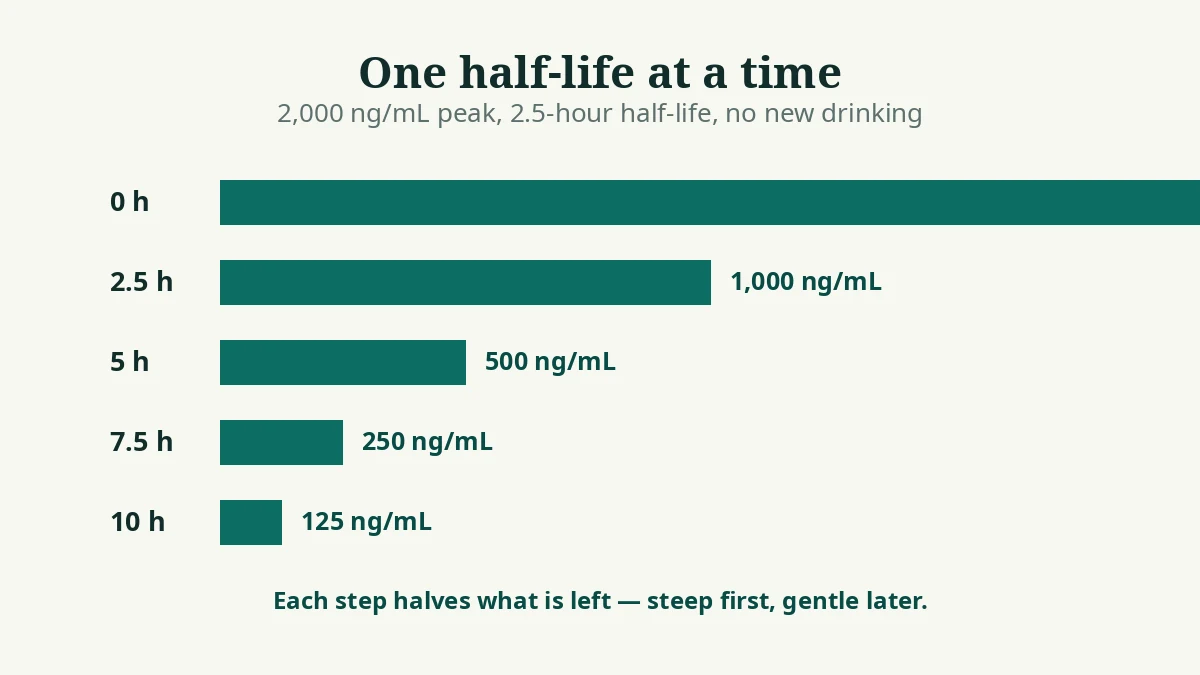
A half-life is a way of describing exponential decay. If a substance has a 2.5-hour half-life and its concentration is 1,000 ng/mL right now, then — with no new substance being added — it will be about 500 ng/mL after 2.5 hours, 250 after 5 hours, 125 after 7.5 hours, and about 62 after 10 hours. Each interval halves whatever is left. The fall is steep at first and gentle later, because each halving removes a smaller absolute amount than the one before.
That shape holds two truths at once. After four half-lives (about 10 hours at a 2.5-hour half-life), only about 6% of the peak remains — yet 6% of a very high peak can still be well above 100 ng/mL, so "most of it gone" is not the same as "below the cutoff."
One distinction matters: EtG's half-life is not alcohol's clearance rate. Ethanol clears at a roughly constant rate (about 15 to 20 mg/dL per hour), not by halving, so "alcohol is gone in 12 hours" does not imply "EtG is gone too."
The decay math, worked through
The formula is the standard exponential-decay equation, and it is the same math behind the decay curve in our EtG calculation formula guide:
EtG(t) = Peak × 0.5^(t ÷ half-life)
Take a worked example. Suppose someone's urine EtG peaks at 2,000 ng/mL — a plausible peak after a heavy evening — and assume a 2.5-hour half-life with no further drinking. The table below follows that peak downward. Read it against the three cutoffs programs actually use.
| Hours after peak | Half-lives elapsed | EtG level (ng/mL) | Above 100? | Above 200? | Above 500? |
|---|---|---|---|---|---|
| 0 | 0 | 2,000 | Yes | Yes | Yes |
| 2.5 | 1 | 1,000 | Yes | Yes | Yes |
| 5 | 2 | 500 | Yes | Yes | At the line |
| 7.5 | 3 | 250 | Yes | Yes | No |
| 10 | 4 | 125 | Yes | No | No |
| 12.5 | 5 | 62 | No | No | No |
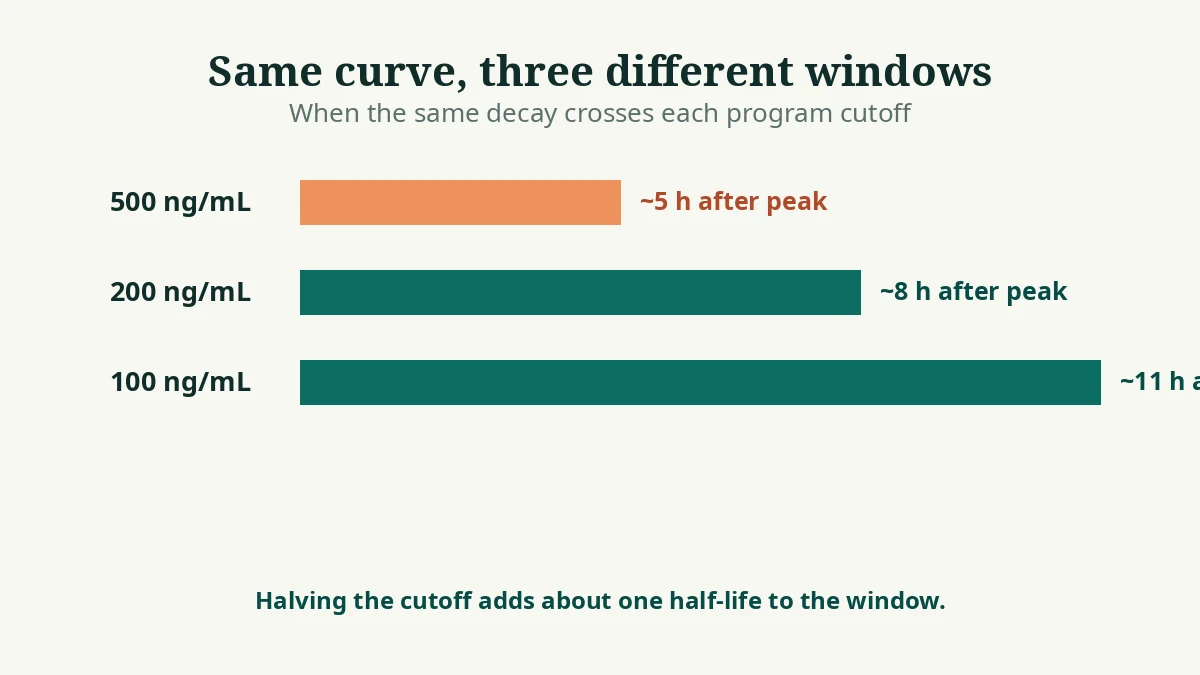
Notice the pattern. From the same peak and the same half-life, the 500 ng/mL test turns negative after about 5 hours past the peak, the 200 ng/mL test after about 8 hours, and the 100 ng/mL test after about 11 hours. Each time the cutoff is halved, roughly one half-life is added to the window. That is the single most useful rule of thumb in EtG testing: halving the cutoff adds about one half-life — roughly 2 to 3 hours — to the detection window, all else being equal.
Our EtG half-life calculator runs this same decay calculation interactively, so you can change the peak, the half-life, and the cutoff and watch the crossing times move. It is a teaching tool for the shape of the curve, not a prediction about any one person's test.
Why the window is 80 hours if the half-life is only 2 to 3 hours
This is the question that makes the half-life feel wrong, and it has three honest answers.
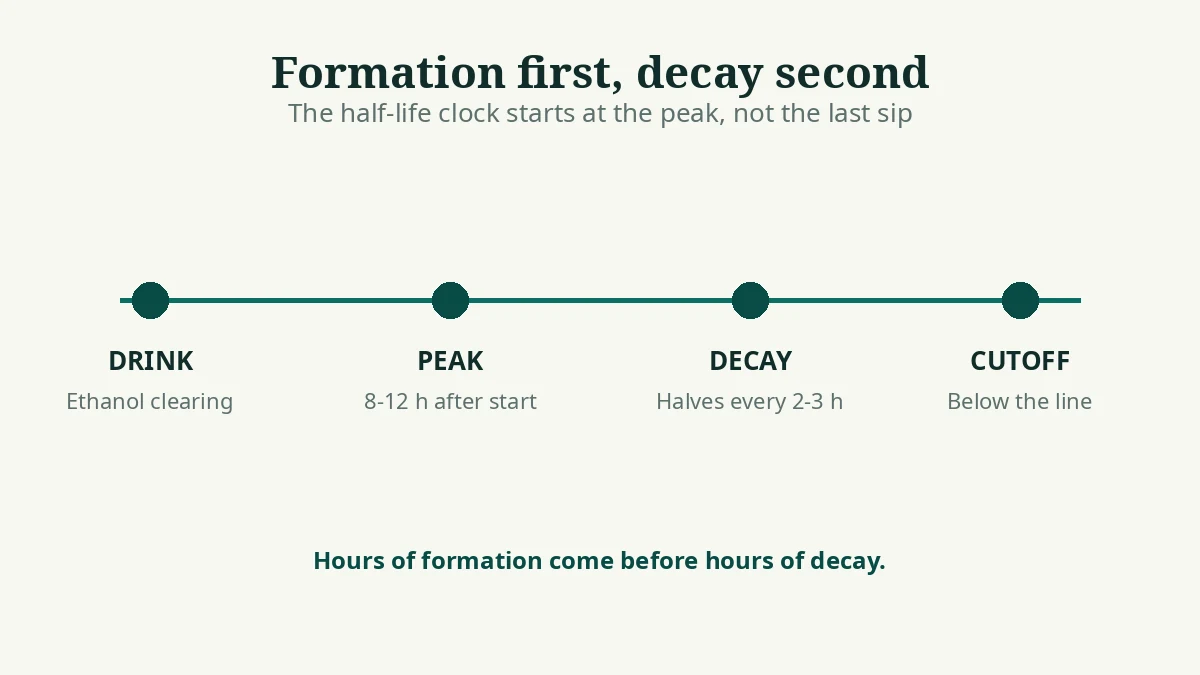
First, formation continues long after the last drink. The half-life clock only starts once EtG production stops, and production does not stop when you stop drinking: ethanol takes hours to clear and EtG forms throughout that clearance. Urine EtG typically peaks roughly 8 to 12 hours after drinking begins, so the decay curve starts at the peak, not at the last sip.
Second, repeated drinking stacks the curve. Someone drinking heavily over a weekend keeps adding new EtG before the previous day's EtG has decayed, so the final decay starts from a higher peak, and each doubling of the peak adds one more half-life to the window. That is why the window caps at about 80 hours rather than growing without limit.
Third, sensitive tests detect very small remainders. After ten half-lives only about 0.1% of the peak remains — but 0.1% of a 100,000 ng/mL peak is still 100 ng/mL, and real peaks after heavy drinking reach tens of thousands. The window is long not because EtG decays slowly, but because the starting amount is large and the cutoff is low, which is why our realistic detection times guide shows ranges, not single numbers.
What actually moves the window
The half-life itself is fairly stable across healthy adults — the published range of about 2 to 3 hours already captures most of the normal variation. What varies much more, and what actually moves a person's window, is everything around it.
Dose and duration. More drinks mean a higher peak, and a higher peak means more half-lives before the level crosses the cutoff. Longer drinking sessions also delay the peak itself, because formation continues for longer. A single drink and a weekend of heavy drinking have the same half-life but very different windows — roughly a day versus up to about 80 hours.
Cutoff level. As the worked example showed, the program's cutoff is often the biggest single lever on the window. A 500 ng/mL workplace screen and a 100 ng/mL probation confirmation test, applied to the same person on the same day, can disagree — and both can be correct, because they are asking different questions.
Kidney function and hydration. EtG leaves in urine, so heavy water intake dilutes the measured concentration without changing the EtG-to-creatinine ratio labs check, and impaired kidney function can slow clearance and lengthen the window. Neither effect changes the half-life predictably for an individual.
Individual metabolism. The enzymes that form EtG vary between people, as does the fraction of ethanol converted to EtG, which is why studies report ranges and two people who drank the same amount can test differently. Any calculator giving a single hour count should be treated with suspicion; the honest output is a range.
Real-world scenario: four drinks on Saturday, a test on Monday
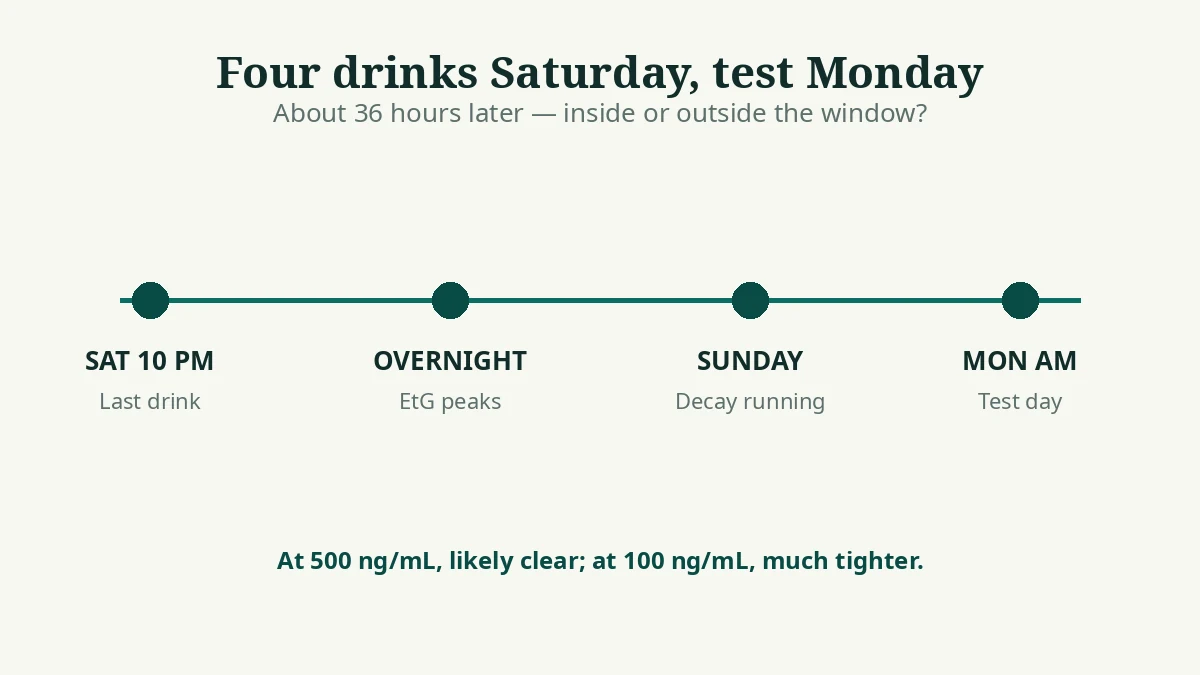
Consider a common situation. Someone has four standard drinks on Saturday evening, finishing around 10 p.m., and faces a urine EtG test on Monday morning, about 36 hours later, at a 500 ng/mL cutoff. How does the half-life help them think about it?
First, the peak: urine EtG would likely peak sometime overnight Saturday, perhaps 8 to 12 hours after drinking began, at a level in the low thousands of ng/mL for four drinks. Second, the decay: from that peak, 500 ng/mL is roughly two to three half-lives away — about 5 to 8 hours of decay, plus the hours before the peak. Third, the cutoff: at 500 ng/mL, the level would most likely have fallen below the cutoff well before Monday morning. At 100 ng/mL, the same episode would need roughly two more half-lives — another 5 or so hours — and could still be positive into Sunday, though by Monday morning it would most likely be negative as well.
Now make it a heavy weekend, drinking Friday and Saturday. The peak is higher, formation runs longer, and the same 36-hour gap can be tight at 100 ng/mL, even though the half-life never changed. Half-life tells you the shape of the fall; dose and cutoff tell you where it starts and where it has to reach.
For a personalized modeled range, use our EtG calculator with your actual drink count, timing, and cutoff. If the result matters for probation, employment, or a court case, the only number that counts is the lab's.
Half-life vs detection window vs the other tests
Three terms get mixed up constantly, so here is the clean separation. Half-life (about 2 to 3 hours) is a property of EtG elimination — how fast the level halves once formation stops. Detection window (about 24 hours after light drinking, up to about 80 hours after heavy drinking) is a property of a test at a cutoff — how long the level stays above the line a program actually uses. Impairment window (hours, while blood alcohol is elevated) is something else entirely, and EtG says nothing about it: a positive EtG days later does not mean someone was impaired days later.
Other biomarkers make the point sharper: breath and blood alcohol clear in hours, EtG covers days, blood PEth roughly 2 to 4 weeks, hair EtG months. Each answers a different question over a different timescale, and quoting a half-life as if it were a window is how people get misled. Our 100 vs 500 ng/mL cutoff guide shows how the same biology plays out at different thresholds.
The bottom line is simple enough to carry with you. EtG's half-life is short, about 2 to 3 hours. Its detection window is long, up to about 80 hours, because formation continues while alcohol clears, because heavy drinking stacks the peak, and because sensitive cutoffs detect tiny remainders. Understand the curve, respect the range, and never turn a half-life into a promise about a test result.
Frequently asked questions
What is the EtG half-life?+
The EtG half-life is about 2 to 3 hours: the time for the concentration of ethyl glucuronide in the body to fall by half, once the liver has stopped forming new EtG. It is an elimination half-life measured in pharmacokinetic studies, not a detection window.
If the EtG half-life is only 2 to 3 hours, why can EtG be detected for up to 80 hours?+
Three reasons: EtG keeps being formed while alcohol is still being cleared, so the decay clock starts hours after the last drink; repeated heavy drinking stacks the peak higher; and sensitive 100 ng/mL tests can detect the tiny fraction that remains after many half-lives. A short half-life with a high peak and a low cutoff produces a long window.
How do I calculate EtG decay with the half-life?+
Use EtG(t) = Peak x 0.5^(t / half-life). For example, a 2,000 ng/mL peak with a 2.5-hour half-life falls to 1,000 after 2.5 hours, 500 after 5 hours, 250 after 7.5 hours, and 125 after 10 hours. Our EtG half-life calculator runs the same math with your own numbers.
Does a lower cutoff really change the detection window that much?+
Yes. Each halving of the cutoff adds roughly one half-life, about 2 to 3 hours, to the window. From the same peak, a test can turn negative at 500 ng/mL hours before it turns negative at 100 ng/mL, which is why the same person can test positive in one program and negative in another.
Does drinking water shorten the EtG half-life?+
No. Water dilutes urine and lowers the measured EtG concentration, but it does not change how fast the body eliminates EtG, and it does not change the EtG-to-creatinine ratio that labs use to spot dilution. Heavy dilution can also flag a sample as dilute, which programs may treat as a failed or invalid test.
Can I use the EtG half-life to predict whether I will pass a test?+
No, not reliably. The half-life describes the shape of the decay curve, but your actual result also depends on dose, drinking duration, the program's cutoff, kidney function, and individual metabolism. Use the half-life to understand the curve and a calculator for a modeled range, and treat any single-hour prediction, including a guarantee of passing, with suspicion.
Evidence and limitations
This article summarizes published research on ethyl glucuronide pharmacokinetics, detection windows, and confirmation testing. Group-level findings cannot predict one person’s result, and this article is educational only — it is not medical or legal advice.
- SAMHSA Advisory: The Role of Biomarkers in the Treatment of Alcohol Use Disorders (2006, revised 2012)
- Dahl et al. (2002) — EtG detectable 22.5–31.5 h after ~0.5 g/kg ethanol, EtG/creatinine ratio unaffected by water diuresis, half-life ~2.5 h
- McDonell et al. (2015) — EtG immunoassay cutoff sensitivity in alcohol-dependent outpatients (1,589 samples)
- Jatlow et al. — EtG/EtS as markers of recent alcohol use, cutoff and confirmation context
- Mackus et al. — EtG detection windows and drinking-pattern effects