The short answer: an ETG test for bartenders is employer-policy testing, not a federal program
An ETG test for bartenders is a urine test for ethyl glucuronide, a direct metabolite of alcohol. It answers one question: has this bartender drunk alcohol in roughly the past one to three days?
For almost every bartender in the United States, testing is company policy: the bar, the restaurant group, or the hotel writes the rules on when testing happens, which cutoff applies, and what a positive costs. No federal agency sets an EtG standard for bartenders, and no state sets a single EtG cutoff for bar staff.
When a bartender faces an ETG test
Bar and restaurant alcohol testing follows the same five triggers as most workplace testing — pre-employment, random, post-incident, reasonable suspicion, and return-to-duty — but the mix is different behind a bar.
| Trigger | Who orders it | Typical timing | What is at stake |
|---|---|---|---|
| Pre-employment | The bar or restaurant group | After a conditional job offer | The job offer itself |
| Random | The employer | Unannounced, during the year | The job; a refusal is often treated as a positive |
| Post-incident | Employer, manager, or insurer | As soon as possible after the incident | The job, the liquor license, the insurance claim |
| Reasonable suspicion | A manager observing impairment | Immediately, same shift | The job; the bartender is usually sent home first |
| Return-to-duty | The employer, after a prior positive or treatment | Before the next shift, then follow-up tests | The job and the return itself |
Pre-employment testing is the most common trigger: a bar group that tests will usually test every new hire before the first shift. Post-incident testing follows anything that goes wrong on the floor: an overservice complaint, a guest injury, a fight, a crash after a shift. Reasonable suspicion is the fastest trigger: a manager who smells alcohol on a bartender can order a test on the spot. Return-to-duty testing applies after a prior positive or a completed treatment program, usually followed by a schedule of follow-up tests.

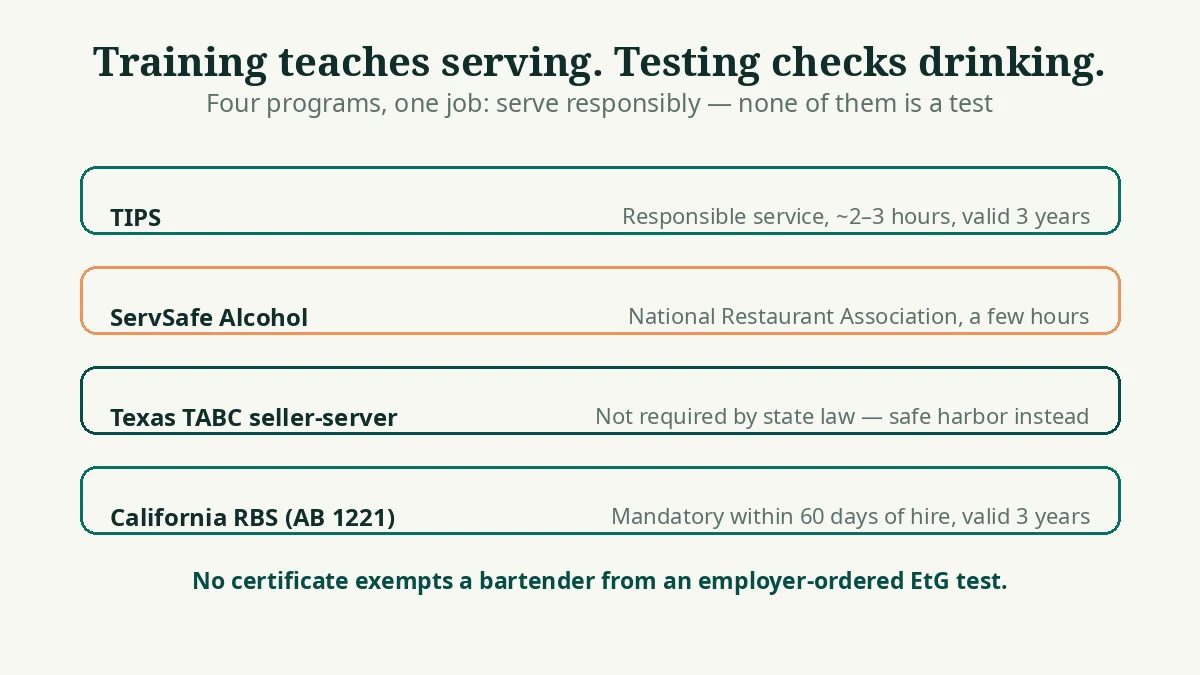
Responsible-server training is not an EtG test
| Program | Who runs it | What it is | Who must hold it |
|---|---|---|---|
| TIPS | Health Communications, Inc. | Responsible-service course, about 2–3 hours, certificate valid 3 years | Voluntary in most states; required by many employers |
| ServSafe Alcohol | National Restaurant Association | Responsible-service course, a few hours, certificate valid 2–3 years | Voluntary in most states; required by many employers |
| Texas TABC seller-server | TABC-accredited providers | State seller-server course, about 2 hours, certificate valid 2 years | Not required by Texas law, but gives the employer a liability safe harbor — so nearly every Texas bar requires it |
| California RBS | California ABC | State program under AB 1221, exam pass mark 70%, certificate valid 3 years | Mandatory for every alcohol server and manager at an on-premises establishment, within 60 days of hire |
The pattern is the same in every state: training teaches a bartender how to serve responsibly — checking IDs, spotting intoxication, refusing service — and it protects the employer's license. It says nothing about whether the bartender drinks, and it is never a substitute for a drug or alcohol test. California is the strictest case: since July 1, 2022, every alcohol server at an on-premises licensed establishment must hold a Responsible Beverage Service certification within 60 days of starting work, under Assembly Bill 1221. Texas is the opposite: state law does not require a seller-server certificate at all, but the Alcoholic Beverage Code gives a certified employer's business a safe harbor against liability for an illegal sale, so almost every Texas bar demands the certificate before a first shift. In both states, the certificate is about serving — the EtG test, where one exists, is about drinking, and it comes from the employer's own policy.
Pouring alcohol does not produce EtG
This is the question every bartender asks first, and the answer is straightforward: handling alcohol cannot make an EtG test positive. EtG is a metabolite — a chemical the body makes inside itself when it processes ethanol. A bottle in your hand is not ethanol in your bloodstream.
Two narrow exceptions are worth knowing. The first is inhalation: research by Arndt and colleagues found that breathing concentrated hand-sanitizer vapor can produce EtG in urine, while skin contact alone did not. A normal bar is not a sealed room full of sanitizer vapor, so ordinary pouring and serving is not that exposure — but a bartender on a long shift in a small, unventilated back bar, constantly using alcohol-based sanitizer, breathes more vapor than most people, and at a 100 ng/mL cutoff that repeated incidental exposure is worth mentioning to a lab. The second exception is tasting: sipping a cocktail to check it, finishing a guest's leftover drink, or taking a shot with a regular is drinking, whatever you call it. The test cannot tell a "taste" from a drink.
The practical line is simple. If you did not swallow it, it did not become EtG — with the single caveat that heavy, repeated inhalation of alcohol vapor can contribute trace amounts at low cutoffs. That is the same incidental-exposure logic behind our guides on whether mouthwash can cause a positive EtG test and whether hand sanitizer affects an EtG test: the exposure has to get ethanol inside the body, and the lower the cutoff, the less exposure it takes. A bartender worried about a result should tell the lab about sanitizer and mouthwash use — and should know that pouring drinks is not an exposure at all.
What cutoff applies to a bartender's EtG test
There is no national EtG cutoff for bartenders: the bar, the restaurant group, or the hotel picks one, usually 100, 200, or 500 ng/mL.
| Drinking | At 100 ng/mL | At 200 ng/mL | At 500 ng/mL |
|---|---|---|---|
| 1–2 drinks | 23–53 hours | 20–46 hours | 15–36 hours |
| 3–4 drinks | 30–68 hours | 26–59 hours | 20–46 hours |
| 5–7 drinks | 38–85 hours | 33–75 hours | 26–58 hours |
These are modeled ranges from the site's calculator, not promises for one person. The pattern is what matters: at 500 ng/mL, each window closes roughly a day sooner than at 100 ng/mL, so the same Saturday-night drinking can be positive at 100 and negative at 500 by Monday morning. That is why the first question after any result should be "which cutoff was used?" The SAMHSA advisory agrees: EtG is "scientifically unsupportable as the sole basis for legal or disciplinary action" — which is why a responsible program confirms a positive screen with LC-MS/MS before acting on it. The full comparison is in our 100 vs 500 ng/mL cutoff guide.

How long EtG stays detectable before a bartender's test
EtG can be detected in urine for up to about 80 hours after drinking, per the SAMHSA advisory.
How much was drunk, the cutoff, and the individual all stretch or shrink the window — but no formula predicts one person's result. Drinking water before a test does not help: it lowers the EtG concentration in one sample, but labs measure the EtG-to-creatinine ratio to catch dilution, and a dilute sample can be flagged. There is no reliable way to shorten the window. And EtG is not a breathalyzer: a breath test measures alcohol right now, while EtG measures a metabolite from days ago. A bartender can blow zero on Monday morning and still test positive for Saturday night's drinks. For the full picture, see our realistic detection times guide and the EtG calculation formula.
Real-world scenario: four drinks Saturday, a random test Monday
Mara is a bartender at a downtown cocktail bar. She finishes her shift Saturday at 11 p.m. and has four drinks with coworkers afterward. On Monday at 9 a.m., her name comes up in the random pool — 58 hours after her last drink.
At 100 ng/mL, the modeled window for three to four drinks is 30–68 hours — Mara is inside it. At 200 ng/mL (26–59 hours) she is still inside it, by a single hour; at 500 ng/mL (20–46 hours) she is past it by twelve hours, and a screen is likely negative. One weekend, one random draw, three outcomes depending on a number she was never told. The lesson is not that 500 ng/mL is safe to drink under — it is that the cutoff decides the result as much as the drinking does. A bartender who drinks on a Saturday and works a random-tested bar on Monday is gambling on a policy detail.

Why bars test at all
Bars test for the same reason other employers test — safety, liability, and the license — but the hospitality numbers explain why the question comes up so often. SAMHSA's analysis of combined 2008–2012 National Survey on Drug Use and Health data found that workers in accommodations and food services had the highest past-year substance use disorder rate of any industry measured, at 16.9%, against 9.5% across all full-time workers — and the highest past-month illicit drug use, at 19.1%. Heavy alcohol use in the industry was 11.8%. Those figures are from 2008–2012 data published in 2015, so they describe the industry's structure, not this year's rate — but they explain why bar groups write testing into their policies.
What a positive — or a refusal — can cost a bartender
The immediate cost is the job: bars run lean, so a bartender pulled off the schedule is often replaced the same week, and the termination follows the confirmation. The secondary cost is the next job: a failed test follows a bartender into the next application, where the same pre-employment test is waiting — and in a small local bar scene, word travels faster than paperwork.
Refusal is not a way around this: most policies treat a refusal as a positive, with the same discipline. The protections worth using: ask for the cutoff and the lab, whether a positive screen was confirmed by LC-MS/MS, and whether a split-sample retest is available. For the wider workplace picture, see our guide to EtG testing for employment.
What to do if you are selected for a test
Respond the same day: a random selection has a reporting deadline, and missing it counts as a refusal. Check the policy first — cutoff, lab, confirmation step, consequence — then give the sample. If the result comes back positive, ask three questions in writing: which cutoff, whether the screen was confirmed by LC-MS/MS, and whether a split-sample retest is available. Mention any incidental exposure honestly — heavy sanitizer use, alcohol mouthwash — and ask whether EtS was also tested.
Do not try to beat the test: water, supplements, and "detox" drinks do not reliably clear EtG, and a dilute sample can be flagged as cheating — which many policies punish more harshly than a positive. The simplest protection is the oldest one: know the policy and the cutoff, and do not drink in the days before a possible test. This article is educational only, not legal or medical advice.
Using the EtG calculator before a test
The EtG calculator estimates the same windows as the tables above — read the result as a range, never a pass date. Run your numbers through the calculator.
Frequently asked questions
Do bartenders get EtG tested?+
Yes — many bar groups, restaurant chains, and hotels test, usually at hire, at random, after an incident, or on reasonable suspicion. Testing is set by the employer's policy, not by a national rule. There is no federal EtG testing program for bartenders, and no national cutoff: the bar, restaurant, or hotel sets it, usually 100, 200, or 500 ng/mL.
Does pouring or handling alcohol cause a positive EtG test?+
No. EtG is only formed inside the body after ethanol is swallowed, so pouring a shot, shaking a cocktail, or wiping a spill cannot make a test positive. Skin contact alone does not produce EtG — research by Arndt and colleagues found that inhalation of concentrated hand-sanitizer vapor can, while skin contact did not. One real exception: tasting a drink counts as drinking. Sipping a cocktail to check it is ingestion, whatever you call it.
What cutoff do bars and restaurants use for EtG?+
There is no standard cutoff. Bars, restaurant groups, and hotels usually pick 100, 200, or 500 ng/mL. The cutoff matters more than the drinking: four drinks are modeled at 30–68 hours at 100 ng/mL but only 20–46 hours at 500 ng/mL, so the same weekend can be positive at one cutoff and negative at another.
How long after drinking will a bartender test positive on an EtG test?+
It depends on how much was drunk and the cutoff. Modeled windows from the site's calculator: one to two drinks, 23–53 hours at 100 ng/mL and 15–36 hours at 500; three to four drinks, 30–68 hours at 100 and 20–46 at 500; five to seven drinks, 38–85 hours at 100 and 26–58 at 500. SAMHSA's advisory puts the outer limit at about 80 hours. These are ranges, not predictions for one person.
Can I be tested after an incident at the bar?+
Yes. Post-incident testing follows an overservice complaint, a guest injury, a fight on the floor, or a crash after a shift, ordered by the employer, a manager, or the insurer. The EtG test checks the days before the incident, not just the shift itself — which is exactly why it matters after an incident, and why the cutoff and the lab should be asked for in writing.
Does TIPS or ServSafe certification protect me from an EtG test?+
No. TIPS, ServSafe Alcohol, a Texas TABC seller-server certificate, and California RBS are all training in responsible service — checking IDs, spotting intoxication, refusing service. None of them is a drug or alcohol test, and none gives an exemption from one. California RBS is mandatory for alcohol servers, and Texas TABC certification gives the employer a liability safe harbor, but both are about serving, not about whether the bartender drinks.
What happens if I refuse an EtG test as a bartender?+
Most policies treat a refusal as a positive, with the same discipline — usually termination. A refusal also removes your best evidence: the sample itself. If you believe a test was ordered unfairly, take the test and challenge the process afterward in writing, asking for the cutoff, the lab, LC-MS/MS confirmation, and whether a split-sample retest is available.
Evidence and limitations
This article summarizes published guidance and research on EtG testing for bartenders, plus the science of alcohol biomarkers. Group-level findings cannot predict one person’s result, and this article is educational only — it is not legal or medical advice. Testing rules vary by employer, bar group, and state; talk to a local attorney about a live case or a termination.
- SAMHSA — Substance Use and Substance Use Disorder by Industry (Bush & Lipari, CBHSQ Report, 2015; combined 2008–2012 NSDUH data): accommodations and food services had the highest past-year substance use disorder rate of any industry (16.9% vs 9.5% across all full-time workers), the highest past-month illicit drug use (19.1%), and 11.8% heavy alcohol use
- SAMHSA — Workplace Drug Testing Resources: testing circumstances (pre-employment, for-cause/reasonable suspicion, post-accident, post-treatment, random) and the rule that any program should comply with applicable local, state, and federal laws
- Texas Workforce Commission — Drug and Alcohol Policies: pre-employment, random, post-accident, and for-cause testing are all allowed in Texas and many other states; some employers are obligated by law to have written drug-free workplace policies
- LegalClarity — California RBS Certification Requirements: AB 1221 (2017) created the statewide standard; every alcohol server and manager at an on-premises establishment must be certified within 60 calendar days of hire; exam pass mark 70%; certificate valid 3 years
- 360training — What is Responsible Beverage Service (RBS) Training?: effective July 1, 2022, all California alcohol servers and managers must hold RBS certification from an ABC-accredited provider and pass the ABC-administered exam, within 60 calendar days of employment
- LiquorReady — How do I get TABC certified?: Texas seller-server course from a TABC-accredited provider, usually 2–4 hours; not required by Texas state law, but Alcoholic Beverage Code Section 106.14 gives certified-employee businesses a safe harbor; certificate valid 2 years
- LaunchAdvisor — Responsible Beverage Service & Compliance for Bars: TIPS (about 2 hours, valid 3 years) and ServSafe Alcohol are the two most widely recognized programs; California RBS is mandatory from September 2022 and TIPS does not satisfy it
- Arndt et al. (2014) — Inhalation but not transdermal resorption of hand sanitizer ethanol causes positive ethyl glucuronide findings in urine, Forensic Science International 237:126–130 (PubMed 24631832): breathing concentrated sanitizer vapor can produce EtG; skin contact alone did not
- Medical University of South Carolina — Urine Ethylglucuronide Testing: EtG is formed when someone drinks, even small amounts; other sources of alcohol (mouthwash, hand sanitizer) can produce EtG above 100 ng/mL
- SAMHSA Advisory: The Role of Biomarkers in the Treatment of Alcohol Use Disorders (2006, revised 2012) — EtG detectable up to ~80 hours; EtG “scientifically unsupportable as the sole basis for legal or disciplinary action”
- McDonell et al. (2015) — EtG immunoassay cutoff sensitivity in alcohol-dependent outpatients (1,589 samples)
- Mackus et al. (2017) — EtG detection and elimination kinetics after controlled alcohol intake
- Jatlow et al. — EtG and EtS in urine after controlled alcohol administration
- EtG Calculator Pro — ETG Testing for Employment: consent and consequences in the workplace
- EtG Calculator Pro — Can Mouthwash Cause a Positive EtG Test?: incidental exposure from alcohol mouthwash
- EtG Calculator Pro — Does Hand Sanitizer Affect an EtG Test?: incidental exposure from alcohol-based sanitizer