EtG test after holiday party: the short answer
The office party ends Friday night. The test notice arrives Monday. That gap — roughly 60 hours from a last drink around 10 or 11 p.m. Friday to a 9 a.m. Monday test — is the whole question, and it cuts both ways. Sixty hours is a long time for EtG: after light or moderate drinking, it is usually enough. But 60 hours is also inside the window for heavier drinking at a strict cutoff, which is why the same Monday test can be a non-event for one coworker and a problem for another.
Here is the fast version. If you had 2 to 4 drinks, most programs will not detect them by Monday morning at any common cutoff. If you had 5 to 7 drinks, the cutoff decides: at 500 ng/mL you are most likely clear, at 100 ng/mL you are still inside the modeled window. If the party turned into 8 or more drinks, even a Tuesday test is not automatically safe at 100 ng/mL. The table below puts numbers on each case, using the same model as our calculator.
This problem is not unique to December. If your big night was Thanksgiving week, the hour math works the same way — see the Thanksgiving-week version of this scenario. December just adds one ingredient the rest of the year does not have: an enforcement season that generates a fresh wave of tests exactly when party drinking peaks.
How long EtG lasts after party drinking: drinks by cutoff
EtG (ethyl glucuronide) is a metabolite your body makes from ethanol and clears in urine. The more you drink, the higher it peaks and the longer it stays above a lab's cutoff. Our calculator models that with honest ranges rather than a single number: base windows by drink count, adjusted by a cutoff multiplier — 1.25 at 100 ng/mL, 1.1 at 200 ng/mL, 0.85 at 500 ng/mL. Applied to a typical party night:
| Drinks in one evening | 100 ng/mL cutoff | 200 ng/mL cutoff | 500 ng/mL cutoff |
|---|---|---|---|
| 1–2 drinks | About 23–53 hours | About 20–46 hours | About 15–36 hours |
| 3–4 drinks | About 30–68 hours | About 26–59 hours | About 20–46 hours |
| 5–7 drinks | About 38–85 hours | About 33–75 hours | About 26–58 hours |
| 8–12 drinks | About 50–105 hours | About 44–92 hours | About 34–71 hours |
| More than 12 drinks | About 65–130 hours | About 57–114 hours | About 44–88 hours |
Read the table from your last drink, not from when the party started, and read it as a range with real uncertainty. Two people who drank the same amount can clear at different speeds depending on body size, pace, food, and liver function. Controlled drinking studies such as Dahl et al. (2002) put the EtG half-life at roughly 2 to 3 hours, which is why the windows are measured in days — and why the low cutoff stretches them so much: at 100 ng/mL, a lab still calls a sample positive long after the level has fallen far below its peak.
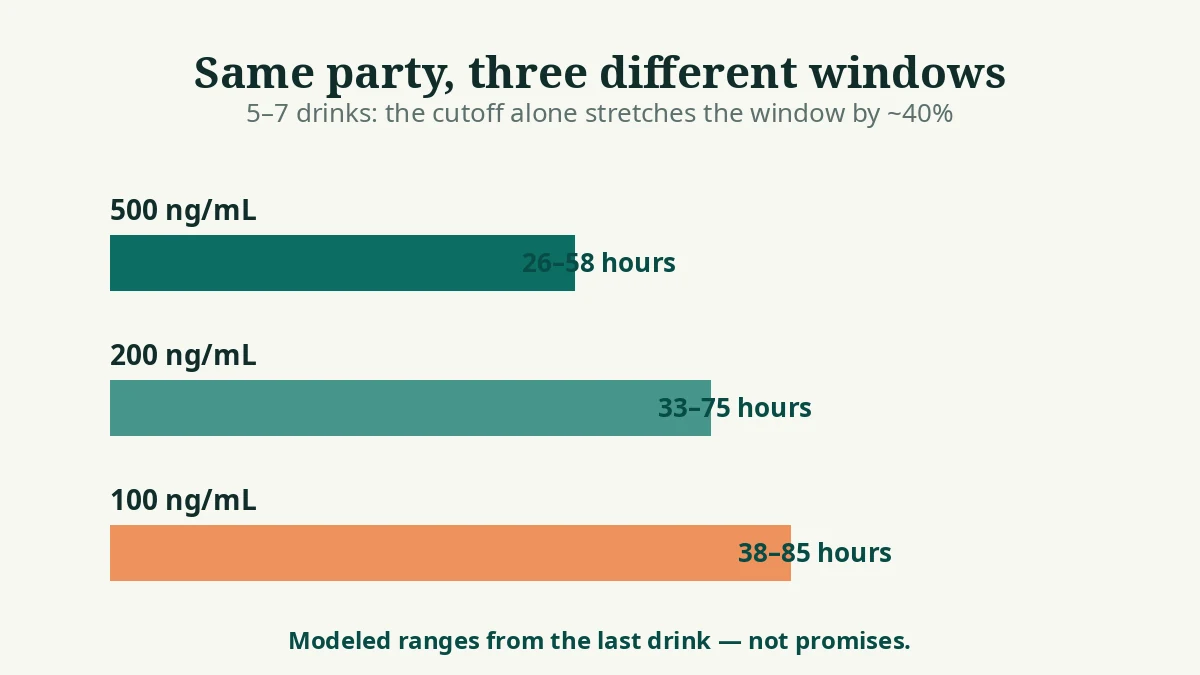
One more pattern matters in December. These windows assume one drinking episode, but party season often means two — the office party Friday, then drinks again Saturday. A second episode restarts the clock, so count hours from the last night you drank, not the first.
The Friday party, Monday test scenario, hour by hour
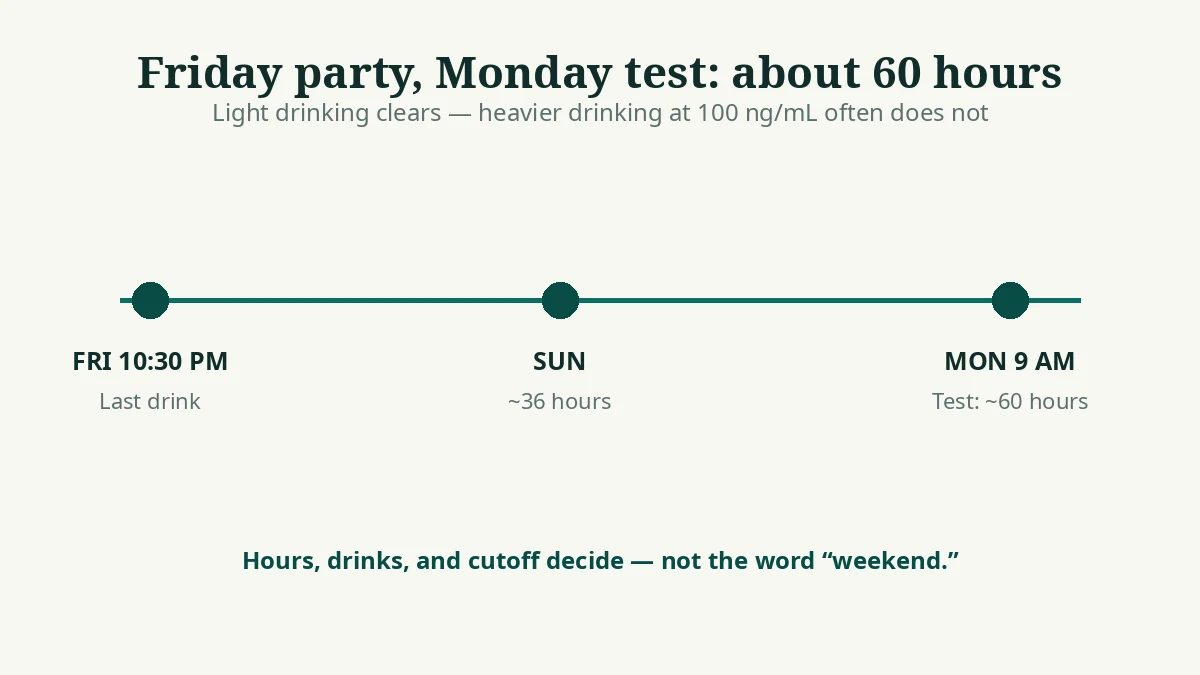
The setup. Your office holiday party runs from about 7 p.m. to 11 p.m. on a Friday, and you have your last drink around 10:30 p.m. On Monday at 9 a.m. you are called for a urine EtG test — a random draw, a scheduled probation test, or a return-to-duty screen. Last drink to test is about 58 to 60 hours. What does the model say?
If you had 3 drinks. Your window is roughly 30 to 68 hours at 100 ng/mL, 26 to 59 hours at 200 ng/mL, and 20 to 46 hours at 500 ng/mL. By Monday morning, a 500 ng/mL test is outside the window for most people, and a 200 ng/mL test is at or just past its edge. At 100 ng/mL you are still inside the top of the range, so a positive is possible even though many people will already have cleared. Honestly, this borderline case is a coin weighted by your own metabolism — not a safe bet either way.
If you had 6 drinks. The picture hardens. Six drinks sit in the 5-to-7 bracket: about 38 to 85 hours at 100 ng/mL, 33 to 75 hours at 200 ng/mL, and 26 to 58 hours at 500 ng/mL. Monday at 60 hours is just past the 500 ng/mL window for most people, but squarely inside the window at the stricter cutoffs. A test pushed to Tuesday morning — about 84 hours after the last drink — clears most 6-drink cases even at 100 ng/mL. A heavy night of 8 to 12 drinks can still reach 105 hours at that cutoff, though, so even Tuesday is not automatically clear.
The lesson is not that Monday is safe or unsafe. It is that "the weekend" is not a unit of time an EtG lab recognizes — hours, drinks, and cutoff are. Instead of guessing from the calendar, you can map your exact party-to-test hours on a timeline.
Christmas week: family drinking, then a test before New Year
The second December pattern is slower and easier to misjudge. Christmas-week drinking is spread out — wine on Christmas Eve, a long Christmas Day, drinks again on the weekend — and the test lands in the gap between Christmas and New Year, when many programs run end-of-year random draws. People misjudge this one because four or five days feels like plenty of time. Sometimes it is; sometimes it is not.
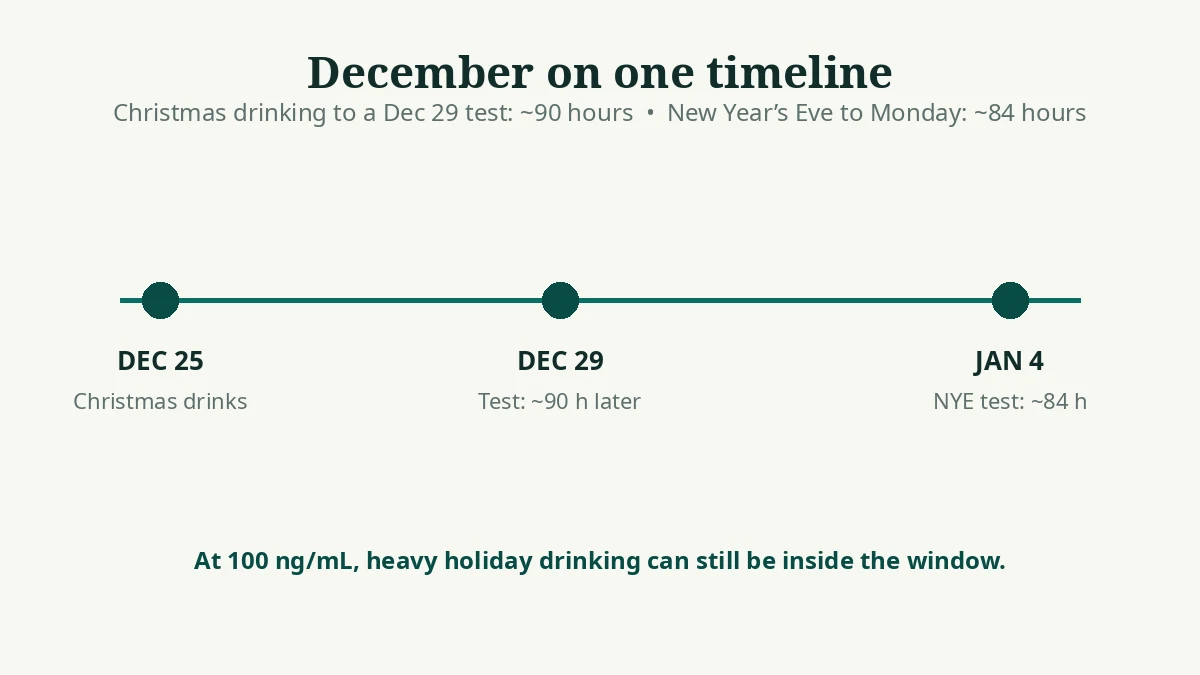
Run the math on a test on Tuesday, December 29. Christmas Day drinking is then about 90 to 96 hours old. Lighter holiday drinking — 2 to 4 drinks on Christmas Day — is normally clear by then at any cutoff. But a heavy Christmas of 8 or more drinks models to as long as 105 hours at 100 ng/mL, so a December 29 or 30 test can still be inside the window. At 500 ng/mL the same drinking usually clears in about 34 to 71 hours, so the Christmas-to-New-Year gap is comfortable at that cutoff. Once again the cutoff, not the calendar, makes the call.
Then the pattern resets. A New Year's Eve drinking EtG test question arrives every January: drinks on December 31, a test in the first week of January. New Year's Eve to the following Monday is about 84 hours — enough for moderate drinking at most cutoffs, but a genuinely heavy New Year's Eve (8 to 12 drinks) can still be detectable at 100 ng/mL at 84 hours, and the heaviest nights reach well past 100 hours. If you are tested in early January, count back to your last drink of the old year, not to January 1.
Why December brings more tests: enforcement season
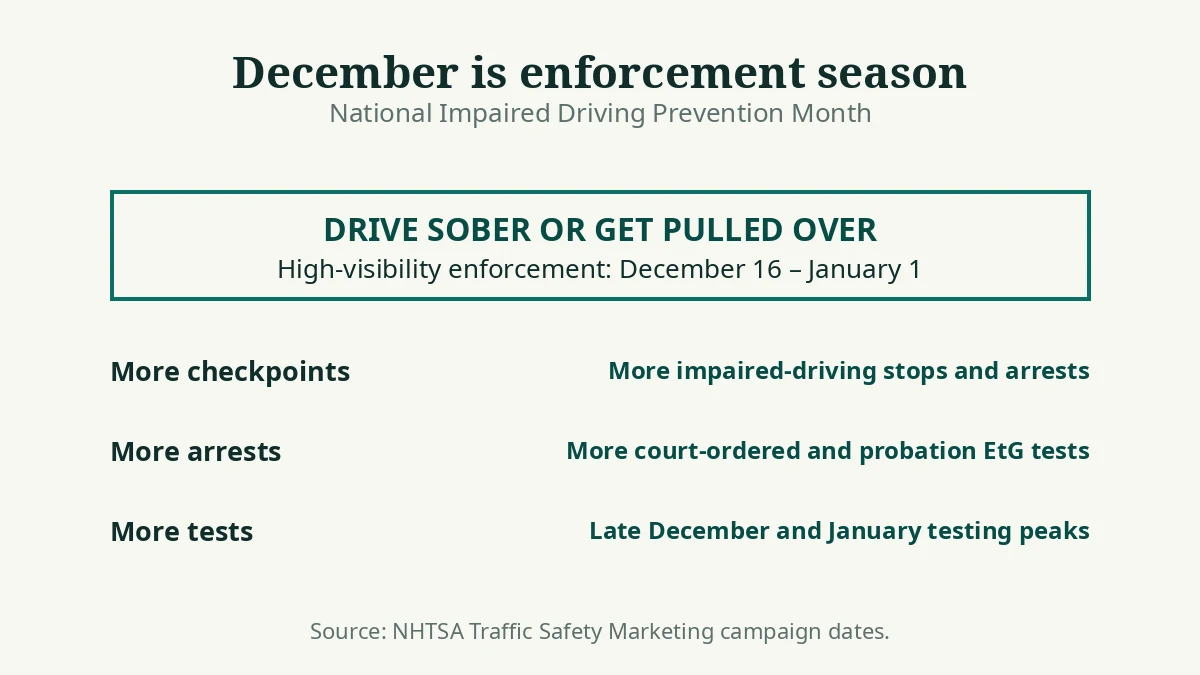
December is National Impaired Driving Prevention Month, and it is also the busiest impaired-driving enforcement period of the year. NHTSA's Drive Sober or Get Pulled Over high-visibility enforcement campaign runs from December 16, 2026 through January 1, 2027 (dates published by NHTSA's Traffic Safety Marketing). In plain terms: more holiday enforcement checkpoints and patrols during exactly the weeks when office parties, family gatherings, and New Year's Eve put the most alcohol in the most drivers.
That enforcement wave is why December DUI enforcement and alcohol testing travel together. A mid-December arrest commonly leads to court-ordered or probation EtG testing starting in late December or January — exactly when the person arrested is surrounded by holiday drinking occasions. If you are already in a program, expect December to be a heavy random-testing month: programs know party season is the highest-risk stretch of the year. For background, see what to expect from EtG testing after a DUI.
The legal backdrop is tightening as well. Several states are tightening DUI law from January 1 — one example is in California's new DUI laws taking effect January 1, 2027. Stricter laws and longer monitoring mean a January EtG positive can carry more weight than it used to. No reason to panic about one office party — but if you are in a monitored program, treat December testing as a when, not an if.
Planning honestly: what actually changes your window
Most of what people try in the 48 hours before a test does not work, and some of it makes things worse. Drinking large amounts of water does not clear EtG faster; it dilutes the urine. Research on exactly this question (Goll et al., 2002) found that water-driven diuresis lowers the raw EtG concentration but leaves the EtG-to-creatinine picture largely intact — and labs routinely check creatinine, so an over-dilute sample can be rejected or treated as a failed test. Detox drinks, vinegar, and niacin have no credible evidence behind them for EtG. The only variable that reliably lowers your EtG level is time since your last drink.
What honest planning looks like is arithmetic, done early. Count your drinks honestly — a generous party pour of wine is often closer to 1.5 standard drinks than 1. Count hours from your last drink to the earliest plausible test time, not the test you hope for. Then compare against the strictest cutoff your program might use, because programs do not always say which one they run. You can run your own drink count, hours, and cutoff through the calculator to see your modeled range, and read how realistic detection times are modeled for the reasoning behind the numbers. Treat every result as a range with uncertainty, never a promise — individual results vary, and the lab's result is the only one that counts.
Finally, the simplest December strategy is a decision, not a calculation. If a test in the next few days would carry real consequences — a probation violation, a custody issue, a job — the only approach that removes the guesswork is not drinking at the party, or keeping it to one or two drinks early in the evening with days of margin afterward. And if the holidays are when drinking keeps putting you at risk, January is when many people reset: here is how a Dry January interacts with EtG testing. This article is educational information, not legal advice; if you face a specific charge or violation, talk to a lawyer in your state.
Frequently asked questions
I drank at the office holiday party on Friday night. Will I pass an EtG test on Monday morning?+
It depends on how much you drank and on the cutoff. Friday night to Monday morning is about 60 hours. At a 500 ng/mL cutoff, the modeled window for up to 5 drinks ends by about 58 hours, so most people in that range will be below the cutoff by Monday. At a 100 ng/mL cutoff the same 5 drinks can stay detectable for 38 to 85 hours, so a Monday test can still be positive. There is no honest yes-or-no answer without your drink count and cutoff.
How long after a holiday party can an EtG test stay positive?+
Using the same model as our calculator: 1 to 2 drinks clear in roughly 15 to 53 hours depending on cutoff, 3 to 4 drinks in about 20 to 68 hours, 5 to 7 drinks in about 26 to 85 hours, and a heavy night of 8 to 12 drinks in about 34 to 105 hours. The 100 ng/mL cutoff always gives the longest window and 500 ng/mL the shortest. These are modeled ranges, not promises about any one person's result.
Does the cutoff matter more than the number of drinks?+
Both matter, and they multiply. The cutoff alone stretches or shrinks the window by about 40 percent: the model applies a 1.25 multiplier at 100 ng/mL and a 0.85 multiplier at 500 ng/mL to the same drinking episode. Three drinks can mean a 20 to 46 hour window at 500 ng/mL or a 30 to 68 hour window at 100 ng/mL. The same weekend can therefore be a pass at one program and a positive at another.
I only had two drinks at the work party. Am I at risk?+
Your risk is low after a full weekend, but not zero on a short turnaround. Two drinks model to about 23 to 53 hours at the strictest 100 ng/mL cutoff and 15 to 36 hours at 500 ng/mL. A Monday-morning test roughly 60 hours later is outside even the longest of those ranges for most people. A random test on Saturday or Sunday, however, would fall inside the window.
Can a test between Christmas and New Year catch Christmas Day drinking?+
Yes, especially at a low cutoff after heavier drinking. Christmas Day to December 29 is about 90 to 96 hours. A heavy Christmas (8 or more drinks) models to up to 105 hours at 100 ng/mL, so a test on December 29 or 30 can still be positive. At 500 ng/mL the same drinking usually clears in about 34 to 71 hours. Lighter Christmas drinking of 2 to 4 drinks is normally clear at any cutoff by then.
Why do more EtG tests seem to land in late December and January?+
December is National Impaired Driving Prevention Month, and NHTSA's Drive Sober or Get Pulled Over high-visibility enforcement runs December 16, 2026 through January 1, 2027. More checkpoints and stops mean more DUI arrests in that window, and arrests commonly lead to court-ordered or probation EtG testing in the weeks that follow. Programs also schedule more random tests around the holidays because they know party drinking peaks then.
Will drinking lots of water before the test clear my EtG faster?+
No. Water does not speed up how fast your body clears EtG; it only dilutes the urine sample. Labs check creatinine to spot dilution, and research going back to Goll et al. (2002) shows the EtG-to-creatinine picture is far less affected by drinking water than the raw EtG concentration. A dilute sample can be rejected or treated as a failed test. Time since your last drink is the only factor that reliably lowers EtG.
Evidence and limitations
This article summarizes published research on ethyl glucuronide detection windows and cutoffs, plus NHTSA’s published December enforcement dates. Group-level findings and modeled ranges cannot predict one person’s result, and this article is educational only — it is not medical or legal advice.
- NHTSA Traffic Safety Marketing — Drive Sober or Get Pulled Over, Winter Holidays: high-visibility enforcement and paid media December 16, 2026 – January 1, 2027; December is National Impaired Driving Prevention Month
- SAMHSA Advisory: The Role of Biomarkers in the Treatment of Alcohol Use Disorders (2006, revised 2012)
- Dahl et al. (2002) — EtG detectable 22.5–31.5 h after ~0.5 g/kg ethanol, EtG/creatinine ratio unaffected by water diuresis, half-life ~2.5 h
- Goll et al. (2002) — Excretion profiles of ethyl glucuronide in human urine after internal dilution (J Anal Toxicol 26(5):262–266): water diuresis lowers urinary EtG concentration; EtG excretion is a small fraction of the ethanol dose
- McDonell et al. (2015) — EtG immunoassay cutoff sensitivity in alcohol-dependent outpatients (1,589 samples)
- Mackus et al. — Pharmacokinetics of ethyl glucuronide and ethyl sulfate and their role in alcohol detection windows (PMC5637917)