Dry January EtG test: the short answer
If you are starting Dry January with a test hanging over the first week, the real question is simple: how big was your last night of drinking? EtG (ethyl glucuronide) is a metabolite your body makes only when ethanol is present. After your final New Year’s Eve drink, EtG rises within hours and then falls steadily. The test does not know you have made a resolution, and it does not know what month it is. It only measures what is still in your urine on test day.
That is why two people who both stopped at 1 a.m. on January 1 can get opposite results. One had three glasses of champagne and tests at a 500 ng/mL cutoff: modeled clear well before the test. The other had ten drinks and tests at 100 ng/mL: still inside the window. Dose and cutoff explain almost all of that difference. Our EtG calculator runs the same model used in the tables below, so you can check your own numbers before test day.
One thing is worth saying plainly: a first-week test is not testing your Dry January. It is testing your New Year’s Eve. Everything below is about reading that window honestly.
Dose and cutoff set the window
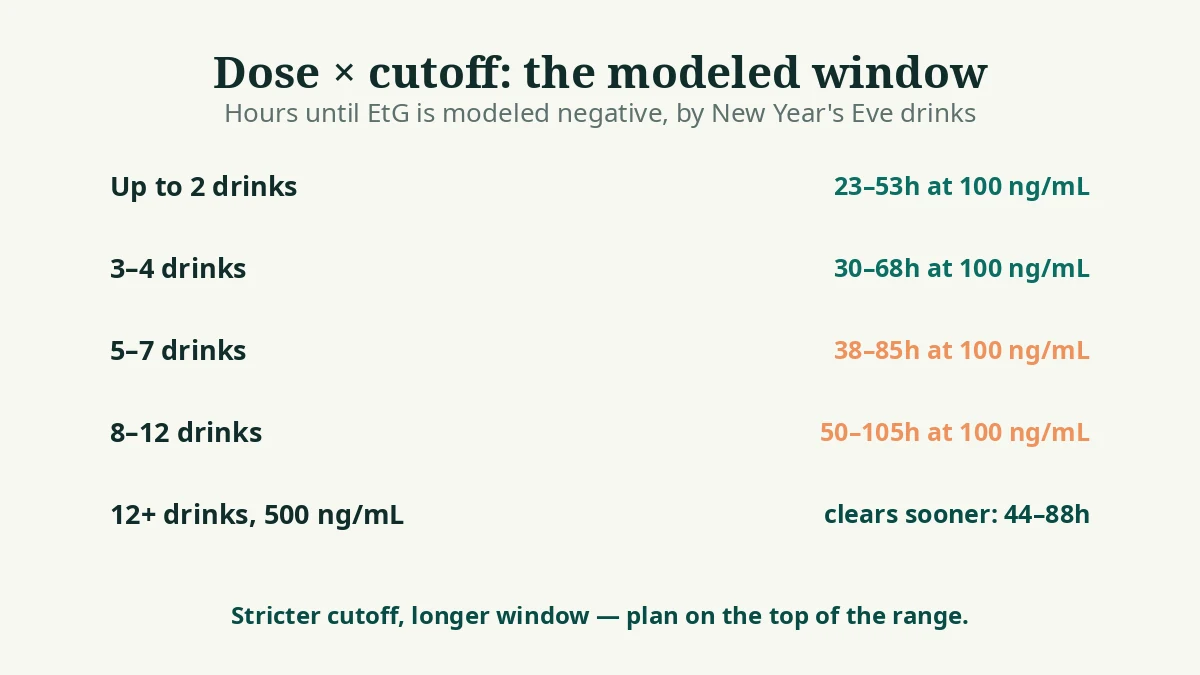
We publish our model instead of hiding it. The calculator starts with a base window set by how much you drank on one occasion: up to 2 drinks, 18–42 hours; up to 4 drinks, 24–54 hours; up to 7 drinks, 30–68 hours; up to 12 drinks, 40–84 hours; and more than 12 drinks, 52–104 hours. It then adjusts for the cutoff the testing program uses: multiply by 1.25 at 100 ng/mL, by 1.1 at 200 ng/mL, and by 0.85 at 500 ng/mL. A stricter cutoff catches smaller amounts for longer. A higher cutoff clears sooner, because the level has less far to fall.
| Drinks on New Year’s Eve | 100 ng/mL | 200 ng/mL | 500 ng/mL |
|---|---|---|---|
| Up to 2 drinks | 23–53 hours | 20–46 hours | 15–36 hours |
| 3–4 drinks | 30–68 hours | 26–59 hours | 20–46 hours |
| 5–7 drinks | 38–85 hours | 33–75 hours | 26–58 hours |
| 8–12 drinks | 50–105 hours | 44–92 hours | 34–71 hours |
| More than 12 drinks | 65–130 hours | 57–114 hours | 44–88 hours |
Worked examples: three drinks (the 3–4 band) model to 30–68 hours at 100 ng/mL, 26–59 at 200 ng/mL, and 20–46 at 500 ng/mL. Eight drinks (the 8–12 band): 50–105 hours at 100 ng/mL, 44–92 at 200, and 34–71 at 500. The cutoff alone moves the end of the window by more than a day.
Read the top of each range as your planning number. These are modeled ranges built from group research, not measurements of your body. Drinking pace, food, body size, liver function, and several heavy days in a row can all push a real result toward the longer end — which is why honest ranges beat a single confident number.
What those hours mean on January dates
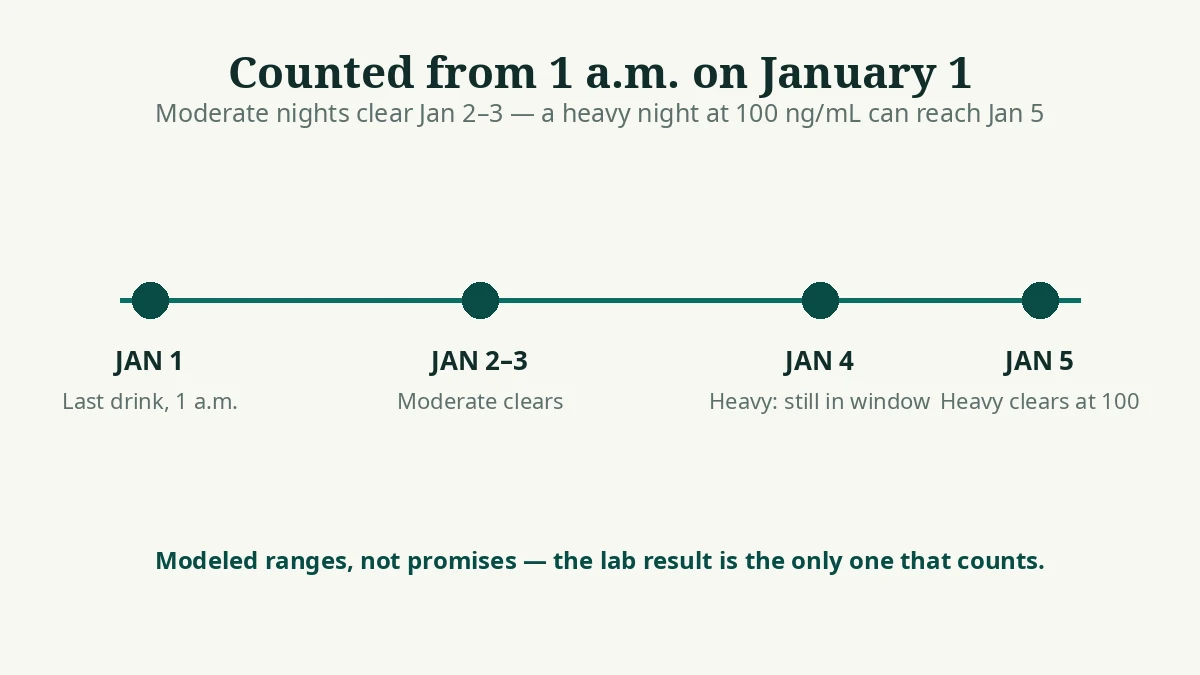
Hours are hard to feel, so here is the same model mapped onto the calendar. Assume the last drink ends around 1 a.m. on January 1 — a typical New Year’s Eve finish. Each cell shows the earliest-to-latest modeled clearance. Before the first time, you would usually still test positive. After the second, the model says negative. A test inside a cell’s span is the gray zone, where dose, cutoff, and metabolism decide.
| Last drinks end 1 a.m., Jan 1 | 500 ng/mL | 200 ng/mL | 100 ng/mL |
|---|---|---|---|
| 2 drinks | Jan 1, 4 p.m. – Jan 2, 1 p.m. | Jan 1, 9 p.m. – Jan 2, 11 p.m. | Jan 2, midnight – Jan 3, 6 a.m. |
| 4 drinks | Jan 1, 9 p.m. – Jan 2, 11 p.m. | Jan 2, 3 a.m. – Jan 3, noon | Jan 2, 7 a.m. – Jan 3, 9 p.m. |
| 7 drinks | Jan 2, 3 a.m. – Jan 3, 11 a.m. | Jan 2, 10 a.m. – Jan 4, 4 a.m. | Jan 2, 3 p.m. – Jan 4, 2 p.m. |
| 10 drinks | Jan 2, 11 a.m. – Jan 4, midnight | Jan 2, 9 p.m. – Jan 4, 9 p.m. | Jan 3, 3 a.m. – Jan 5, 10 a.m. |
| 14 drinks | Jan 2, 9 p.m. – Jan 4, 5 p.m. | Jan 3, 10 a.m. – Jan 5, 7 p.m. | Jan 3, 6 p.m. – Jan 6, 11 a.m. |
The headline row is the heavy one. Ten drinks at a 100 ng/mL cutoff can run to the morning of January 5, and a very heavy night (14 drinks) can reach January 6 at that cutoff — nearly a week into a month that was supposed to be dry. At 500 ng/mL, the same nights are modeled clear two to three days earlier. If you do not know which cutoff your program uses, assume the strict one until you can confirm it.
For the research behind windows like these, see our guide to realistic EtG detection times, and for a visual version of the same math, try the EtG timeline calculator.
Real-world scenario: the Monday, January 4 test
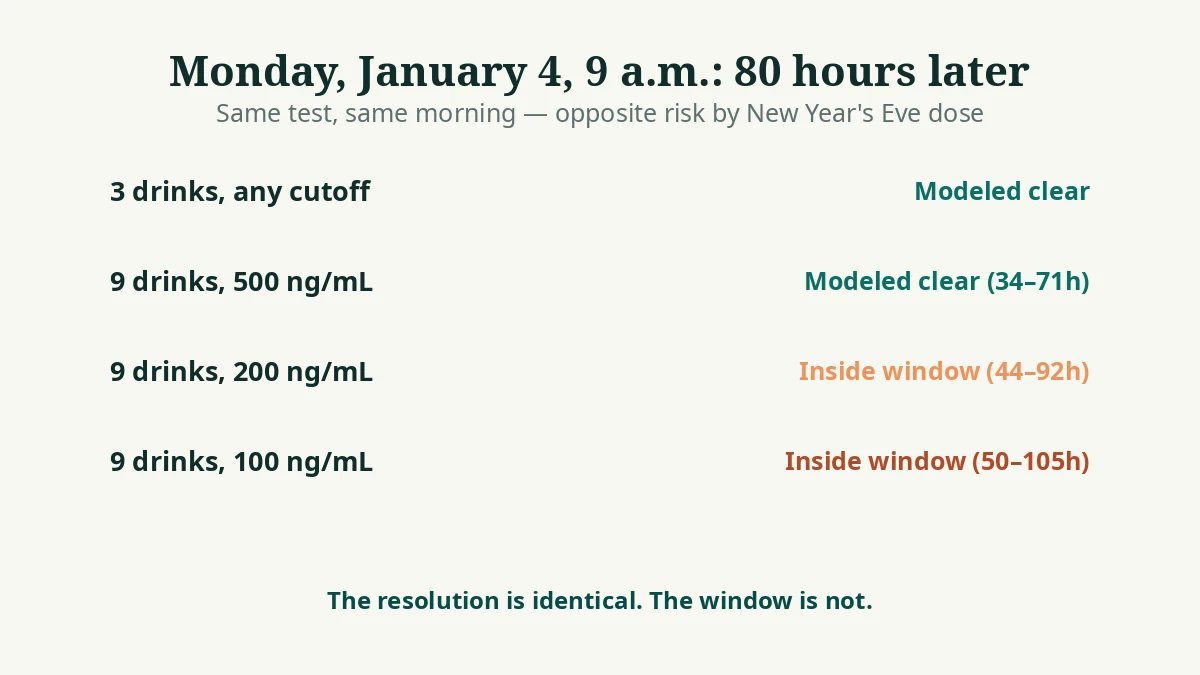
Here is the version of this story that plays out every year. Two coworkers both start Dry January on January 1 and both face a workplace test on Monday, January 4 at 9 a.m. — exactly 80 hours after a 1 a.m. finish on New Year’s Eve. Their resolutions are identical. Their windows are not.
The first had a heavy New Year’s Eve: roughly nine drinks across the night, in the 8–12 drink band. At a 500 ng/mL cutoff, the modeled window is 34–71 hours, so by Monday morning the model says clear. At 200 ng/mL the window is 44–92 hours, and at 100 ng/mL it is 50–105 hours — Monday’s test falls inside both ranges. If this program tests at a strict cutoff, a positive result on January 4 is a real possibility, three full days into Dry January.
The second coworker had three drinks. That band tops out at 68 hours even at 100 ng/mL, so by 80 hours the model says clear at every cutoff. Same test, same morning, opposite risk — and the only difference is what happened before 1 a.m. on January 1.
If the heavy drinker’s test slipped to Wednesday, January 6, the picture changes again: 128 hours after the last drink is beyond even the 105-hour top of the 100 ng/mL range. No product, workout, or gallon of water moved that date — time, and only time, did the work.
The whole holiday season, one last drink at a time
EtG has a short memory. It does not add up your December. Each drinking episode starts its own window when that episode ends, so a January test cares about your final drink, not your December total. If you drank on December 30 and again on December 31, the clock that counts started around 1 a.m. on January 1. If your last drink was at a party on December 28, your window is already days older than the calendar suggests.
If your risk day fell earlier in the season, the same dose-and-cutoff math applies to those dates: our walkthrough of an EtG test after Thanksgiving and our guide to an EtG test after a holiday party run the identical model for a late-November weekend and for mid-December parties. Read together, the three guides cover the whole holiday season — because the season is exactly when “one last night” tends to meet a first-week test.
A Dry January promise does not change a urine result
This is the honest section, and it matters. A commitment to stop drinking is genuinely worthwhile — for your health, your sleep, and your standing with any program watching. But it does not change what is already in your urine. EtG leaves your body on its own schedule, through normal metabolism and excretion. Declaring January dry does not accelerate a single hour of it.
That is also why flush products and detox drinks do not work the way their labels imply. Heavy water intake dilutes the sample: the EtG concentration drops because there is more water, not because there is less EtG. Labs know this, which is why they measure creatinine alongside EtG. A sample with very low creatinine is flagged as dilute and, in many programs, treated as a failed or retest event. Research (Dahl et al., 2002) found the EtG-to-creatinine ratio is largely unaffected by water diuresis — dilution shows up in the numbers even when the headline concentration dips. Detox drinks are mostly expensive dilution plus vitamins to add color back; none remove EtG faster.
If you want the detail, read what actually happens when you drink extra water before an EtG test, and how labs use creatinine to spot dilution. The short version never changes: there is no flush, cleanse, or home remedy that shortens EtG clearance. Only time does.
Planning your first week of January
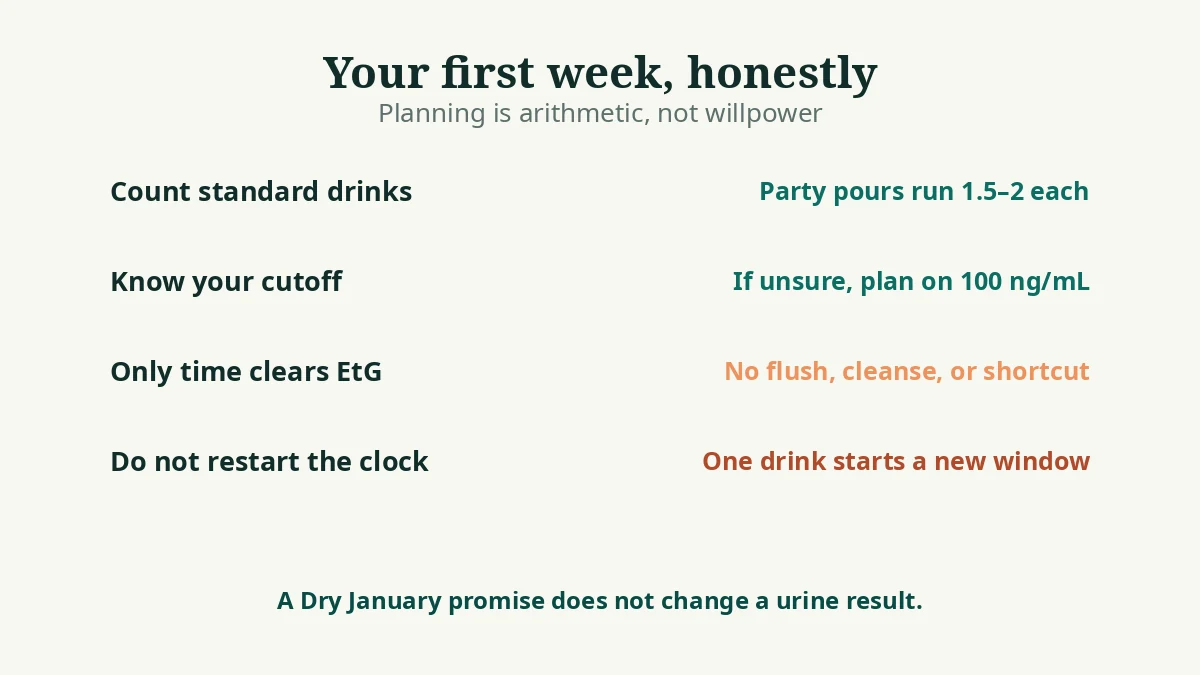
Count your last night honestly. Use standard drinks: 12 oz of 5% beer, 5 oz of wine, or a 1.5 oz shot of spirits. Party pours are often one and a half to two standard drinks each, so a night of “four big glasses” may be six or seven standard drinks. The band you pick changes the window by a day or more.
Find your cutoff. Program paperwork or a direct question to the testing coordinator will usually tell you whether you face 100, 200, or 500 ng/mL. If you cannot confirm it, plan around 100 ng/mL — the longest window.
Run your own numbers. The EtG elimination calculator applies the same dose-and-cutoff model to your drink count and finish time. Compare its latest clearance time with your test time. If the test falls before that latest time, you are in the gray zone, and no honest tool can tell you otherwise.
Do not restart the clock. A “final” drink on January 2 or 3 starts a brand-new window and can turn a test you would have cleared into a positive. If the modeled window overlaps your test date, the useful moves are boring: know your dates, keep documentation of your last drink, and talk to your officer, counselor, or program contact early rather than gambling silently.
Frequently asked questions
If my last drink was on New Year's Eve, when will my EtG test be negative?+
It depends on how much you drank and your cutoff. Ending around 1 a.m. on January 1, a moderate night (3–4 drinks) is modeled negative at most cutoffs sometime on January 2–3. A heavy night (8–12 drinks) at a 100 ng/mL cutoff can stay positive into January 4–5, and a very heavy night can reach January 6 at that cutoff. Use the longest end of your range as the planning number.
Can I test positive in the first week of January if I started Dry January on January 1?+
Yes. An EtG test in the first days of January measures your last drinks, not your resolution. EtG from New Year's Eve drinking remains detectable for roughly 15 to 130 hours depending on dose and cutoff, so a test on January 2–4 can be positive even if you have not touched alcohol since midnight. The test is reading late December, not your January behavior.
Does starting Dry January make EtG clear faster?+
No. Stopping drinking prevents new EtG from forming, but the EtG already in your body leaves on its own schedule through normal metabolism and excretion. A Dry January commitment does not speed that clearance by even an hour. Only time between your last drink and the test lowers your level.
Will drinking lots of water or a detox drink flush EtG out before a January test?+
No. Extra water dilutes the urine sample rather than removing EtG, and labs measure creatinine to detect exactly that. A very dilute sample is often flagged and can be treated as a failed or retest event. Research (Dahl et al., 2002) found the EtG-to-creatinine ratio is largely unaffected by water diuresis. Detox and flush products are essentially dilution with coloring, and none shorten EtG clearance.
Which cutoff matters most for a January probation or employer test: 100, 200, or 500 ng/mL?+
The lower the cutoff, the longer the window. For 8 drinks, the modeled window is 50–105 hours at 100 ng/mL, 44–92 hours at 200 ng/mL, and 34–71 hours at 500 ng/mL — a difference of more than a day. Many probation programs use stricter cutoffs than workplaces. If you do not know your program's cutoff, plan around 100 ng/mL until you can confirm it.
I had 8 or more drinks on New Year's Eve and I test on January 3 or 4. Am I at risk?+
At strict cutoffs, yes. Eight drinks model to 50–105 hours at 100 ng/mL and 44–92 hours at 200 ng/mL, so a test 57–80 hours after a 1 a.m. finish falls inside both windows. At 500 ng/mL (34–71 hours) a January 4 morning test is more likely modeled clear. Treat January 3–4 as a genuine risk window after a heavy night, not a safe zone.
What should I do if my test falls inside the modeled window?+
Do not drink anything further — a new drink restarts the clock — and do not try dilution or detox products, which add a dilute-sample problem on top of the original one. Keep any honest documentation of when your drinking stopped, know your test date and cutoff, and consider speaking with your officer, counselor, or program contact early. Only elapsed time moves you out of the window.
Evidence and limitations
This article summarizes published research on ethyl glucuronide detection windows, cutoffs, and urine dilution. Group-level findings cannot predict one person’s result, and this article is educational only — it is not medical or legal advice.
- SAMHSA Advisory: The Role of Biomarkers in the Treatment of Alcohol Use Disorders (2006, revised 2012)
- Dahl et al. (2002) — EtG detectable 22.5–31.5 h after ~0.5 g/kg ethanol, EtG/creatinine ratio unaffected by water diuresis, half-life ~2.5 h
- Goll et al. (2002) — EtG excretion profiles in human urine after internal dilution
- McDonell et al. (2015) — EtG immunoassay cutoff sensitivity in alcohol-dependent outpatients (1,589 samples)
- Mackus et al. (2017) — EtG and EtS detection windows after controlled alcohol administration
- Jatlow et al. — EtG/EtS as markers of recent alcohol use, cutoff and confirmation context