California new DUI laws 2027: the short answer
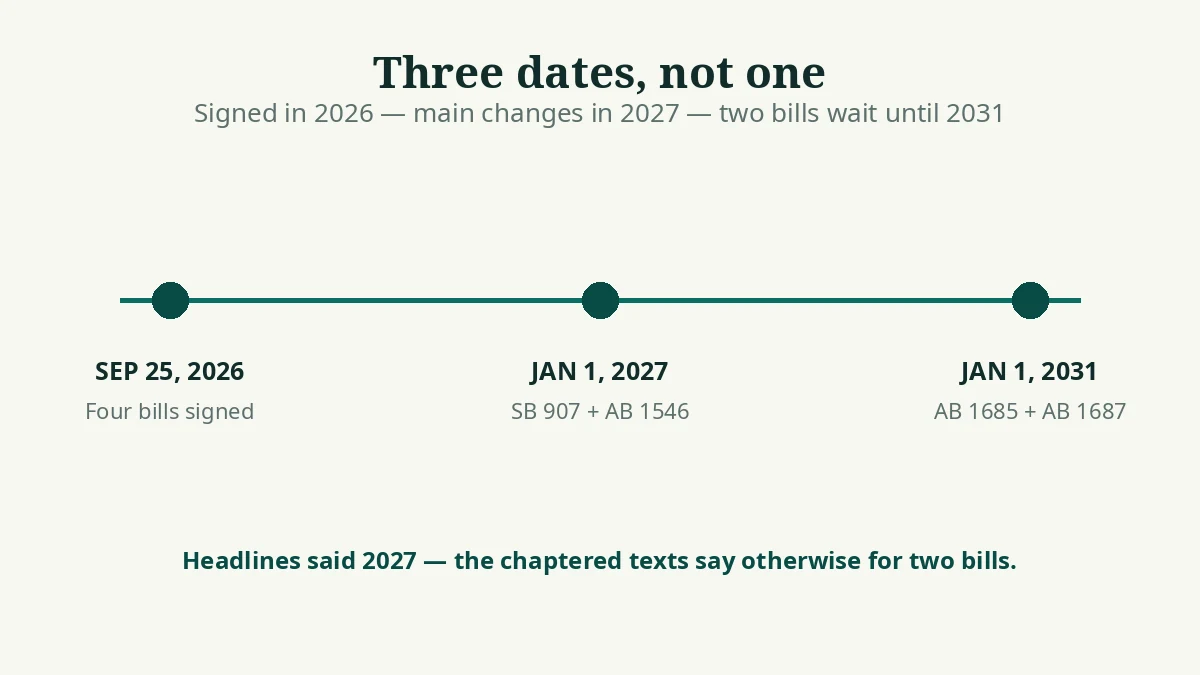
On September 25, 2026, Governor Gavin Newsom signed four bills that together form the most significant change to California DUI law in years. Two of them change what happens in court from January 1, 2027. The other two are signed law now but sit dormant until 2031, a delay written into the bills themselves. Reporting on the signing often blended all four into a single "2027" story, so the dates matter as much as the penalties.
The through-line is repeat offending. None of the four bills rewrites the law for a first DUI arrest. What they do is steepen the ladder for people who come back: felony exposure arrives one offense earlier, hit-and-run penalties rise for drivers with a recent DUI record, the DMV point value of the most serious intoxicated manslaughter offense triples in effect, and the longest license loss in the package — 72 months — is reserved for an injury DUI committed after four or more priors.
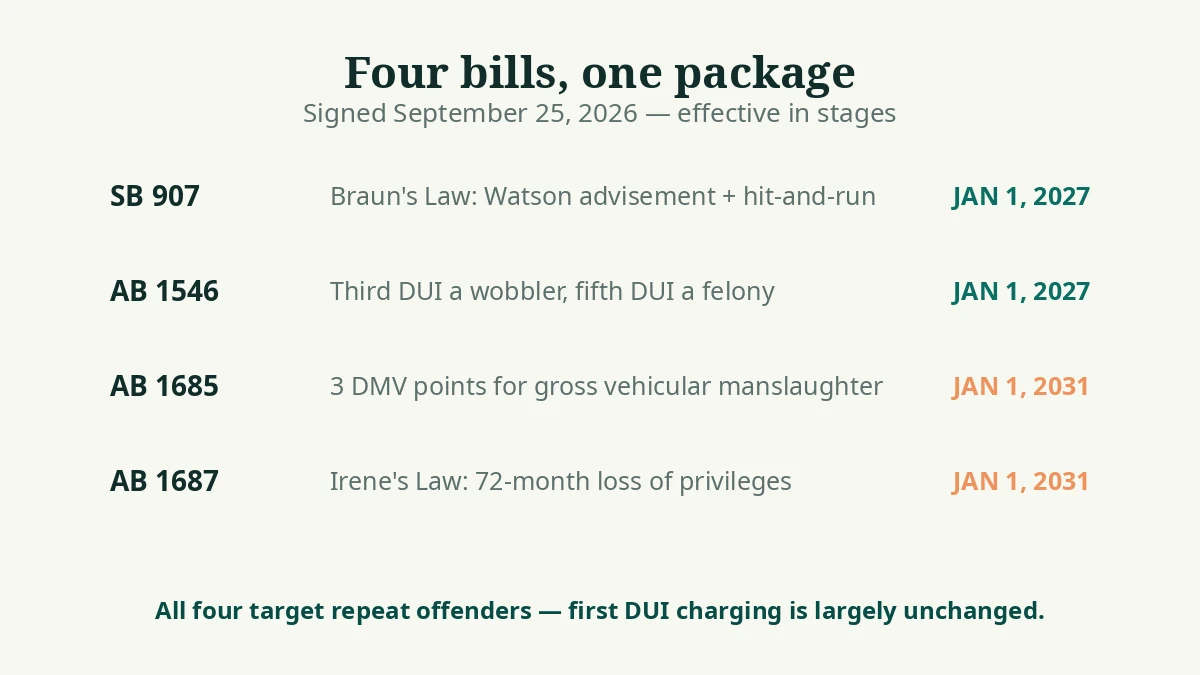
| Bill | What changes | Effective date |
|---|---|---|
| SB 907 — Braun's Law | Watson advisement required when a DUI charge is resolved by a plea to a different or lesser offense; higher hit-and-run penalties with a qualifying prior within 10 years | January 1, 2027 |
| AB 1546 | Third DUI within 10 years becomes a wobbler (felony possible); fifth DUI becomes a straight felony; revocation extended to 5 years and interlock to 48 months at the highest tier | January 1, 2027 |
| AB 1685 | Gross vehicular manslaughter while intoxicated carries 3 DMV points; DMV keeps the conviction record available for 10 years | Operative January 1, 2031 |
| AB 1687 — Irene's Law | 72-month loss of driving privileges for a DUI causing bodily injury with four or more priors within 10 years; restricted license possible after 12 months with a 72-month interlock | Operative January 1, 2031 |
Not legal advice: this article summarizes the chaptered bill texts published by the California Legislature for education. It does not describe any individual's case. If you face a DUI charge or a probation issue, a California DUI attorney is the right source for advice about your situation.
SB 907 and Braun's Law: the Watson advisement loophole closes
SB 907, by Senator Bob Archuleta, does two things in its final chaptered form. It amends Vehicle Code section 20001 (hit-and-run) and section 23635, which the bill designates as Braun's Law, named for Braun Levi, an 18-year-old Loyola High School student killed in May 2025 in Manhattan Beach by a suspected repeat drunk driver.
The Braun's Law provision is about a warning. Under existing law, a person convicted of DUI receives the Watson advisement from Vehicle Code section 23593: the court formally advises them that driving under the influence is extremely dangerous to human life, and that if they drive impaired again and kill someone, they can be charged with murder. That advisement matters because it proves the driver knew the risk — a key element of a later Watson murder prosecution. But the advisement attached to a DUI conviction. A defendant who pleaded guilty to a different or lesser offense in place of the DUI charge could leave court without ever receiving it. New section 23635(d) closes that gap: if a defendant pleads guilty or no contest to a different or lesser offense as a substitute for an alleged violation of section 23152, the court shall give the section 23593 advisement.
The second half of SB 907 raises hit-and-run penalties for drivers with a recent record. Leaving the scene of an injury accident within 10 years of a conviction for a wet reckless, a DUI, a DUI causing injury, or an intoxicated manslaughter offense becomes punishable by two, three, or four years in state prison. Where the accident causes death or permanent, serious injury and the same prior exists, the range rises to three, four, or five years.
AB 1546: the repeat-offender ladder steepens
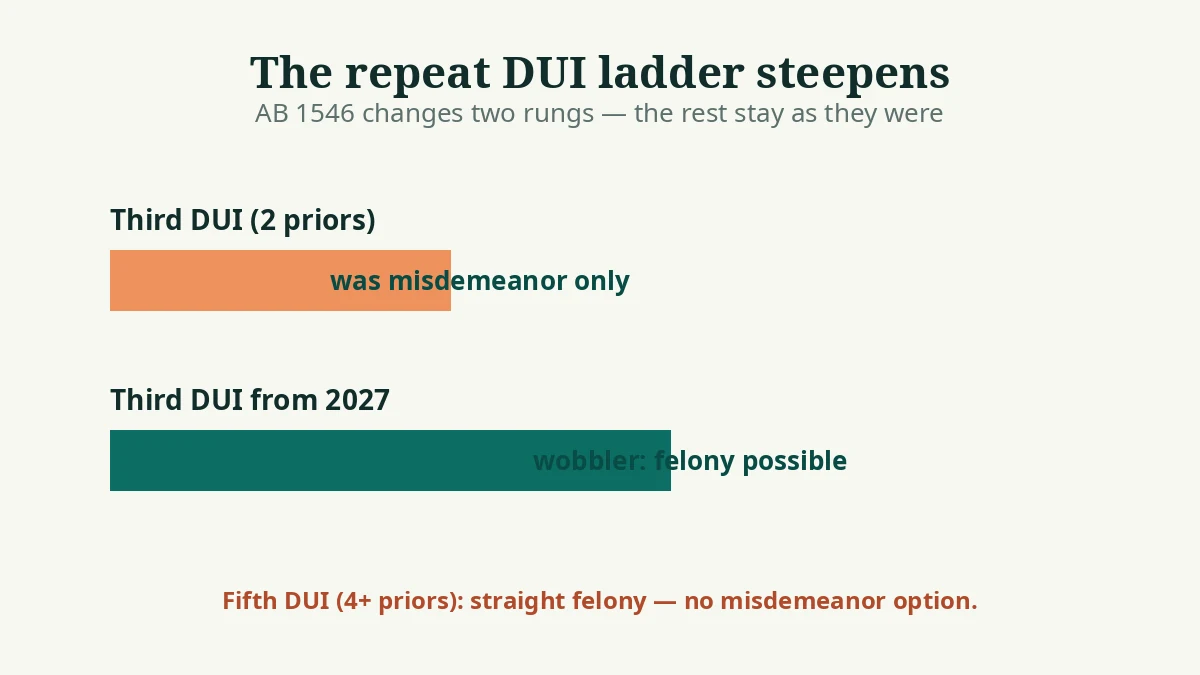
AB 1546, by Assemblymember Nick Schultz, changes two rungs of California's existing DUI ladder, and its own legislative analysis is explicit about what it does not change: sanctions for a first DUI, a DUI with one prior, and a DUI with three priors stay as they are.
The first change concerns a DUI committed within 10 years of two prior qualifying convictions — in plain terms, a third DUI. That offense was a misdemeanor, punishable by 120 days to one year in county jail. From January 1, 2027 it is a wobbler: it can still be handled as a misdemeanor on those same jail terms, or it can be charged and punished as a felony with 16 months, two years, or three years in county jail, plus a fine. Prosecutors gain a felony option one offense earlier than before.
The second change concerns a DUI committed within 10 years of four or more priors — a fifth DUI. That offense was a wobbler; from 2027 it is a straight felony, with the misdemeanor option removed. The legislative analyses also record the licensing consequences at that tier: the revocation period extends from four years to five years, and the mandatory ignition interlock device term extends from 36 months to 48 months, while a three-prior conviction carries a 36-month interlock term. One date worth knowing for context: the underlying ignition interlock framework in existing law currently runs until January 1, 2033, when the Legislature would need to extend it again.
AB 1685 and AB 1687: signed now, operative in 2031
The second half of the package is real law with a future start date, and honest reporting has to say so plainly. Both bills state their operative date in their own text: January 1, 2031.
AB 1685, by Assemblymember Tom Lackey, works on the DMV record. A conviction for gross vehicular manslaughter while intoxicated, under Penal Code section 191.5(a), will carry three points on the driver's record — the first three-point offense for non-commercial drivers — and the DMV must keep that conviction available for 10 years. Points accumulate toward negligent-operator action, so the most serious intoxicated driving offense stays visible to courts and law enforcement for a decade.
AB 1687, also by Assemblymember Lackey, is Irene's Law. It adds Vehicle Code section 13352.7, which applies to a narrow, serious category: a conviction for DUI causing bodily injury where the offense occurred within 10 years of four or more separate qualifying violations. For that driver, the privilege to drive is lost for 72 months. Reinstatement requires proof of financial responsibility and completion of a 30-month DUI program, or an 18-month program where a 30-month program is not available in the county. After 12 months the person may apply for a restricted license, but only on conditions that include maintaining a certified ignition interlock device for the full 72-month term.
Who is affected — and who is not
If you have never had a DUI, almost nothing in this package changes the charge you would face for a first offense, and the same is true for a second offense. The bills are aimed further up the ladder: people with two or more priors within 10 years, people who resolve a DUI charge by pleading to something else, people who flee an injury crash with a DUI record, and the small group whose injury DUI comes after four or more priors. Priors are counted within a 10-year window, and qualifying priors include wet reckless pleas under section 23103.5 as well as DUI and DUI-causing-injury convictions — which is one reason the Braun's Law advisement matters: a "lesser" plea still sits inside the system that counts priors.
Timing also decides who is affected. Penalties generally follow the law in force when the offense occurs, so the 2027 changes govern new offenses from that date, and the 2031 provisions govern later cases. The December enforcement season preceding the change is its own risk period: the holiday-party testing season produces arrests the new ladder will then process. None of this is retroactive for a case already resolved.
What this means for alcohol testing and monitoring
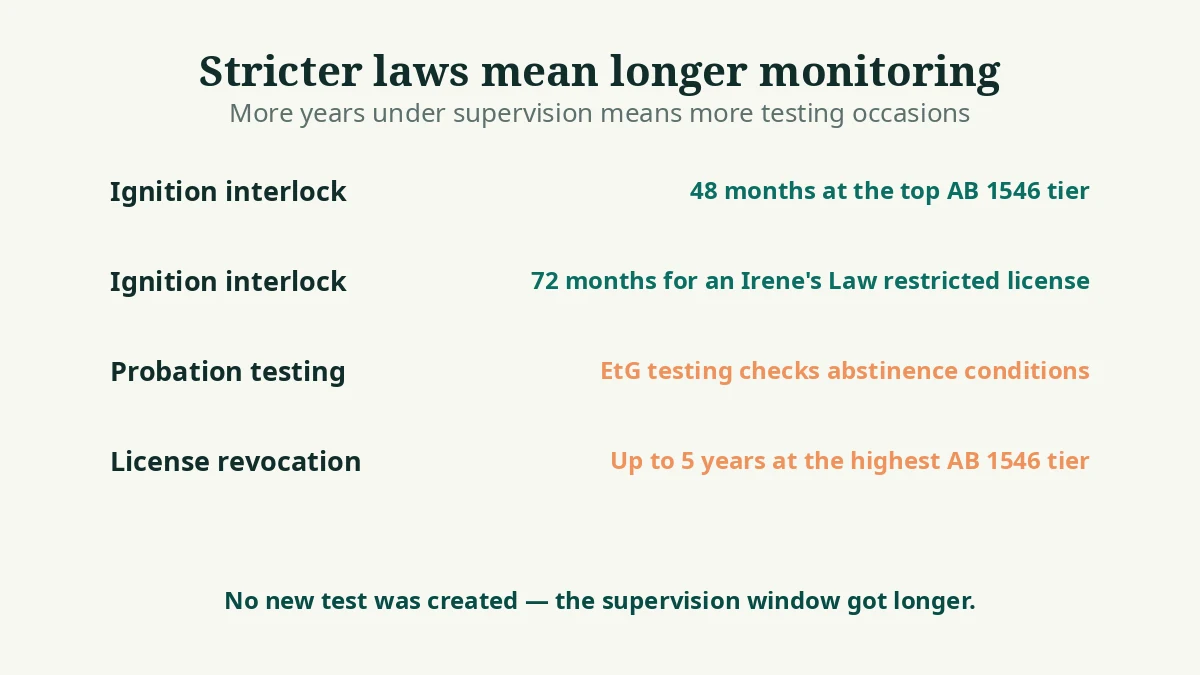
None of the four bills creates a new alcohol test, sets an EtG cutoff, or orders a single additional urine test. The testing effect is indirect but real, and it runs through supervision. Felony exposure, longer revocations, and longer interlock terms all mean repeat offenders spend more time under conditions a court or program actively monitors — and in California, abstinence conditions for DUI probation and DUI programs are commonly checked with alcohol testing, including urine EtG testing that can detect drinking for up to roughly 80 hours. Our state guide explains how EtG testing works in California programs, including probation, DUI programs, and drug courts.
Two features sharpen that effect. First, an ignition interlock is itself a testing device: a 48-month term under AB 1546, or 72 months on a restricted license under Irene's Law, means years of breath tests before the car starts, with violations reported. Second, the longer the supervision window, the more one drinking episode matters. Someone in a multi-year program who drinks on a Friday can face a Monday test — the situation our guide to EtG tests and DUI cases walks through. To estimate your own window, the EtG timeline calculator shows how it stretches with drink count, and the EtG calculator models the range for your cutoff. These are educational estimates, not predictions.
If you are on DUI probation in California now
Your existing case does not change. The sentence, probation terms, program enrollment, and any interlock order you already have remain exactly what your court imposed; the 2027 laws do not reopen them. What changes is the arithmetic of a new offense. A further DUI now carries felony exposure a step earlier, a plea bargain no longer avoids the Watson advisement and the record it creates, and a hit-and-run with your record carries prison ranges that did not exist before.
The practical reading is unglamorous: treat every condition as live for its full term. Attend the program, keep the interlock maintained, and assume any drinking during supervision can be detected and reported, by an interlock, a scheduled test, or a random one. If a violation is alleged, your last drink's timeline and the test type become central facts — a conversation for your attorney and program, not a calculator. This article explains the landscape; it cannot advise you.
Frequently asked questions
When do California's new DUI laws take effect?+
The main changes take effect January 1, 2027: Braun's Law (SB 907) and the AB 1546 repeat-offender penalty changes. Two parts of the package wait longer. AB 1685 (three DMV points for gross vehicular manslaughter while intoxicated) and AB 1687, Irene's Law (a 72-month loss of driving privileges for a DUI causing injury with four or more priors), both become operative January 1, 2031.
What is Braun's Law (SB 907)?+
Braun's Law is Vehicle Code section 23635, added by SB 907 and named for Braun Levi, an 18-year-old killed by a suspected repeat drunk driver in 2025. From January 1, 2027, a court must give the Watson advisement — the formal warning that impaired driving is extremely dangerous and that a future DUI killing someone may be charged as murder — even when a defendant pleads guilty or no contest to a different or lesser offense instead of the DUI charge. SB 907 also raises hit-and-run penalties for drivers with a qualifying DUI-related conviction in the previous 10 years.
Does AB 1546 change penalties for a first or second DUI?+
No. AB 1546 leaves first-offense DUI sanctions and DUI with one prior unchanged, and it also leaves the three-prior tier as it was. It changes two rungs of the ladder: a DUI with two priors within 10 years (a third DUI) becomes a wobbler that can be charged as a felony, and a DUI with four or more priors within 10 years (a fifth DUI) becomes a straight felony. For the four-or-more-priors category it also extends license revocation from four to five years and the ignition interlock term from 36 to 48 months.
What is a Watson advisement?+
The Watson advisement is the warning in Vehicle Code section 23593, named after People v. Watson (1981). A court tells the person that driving under the influence is extremely dangerous to human life and that if they drive impaired again and kill someone, they can be charged with murder. Until now the advisement was tied to a DUI conviction itself, so pleading to a lesser or different offense could avoid it. Braun's Law closes that gap for substitute pleas from January 1, 2027.
What does Irene's Law (AB 1687) do, and why does it start in 2031?+
Irene's Law adds Vehicle Code section 13352.7. From January 1, 2031, a person convicted of DUI causing bodily injury who has four or more qualifying prior convictions within 10 years loses driving privileges for 72 months. A restricted license may be possible after 12 months, but only with a certified ignition interlock device maintained for the full 72 months, plus program completion and proof of financial responsibility. The delayed start is written into the law itself, in section 13352.7(d).
Will the new laws mean more alcohol testing for repeat offenders?+
Very likely in practice, though the bills do not create a new EtG testing program. Longer license revocations, longer ignition interlock terms, and felony exposure for repeat offenses all come with longer and closer supervision, and California DUI probation and DUI programs already use alcohol testing, including urine EtG testing, to check abstinence conditions. More repeat offenders spending longer under supervision means more testing occasions, not a new test.
I am on DUI probation in California now. Do the new laws change my case?+
The new penalties apply to offenses under the law in force when the offense occurs; they do not rewrite a sentence or probation terms you already have. Your current obligations — abstinence conditions, testing, program attendance, and interlock requirements if ordered — stay exactly as your court and program set them. What changes on January 1, 2027 is the risk attached to a new offense: a further DUI is more likely to be charged as a felony, and a plea to a lesser offense will now come with a Watson advisement. This is general information, not legal advice; an attorney can advise on your specific case.
Evidence and limitations
This article summarizes the chaptered texts of SB 907, AB 1546, AB 1685, and AB 1687 as published by the California Legislature, together with published guidance on alcohol biomarker testing. Statutes are applied by courts to individual facts, and this article is educational only — it is not legal or medical advice.
- SB 907 (Archuleta), Chapter 443, Statutes of 2026 — Braun’s Law: Vehicle Code sections 20001 and 23635
- AB 1546 (Schultz), Chapter 444, Statutes of 2026 — repeat DUI penalties, revocation, and ignition interlock
- AB 1685 (Lackey), Chapter 445, Statutes of 2026 — DMV points for gross vehicular manslaughter while intoxicated (operative January 1, 2031)
- AB 1687 (Lackey), Chapter 446, Statutes of 2026 — Irene’s Law: Vehicle Code section 13352.7 (operative January 1, 2031)
- SAMHSA Advisory: The Role of Biomarkers in the Treatment of Alcohol Use Disorders (2006, revised 2012)