EtG test after Thanksgiving: the short answer
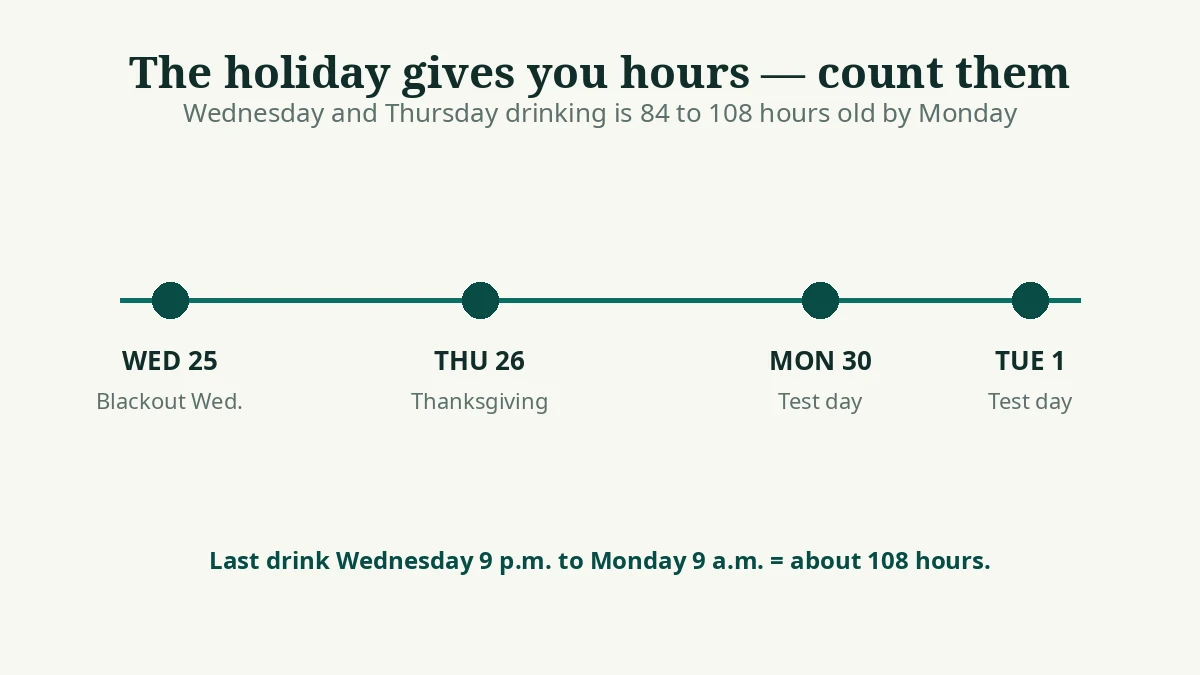
An EtG test after Thanksgiving usually comes down to one piece of arithmetic: how many hours sit between your last drink and the test. Thanksgiving week drinking happens on Wednesday evening, November 25, 2026 — the night out with friends home for the holiday, often called Blackout Wednesday — and again at Thanksgiving dinner on Thursday, November 26. Probation and program tests, though, rarely run on the holiday weekend itself. The test that worries people is the one scheduled for Monday, November 30, or Tuesday, December 1.
That gap works in your favor. If your last drink was Wednesday night, roughly 108 hours have passed by Monday at 9 a.m. If your last drink was with Thanksgiving dinner on Thursday, roughly 84 to 90 hours have passed. For light to moderate drinking — a few drinks at dinner, a couple of beers on Wednesday — the modeled window closes well before Monday at every common cutoff, including 100 ng/mL.
The honest exception is dose. EtG windows stretch with drink count, and a heavy holiday session can produce a window at 100 ng/mL that reaches past 100 hours — close enough to a Monday test to be genuinely uncertain. And none of this applies if you drank again on Friday or Saturday: that drinking is far more recent, and it resets the clock completely. The sections below work through each case with the same model our calculator uses, so you can run your own scenario in the calculator with your own numbers afterwards.
Count the hours first: Wednesday and Thursday to Monday
Before drink counts and cutoffs, fix the timeline. EtG (ethyl glucuronide) is a urine metabolite of alcohol, and its detection window runs from your last drink, not your first. So the only hours that matter are the hours between the last sip and the moment you give the sample.
| Last drink | Test: Monday Nov 30, 9 a.m. | Test: Tuesday Dec 1, 9 a.m. |
|---|---|---|
| Wednesday Nov 25, 9 p.m. (Blackout Wednesday) | About 108 hours | About 132 hours |
| Thursday Nov 26, 7 p.m. (Thanksgiving dinner) | About 86 hours | About 110 hours |
| Friday Nov 27, 9 p.m. | About 60 hours | About 84 hours |
| Saturday Nov 28, 9 p.m. | About 36 hours | About 60 hours |
Read the table the way a lab result will be read: a test can only be positive if the detection window for your dose and cutoff is still open at the test hour. Wednesday drinking tested on Tuesday is 132 hours old — beyond even the longest modeled window below. At 108 hours on Monday, it is beyond every window except the heaviest drinking at the strictest cutoff. Thursday dinner drinking, at about 86 hours on Monday, sits in the same position. The fear that any holiday drinking automatically fails a holiday drinking probation test the next week overstates the risk for Wednesday and Thursday — the long weekend gives you a lot of time, and time is the main variable.
Detection windows by drinks and cutoff: the holiday table
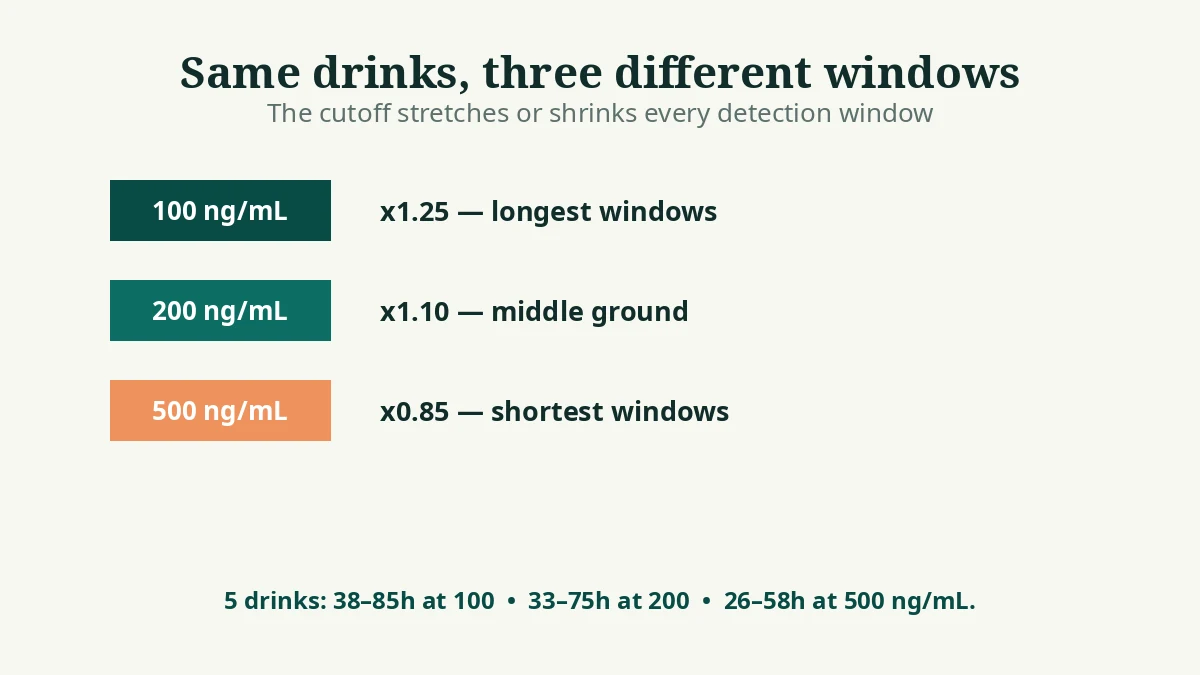
How long does EtG last after holiday drinking? It depends on two things: how much you drank, and the cutoff your program uses. The table below uses the exact model behind this site's calculator. Each drink count has a base detection window; the cutoff then stretches or shrinks it — multiplied by 1.25 at 100 ng/mL, by 1.1 at 200 ng/mL, and by 0.85 at 500 ng/mL. Windows are hours after the last drink.
| Drinks in the session | 100 ng/mL | 200 ng/mL | 500 ng/mL |
|---|---|---|---|
| Up to 2 drinks | 23–53 hours | 20–46 hours | 15–36 hours |
| Up to 4 drinks (for example, 3 drinks) | 30–68 hours | 26–59 hours | 20–46 hours |
| Up to 7 drinks (for example, 5 drinks) | 38–85 hours | 33–75 hours | 26–58 hours |
| Up to 12 drinks | 50–105 hours | 44–92 hours | 34–71 hours |
| More than 12 drinks | 65–130 hours | 57–114 hours | 44–88 hours |
Now hold the table up against the timeline. Thursday dinner at 86 hours before a Monday test: up to 7 drinks is outside every window in the table, including 38 to 85 hours at 100 ng/mL — though 85 against 86 is close, and real bodies vary around any model. Up to 12 drinks at 100 ng/mL runs to 105 hours, which covers the Monday test. More than 12 drinks at 100 ng/mL runs to 130 hours, covering Monday and reaching toward Tuesday.
At 500 ng/mL, even the heaviest row tops out at 88 hours, so Thursday drinking is at or past the edge by Monday and Wednesday drinking is past it entirely. The realistic risk zone for a Monday test is narrow and specific: heavy drinking, tested early Monday, at a 100 ng/mL cutoff. These are modeled ranges from published research, not measurements of your body, and if you drank on more than one day the window runs from the last drink of the last session. Our EtG timeline calculator lays the same model out hour by hour.
Real-world scenarios: Wednesday night, Thursday dinner, Monday test
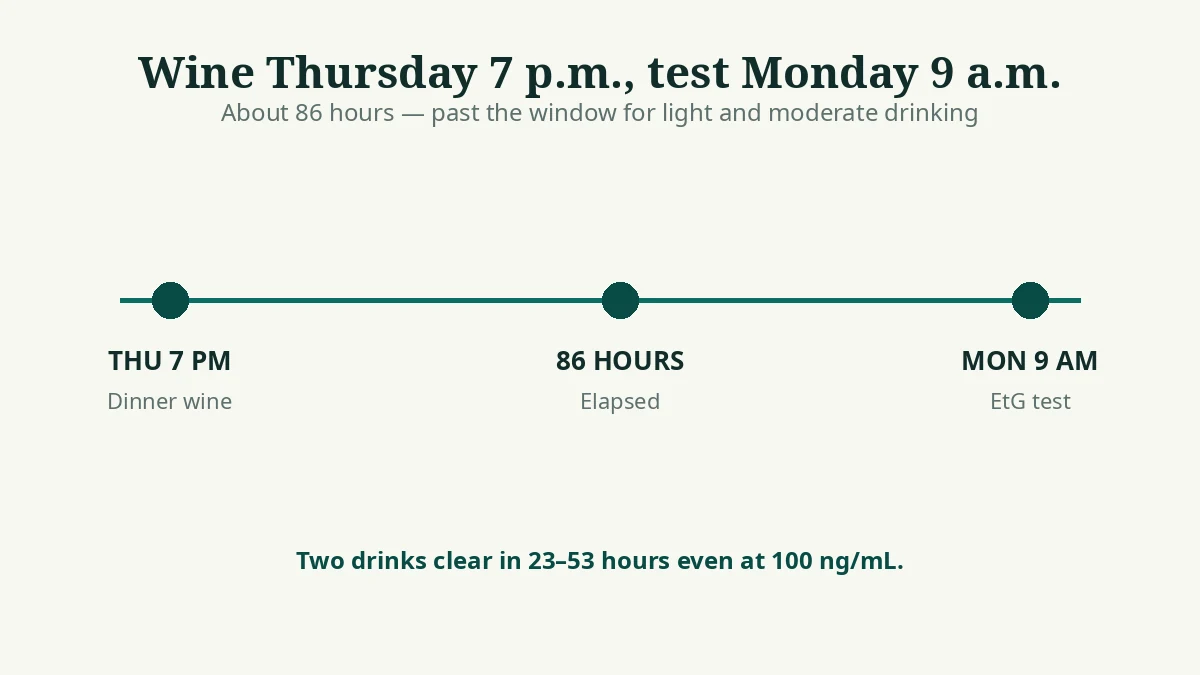
Scenario 1 — wine at Thanksgiving dinner. You have two glasses of wine with Thanksgiving dinner on Thursday, finishing around 7 p.m., and your test is Monday at 9 a.m. That is about 86 hours. Two drinks model to 23 to 53 hours at 100 ng/mL, 20 to 46 hours at 200 ng/mL, and 15 to 36 hours at 500 ng/mL. Every window closed more than a day before the test. EtG after Thanksgiving dinner at this level is the lowest-risk pattern in this article, at any cutoff.
Scenario 2 — a fuller Thanksgiving table. Same dinner, but the evening runs longer: four drinks across the afternoon and meal, last drink Thursday at 9 p.m., test Monday at 9 a.m. — about 84 hours. Four drinks model to 30 to 68 hours at 100 ng/mL and less at higher cutoffs. The window still closes roughly 16 hours before the test at the strictest cutoff.
Scenario 3 — Blackout Wednesday, heavy. Wednesday night out goes big: ten drinks between 8 p.m. and midnight, nothing after. Blackout Wednesday drinking EtG windows are the longest of the holiday because the dose is the largest. Ten drinks fall in the up-to-12 tier: 50 to 105 hours at 100 ng/mL. A Monday 9 a.m. test is about 105 to 108 hours after that last drink — right at the top edge of the range. At 200 ng/mL the window tops out at 92 hours and at 500 ng/mL at 71 hours, both clear of Monday. This is the genuinely borderline case: heaviest tier, strictest cutoff, earliest test. A Tuesday test, at about 132 hours, sits beyond even this window.
Scenario 4 — one more round on Friday. You drank moderately on Thursday, then had three drinks on Friday night, last drink 10 p.m. The Thursday clock no longer matters; the Friday clock does. Monday at 9 a.m. is about 59 hours later, and three drinks at 100 ng/mL model to 30 to 68 hours — the test falls inside the window. Most post-holiday positives happen this way: not the holiday itself, but the smaller later session nobody recalculated. For program testing context, our guide to EtG testing for probation explains how cutoffs and confirmation work.
Why Friday and Saturday drinking is a different story
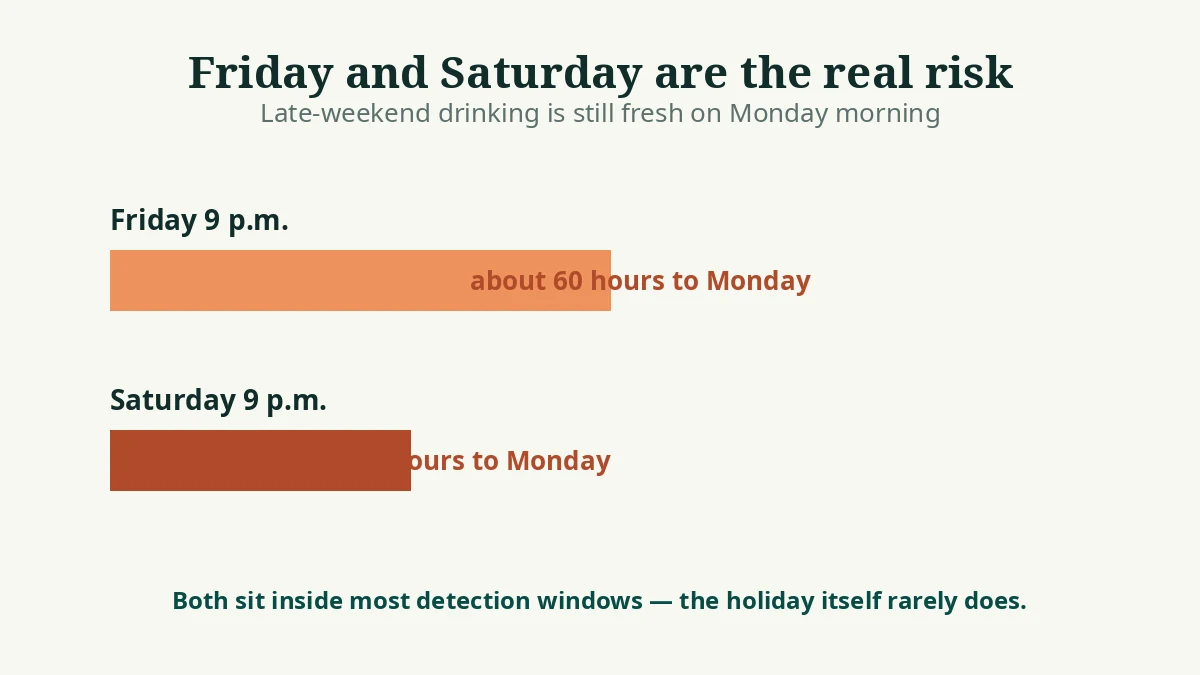
Everything reassuring above depends on the drinking stopping by Thursday night. An EtG test Monday after drinking on Friday or Saturday is a much tighter problem, because the elapsed time collapses: Friday night drinking is about 60 hours old on Monday morning, and Saturday night drinking is only about 36 hours old.
Compare those numbers with the table. At 36 hours, even two drinks at 100 ng/mL (23 to 53 hours) can still be inside the window, and five drinks are inside the window at every cutoff. At 60 hours, five drinks at 100 ng/mL (38 to 85 hours) and at 200 ng/mL (33 to 75 hours) are still open, and heavier sessions are open at all three cutoffs. There is no cutoff at which Saturday drinking is a safe bet for a Monday test.
The practical rule is simple: the holiday itself is rarely the problem, because the calendar gives you four days. The weekend after it is the problem, because it gives you one or two. If a Monday or Tuesday test matters, Friday and Saturday decide it — and no amount of water or exercise reliably shortens an EtG window.
What can still make a Monday result positive
Even with Wednesday or Thursday drinking, a few factors can push a result toward the long end of its range. Dose is the biggest: holiday pours are generous, a "glass of wine" at a family table is often a drink and a half, and undercounting is the most common reason a modeled window looks safer than the real one. When in doubt, run the next row of the table.
Pace and repeat days matter too: drinking steadily into the late evening keeps levels topped up, and back-to-back holiday drinking always dates from the later day's last drink. Finally, the cutoff is often unknown until the result arrives — many programs screen at 100 ng/mL precisely because it catches more. If you do not know your cutoff, plan against 100 ng/mL. For how windows behave in the first two days, see our breakdown of how long EtG stays in urine after 48 hours.
Planning the rest of the holiday season
Thanksgiving is only the first test of the season. December brings office parties, family gatherings, and New Year's Eve, and the same arithmetic applies to all of them: count the hours from the last drink to the test, check the dose against the cutoff, and be honest about the pours. If a December party sits close to a scheduled test, our guide to the EtG test after a holiday party works through that tighter timeline, where the gap is often a day or two rather than four.
And if the holidays have you thinking about a reset rather than a calculation, January is the common moment for it. Our Dry January and EtG testing guide covers what a month without drinking does to test results. Either way, the principle running through the whole season is the one this article started with: EtG rewards elapsed time more than any trick, and the calendar — used honestly — is the most reliable guide you have.
Frequently asked questions
Will Thanksgiving drinking show up on a Monday EtG test?+
Usually not, if the drinking was light to moderate and stopped by Thursday night. By Monday at 9 a.m., Thursday dinner drinking is about 86 hours old and Wednesday night drinking about 108 hours old, which is past the modeled window for up to 7 drinks at every cutoff. Heavy drinking (more than 7 drinks) at a 100 ng/mL cutoff can still be borderline on Monday.
How long does EtG last after holiday drinking?+
It depends on dose and cutoff. Using this site's calculator model: up to 2 drinks clear in about 15 to 53 hours depending on cutoff, up to 4 drinks in 20 to 68 hours, up to 7 drinks in 26 to 85 hours, up to 12 drinks in 34 to 105 hours, and more than 12 drinks in 44 to 130 hours. The shortest numbers are at 500 ng/mL and the longest at 100 ng/mL.
What if I drank on Blackout Wednesday and my test is Monday?+
Wednesday night drinking is about 105 to 108 hours old by a Monday morning test. Moderate Blackout Wednesday drinking (up to 7 drinks) is past the modeled window at all cutoffs. A heavy session of more than 12 drinks at a 100 ng/mL cutoff models to 65 to 130 hours, so a Monday test can still fall inside that range; a Tuesday test, at about 132 hours, sits beyond it.
Is a Tuesday EtG test safer than a Monday test after Thanksgiving?+
Yes, by a full day. A Tuesday test adds about 24 hours to every gap: Thursday dinner drinking is about 110 hours old and Wednesday drinking about 132 hours old. That puts even the heaviest modeled window (more than 12 drinks at 100 ng/mL, up to 130 hours) at or past its edge for Wednesday drinking, though no window is a guarantee for any individual.
What if I drank again on Friday or Saturday after Thanksgiving?+
That drinking matters far more than the holiday itself. Friday night drinking is only about 60 hours old at a Monday test and Saturday night drinking about 36 hours, so both fall inside the modeled window for most drink counts. Five drinks on Friday, for example, model to 38 to 85 hours at 100 ng/mL, which covers a Monday morning test.
Which cutoff matters most for a holiday drinking probation test?+
The 100 ng/mL cutoff, because it produces the longest windows: every drink tier runs 25 percent longer than its base window at 100 ng/mL, compared with 10 percent longer at 200 ng/mL and 15 percent shorter at 500 ng/mL. Many probation programs screen at 100 ng/mL, so if you do not know your cutoff, plan against 100 ng/mL.
Can I clear EtG faster before a Monday test?+
No method reliably shortens the EtG window. EtG clears as the body metabolizes and excretes it over time; heavy water intake dilutes a urine sample but labs check creatinine and dilution, and a dilute sample can itself be flagged by a program. The only factor that consistently helps is elapsed time since the last drink.
Evidence and limitations
This article summarizes published research on ethyl glucuronide detection windows and cutoffs, using the same modeled ranges as this site’s calculator. Group-level findings and modeled ranges cannot predict one person’s result, and this article is educational only — it is not medical or legal advice.
- SAMHSA Advisory: The Role of Biomarkers in the Treatment of Alcohol Use Disorders (2006, revised 2012)
- Dahl et al. (2002) — EtG detectable 22.5–31.5 h after ~0.5 g/kg ethanol, EtG/creatinine ratio unaffected by water diuresis, half-life ~2.5 h
- Goll et al. (2002) — early validation work on urinary EtG detection after alcohol consumption
- McDonell et al. (2015) — EtG immunoassay cutoff sensitivity in alcohol-dependent outpatients (1,589 samples)
- Mackus et al. — EtG pharmacokinetics and detection after controlled alcohol doses
- Jatlow and Hereema — EtG/EtS as markers of recent alcohol use, cutoff and confirmation context