Who uses the 500 ng/mL cutoff?
500 ng/mL is the default EtG cutoff for most American workplace and general screening programs. SAMHSA's advisory on alcohol biomarker testing points programs toward this level, and employer testing programs, employee assistance programs, many treatment-monitoring programs, and family courts in numerous jurisdictions have standardized on it.
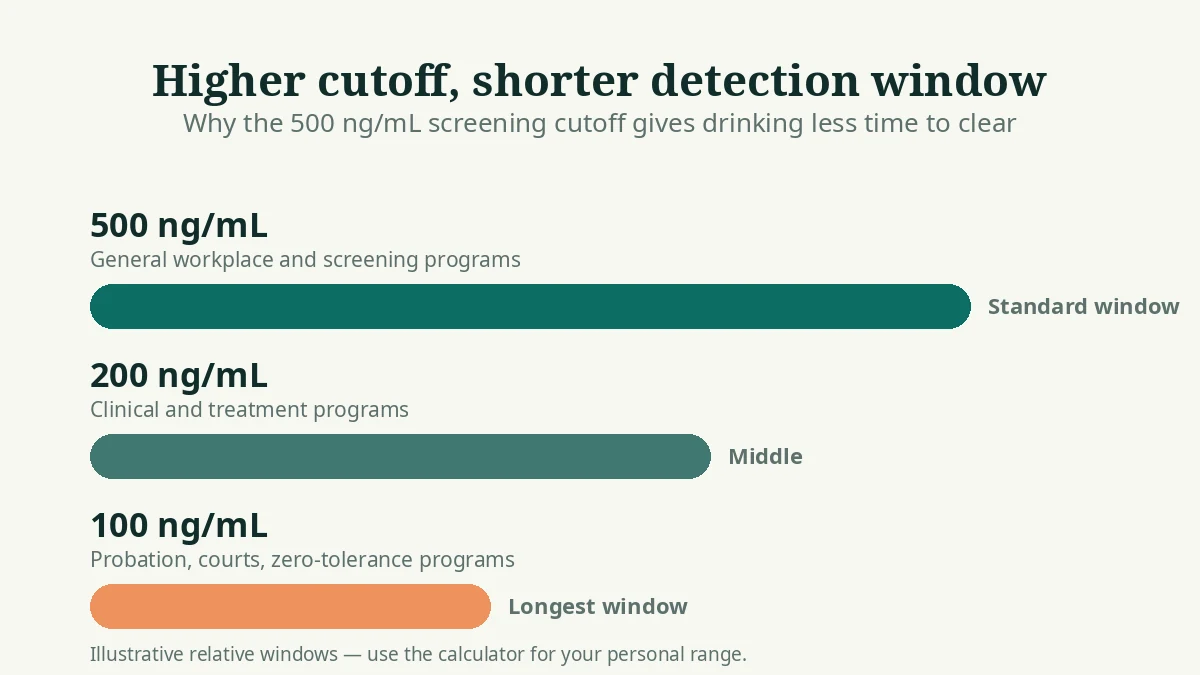
The reason is balance. At 500 ng/mL, a test reliably catches meaningful drinking inside its window while ignoring the trace-level exposures — a splash of mouthwash, a shift of hand sanitizer — that can trigger positives at 100 ng/mL. That balance is exactly what a workplace program wants: few enough false alarms to run at scale, enough sensitivity to catch real use.
It is not universal. Probation departments, courts, and zero-tolerance monitoring programs frequently test at 100 ng/mL precisely because they want the longer window and the lower tolerance for any drinking. If you are being tested by a program like that, use our 100 ng/mL calculator instead — the window it reports will be meaningfully longer.
How to read your result
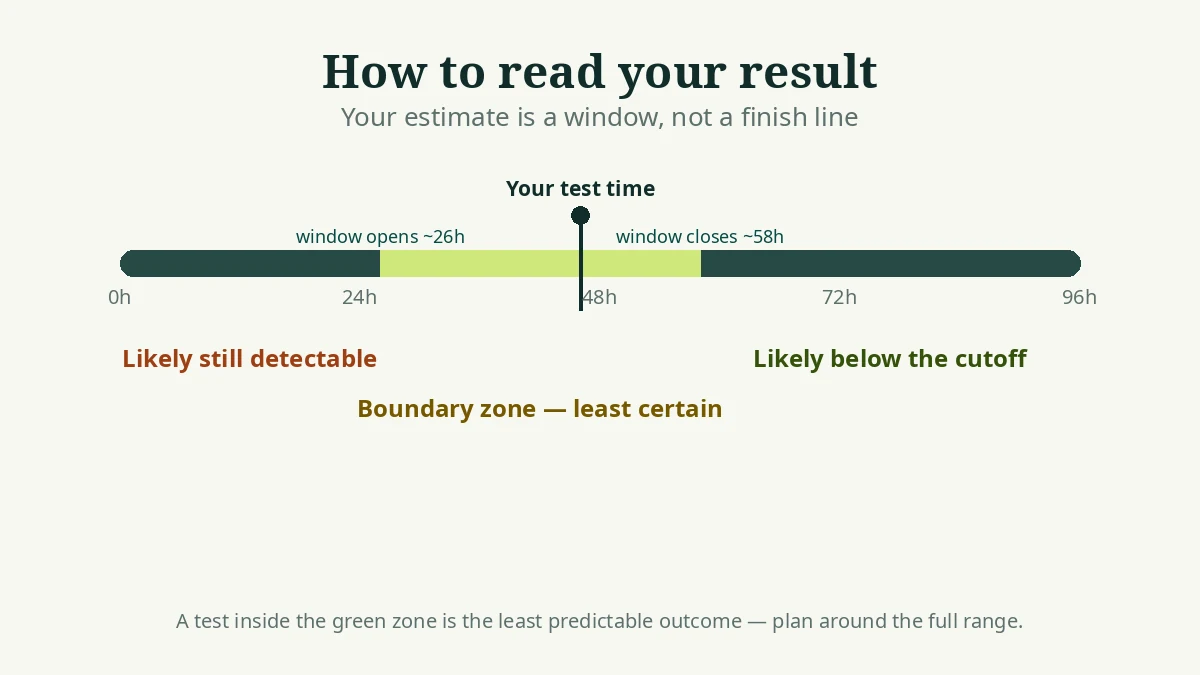
Enter what you drank and when, and the calculator returns a modeled detection window — for example, 26–58 hours. Read it the way the research supports: before the window opens, EtG from that drinking is most likely still detectable; after the window closes, it is most likely below 500 ng/mL. Between the two edges is the boundary zone, where individual biology decides and no honest calculator can promise an outcome.
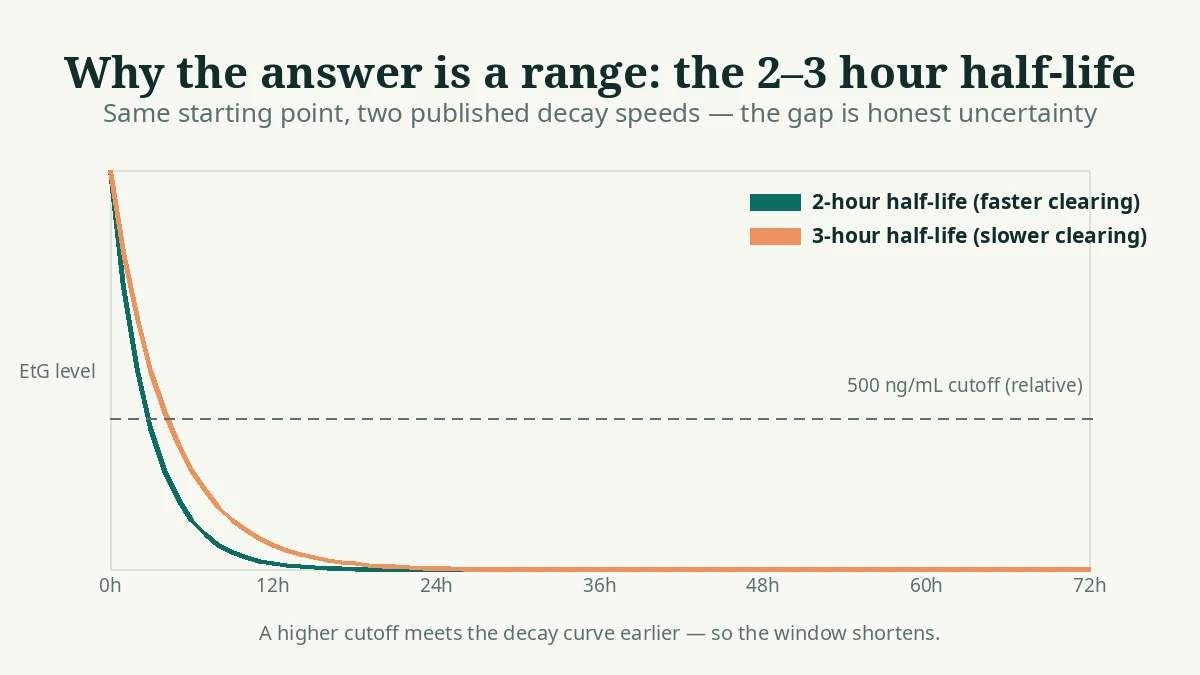
The width of the window is not padding — it is the published science. EtG's elimination half-life is reported across studies at roughly 2 to 3 hours, and the calculator runs both published speeds, then adjusts for how much you drank, whether the drinking repeated over days, and how long the session ran. Below the result you will see the same estimate recomputed at 100 and 200 ng/mL, so you can see exactly how the cutoff changes the answer.
A 500 ng/mL scenario: Saturday wedding, test Wednesday morning
Take a common workplace situation: five standard drinks at a Saturday wedding, last drink around midnight, and a random urine screen Wednesday at 9 a.m. — about 81 hours later. The calculator models five drinks at 500 ng/mL as roughly a 26–58 hour window.
At 81 hours, the test falls beyond the upper edge of the modeled window — which is reassuring but not a promise. A slower-than-average metabolism, concentrated morning urine, or drinking that spilled into Sunday would all push the real window longer. This is the honest way to use the tool: the range tells you where the uncertainty sits, and you plan around the full range, not the friendlier edge.
Why no calculator can promise you will pass
Five variables sit between any estimate and your actual result: urine concentration (dilution), kidney function, the test method (immunoassay screening vs. LC-MS/MS confirmation), incidental ethanol exposure, and your individual metabolism. No web form can measure those, which is why no honest calculator reports pass or fail.
Be skeptical of calculators that output a single hour — "you will test clean at 47 hours." That number is an artifact of their chosen constants, not a measurement of you. Competitors publish fixed ng/mL-per-drink figures presented as fact; the published literature supports ranges, and our methodology page shows exactly how this calculator builds them.
100 vs 200 vs 500 ng/mL at a glance
| Cutoff | Typical users | Detection window | Incidental exposure risk |
|---|---|---|---|
| 100 ng/mL | Probation, courts, zero-tolerance programs | Longest — catches light and older drinking | Highest — trace exposure can register |
| 200 ng/mL | Clinical and treatment programs | Middle | Moderate |
| 500 ng/mL | Workplace, general screening, treatment monitoring | Shortest of the three — focused on meaningful use | Lowest — incidental exposure rarely matters |
Frequently asked questions
How long does alcohol stay detectable on a 500 ng/mL EtG test?
It depends on how much was consumed. Published research reports detection up to about 80 hours after heavy use at sensitive cutoffs, and the window shortens at 500 ng/mL: one or two drinks typically fall below 500 ng/mL within a day, while heavier drinking can remain detectable for two to three days. Enter your own numbers in the calculator above for an honest range.
Will one or two drinks show up on a 500 ng/mL EtG test?
Usually not beyond the first 12 to 24 hours. One or two standard drinks generally produce EtG levels that fall below the 500 ng/mL threshold quickly, though heavy incidental exposure or an unusually slow metabolism can change that. This cutoff is specifically chosen to ignore trace-level exposure.
Is 500 ng/mL a standard cutoff for EtG?
Yes. 500 ng/mL is the most widely used EtG cutoff in the United States. SAMHSA's advisory on alcohol biomarker testing points screening programs toward this level, and most workplace, treatment-monitoring, and general screening programs follow it. Stricter programs (probation, courts, zero-tolerance monitoring) often test at 100 ng/mL instead.
Can hand sanitizer or mouthwash cause a positive at 500 ng/mL?
It is very unlikely. Studies of incidental ethanol exposure (hand sanitizer, mouthwash, some foods and medicines) have produced positive results mainly at the 100 ng/mL level. At 500 ng/mL, documented false positives from incidental exposure are rare. Read our hand sanitizer analysis for the research details.
Why does this calculator give a range instead of one number?
Because the published science gives a range. EtG's elimination half-life is reported as roughly 2 to 3 hours across studies, and individual metabolism, urine dilution, kidney function, and test method all shift real results. A calculator that outputs one fixed hour is manufacturing precision the research does not support.
How accurate is an EtG test at 500 ng/mL?
At 500 ng/mL, EtG testing is highly sensitive to real drinking within the window and has fewer false positives from incidental exposure than lower cutoffs. The trade-off is that it misses light or older drinking that a 100 ng/mL test would catch. Accuracy is about the fit between the cutoff and the program's goal, not a single number.
Evidence and limitations
This page summarizes primary research and public-health guidance. Group-level findings cannot predict one person's result.
Sources: