EtG vs EtS test: the short answer
If you have ever read a lab report that says "EtG/EtS," you have already met both metabolites. EtG vs EtS test questions usually come from people who see the second abbreviation and wonder whether they took the wrong test, or whether EtS is a stricter test they should worry about separately. It is neither. EtG and EtS are two chemical footprints left by the same alcohol, in the same urine, from the same drinking episode.
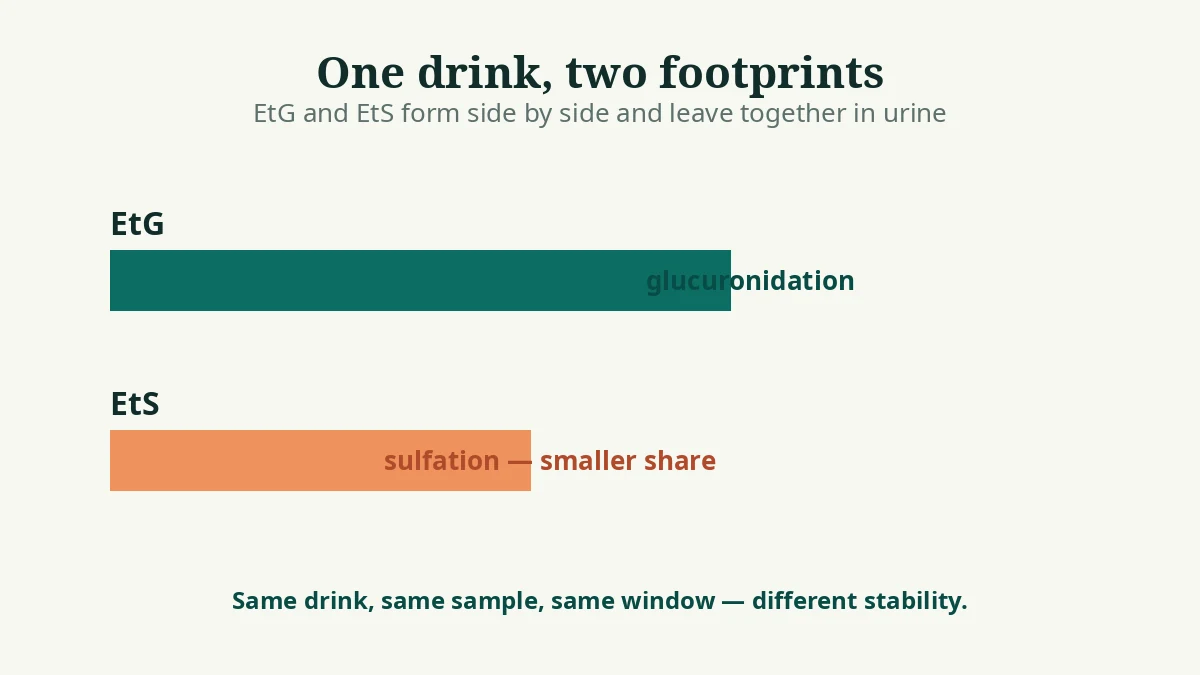
After you drink, your liver processes ethanol through several routes. A small fraction — well under 1% of the dose — is converted into EtG by attaching a glucuronide group, and a still smaller fraction into EtS by attaching a sulfate group. Both are water-soluble, both leave in urine, and both are detectable long after breath and blood alcohol have reached zero.
The difference is in how they behave, not what they detect. EtG is the metabolite screening tests look for; EtS is the partner confirmation labs measure alongside it, because EtS survives conditions that can corrupt an EtG result.
| EtG | EtS | |
|---|---|---|
| Full name | Ethyl glucuronide | Ethyl sulfate |
| Sample | Urine (also blood, hair) | Urine (also blood, hair) |
| How it forms | Glucuronidation in the liver | Sulfation in the liver |
| Share of the dose | Roughly 0.02–0.06% of ethanol | Even smaller, roughly 0.01–0.03% |
| Detection window | Hours to about 80 hours after heavy drinking | Roughly the same window, hours to about 80 hours |
| Screening test | Yes — urine immunoassays screen for EtG | No standalone screen — measured by LC-MS/MS confirmation |
| Key strength | Well studied, widely available, sensitive | Stable in stored urine; resists bacterial breakdown |
| Key weakness | Can degrade in infected urine; can form after collection | Lower concentrations; needs sensitive lab equipment |
What EtG is, and why it became the standard test
EtG earned its position for practical reasons. It was characterized early, it is present in urine at concentrations that screening immunoassays can detect, and decades of studies have mapped how its levels rise and fall after drinking. After a moderate dose, EtG typically becomes detectable within a few hours and peaks roughly 8 to 12 hours after drinking begins. Its own half-life is short — about 2 to 3 hours — but because the body keeps producing it while ethanol is being cleared, the overall detection window stretches to about a day after light drinking and up to about 80 hours after heavy drinking.
That profile made EtG the workhorse of alcohol monitoring. Probation departments, treatment programs, employers, and family courts can order a urine EtG screen, get a result quickly, and interpret it against a program cutoff — usually 100, 200, or 500 ng/mL. At 100 ng/mL the test is sensitive but incidental exposure from mouthwash or hand sanitizer is most likely to matter. At 500 ng/mL it is more specific to real drinking, but light drinking from a day earlier may fall below it. The same sample can therefore be positive at one program and negative at another, with no contradiction involved.
What EtS is, and why labs add it
EtS was identified later than EtG and spent years as a research curiosity. That changed when labs noticed that in samples where EtG behaved strangely, EtS behaved normally. Two problems drive the point home.
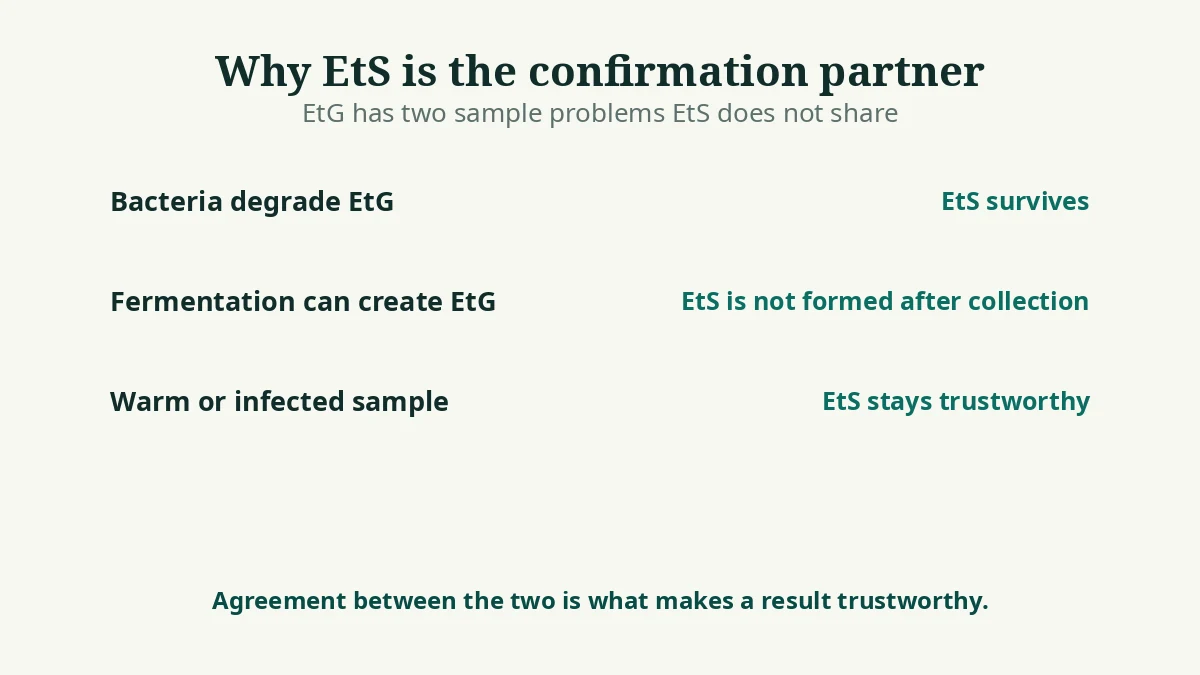
The first problem is bacterial degradation. Urine is not sterile in practice, and bacteria that produce the enzyme beta-glucuronidase — including common urinary tract infection bacteria such as E. coli — can break EtG back down, lowering its concentration in the sample. A sample stored warm, or collected from someone with a urinary tract infection, can therefore show a falsely low or even negative EtG even though the person drank. EtS is not a glucuronide, so that enzyme cannot touch it. In the same degraded sample, EtS remains measurable.
The second problem runs in the opposite direction: EtG can form after collection. If a urine sample contains glucose and yeast or bacteria, fermentation during storage can produce ethanol, which can then be converted into EtG in the sample itself. The result is a positive EtG from a sample that contained no EtG when it was collected. EtS is not formed this way in stored urine, so a sample that is positive for EtG but negative for EtS raises a flag that the EtG may be an artifact, not evidence of drinking.
Those two properties are why confirmation labs report EtG and EtS together. The pair is self-checking: agreement strengthens the result, and disagreement tells the lab to investigate the sample rather than simply report the EtG number.
Detection windows: EtG vs EtS side by side
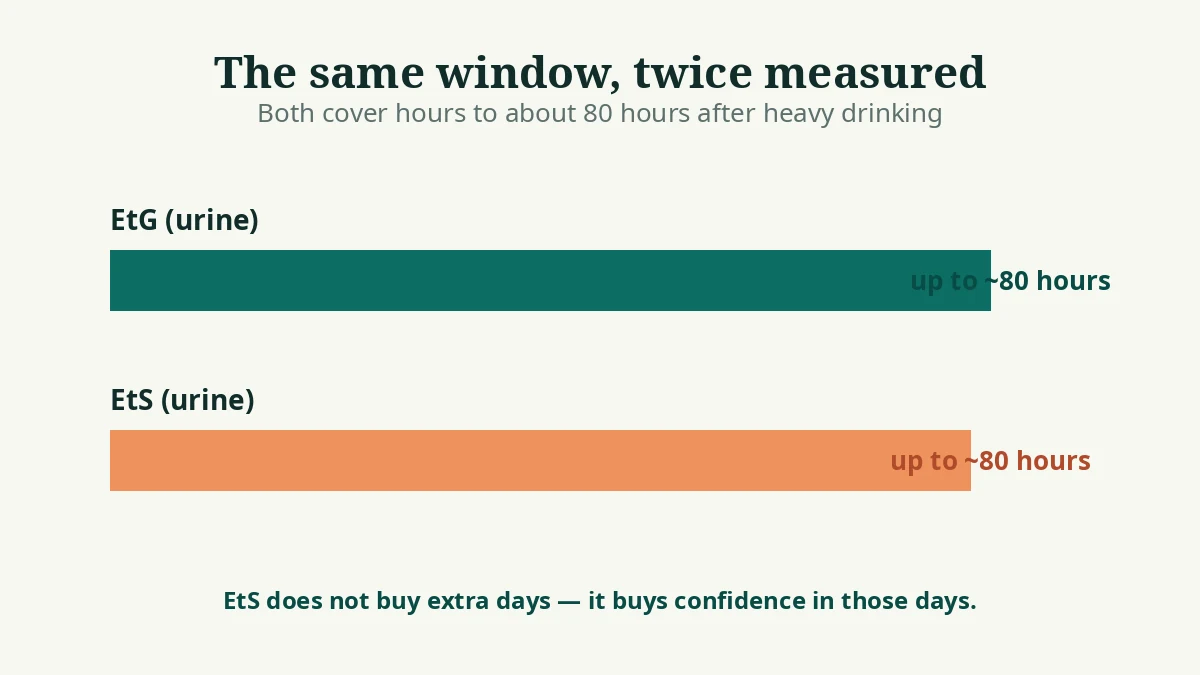
For practical purposes, treat the two windows as the same. Both appear within hours of drinking, and both can remain detectable for up to about 80 hours after heavy drinking. Some studies find EtS clearing slightly earlier or later than EtG in individual samples, but the difference is small and inconsistent — not a reliable gap to plan around.
| Drinking pattern | EtG window | EtS window |
|---|---|---|
| 1–2 drinks, one occasion | Roughly 12–24 hours at 500 ng/mL; up to about 30 hours at 100 ng/mL | Roughly the same, sometimes a few hours shorter |
| 3–4 drinks, one evening | Roughly 24–48 hours depending on cutoff | Roughly the same range |
| Heavy evening (8+ drinks) | Up to about 60–80 hours | Up to about 60–80 hours |
| Repeated heavy drinking | Still about 80 hours after the last drink — the window does not keep growing | Same ceiling: about 80 hours after the last drink |
The last row matters most: EtS is not a longer-window test. If you need weeks rather than days, the test you want is a blood PEth test (roughly 2 to 4 weeks) — a different metabolite in a different sample. EtS extends the reliability of the EtG window; it does not extend the window itself.
How testing actually works: screen first, confirm with both
Most EtG testing happens in two stages. The first stage is a screening immunoassay, a fast, inexpensive test that looks for EtG only. Immunoassays work by antibody binding, which means they can cross-react with similar molecules and produce false positives — one reason a screening positive is never the final word in a serious setting.
The second stage is confirmation by liquid chromatography–tandem mass spectrometry (LC-MS/MS), the laboratory method that identifies molecules by their exact mass and structure. Confirmation testing measures EtG and EtS separately, with much lower detection limits and much higher specificity than a screen. A confirmation result typically reports both numbers, and many laboratories apply separate cutoffs — commonly 100 ng/mL for EtG and 50 or 100 ng/mL for EtS, depending on the laboratory and the program ordering the test.
This two-stage design is also why you cannot usually order "just an EtS test." Labs offer EtG screening and EtG/EtS confirmation as a package: EtS alone would add cost without adding a window, and EtG alone would leave the stability problems unchecked. If your result letter shows only an EtG number, it may be a screening result that was never confirmed — worth asking about if the result is disputed.
Incidental exposure deserves the same paired thinking. Mouthwash, hand sanitizer, and fermented foods can produce small amounts of both EtG and EtS, because both come from real ethanol entering the body. EtS does not rescue a low-cutoff positive caused by mouthwash — both metabolites will be present, just at low levels. What EtS rescues is sample integrity: whether the EtG in the cup is the EtG that was in the body when the sample was given.
Real-world scenarios: when EtS changes the answer
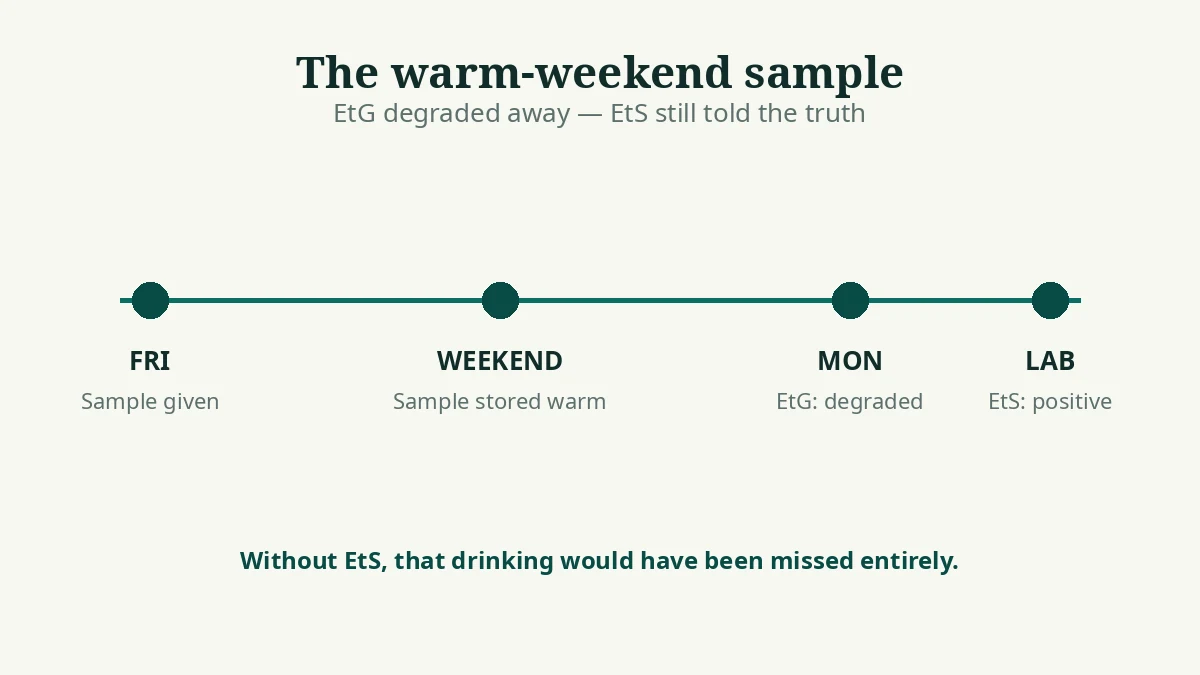
Scenario 1 — the stored sample. A probation sample given on Friday sits unrefrigerated over a hot weekend before reaching the lab. Screening EtG comes back negative, surprising the program. Confirmation finds EtS clearly positive: bacteria degraded the EtG, but EtS survived. Without EtS, the drinking would have been missed.
Scenario 2 — the disputed positive. A person in treatment tests positive for EtG at a low cutoff and insists they did not drink. Confirmation shows EtG positive but EtS negative, and the sample contains glucose with signs of fermentation. The lab flags the EtG as possibly formed after collection, and the program treats the result as inconclusive rather than a violation. That distinction can matter enormously for someone's liberty or employment, and it exists only because EtS was measured.
Scenario 3 — the Monday-morning test. Someone drinks heavily at a Saturday wedding and faces a urine test on Monday morning, about 36 hours later. Both EtG and EtS are positive, and the two numbers agree. That is the normal case: most of the time, the pair simply confirms itself. EtS earns its keep in the minority of samples where something has gone wrong — exactly when accuracy matters most.
Which one matters for your situation
For most people facing a test, the honest answer is that both matter, and you do not get to choose between them. Programs order the pair because the pair is the test. But the emphasis shifts by situation.
If you are on probation or in treatment, EtS matters most when a result is disputed or a sample was stored badly. Ask whether your result was confirmed by LC-MS/MS with both metabolites reported — a screening-only EtG positive, especially at 100 ng/mL, is weaker grounds for a consequence than a confirmed EtG/EtS pair.
If you run a program, the pair is the defensible choice. A policy relying on screening EtG alone invites exactly the two challenges — degraded negatives and fermented positives — that EtS was added to prevent.
If you are estimating your own window, EtG is the number to model, because it is the metabolite your program's cutoff refers to. Use our EtG calculator with your real drink count and cutoff, and read the result as a modeled range, not a prediction. EtS follows roughly the same timeline, so there is no separate EtS window to calculate.
One final caution: neither number is a drink count. An EtG of 900 ng/mL does not prove a binge, and an EtS of 60 ng/mL does not translate into drinks. Both are best read as evidence that drinking happened within the last few days, with confirmation, timing, and the program's cutoff deciding what that means.
Frequently asked questions
Is an EtS test different from an EtG test?+
Not in the way most people expect. EtS (ethyl sulfate) and EtG (ethyl glucuronide) are two metabolites made from the same drink and measured together in the same urine sample. You do not take a separate EtS test; laboratories confirm an EtG screen by measuring both metabolites with LC-MS/MS, because the pair is more reliable than either one alone.
Does EtS stay in urine longer than EtG?+
No, not in any reliable way. Both metabolites cover roughly the same window — up to about 80 hours after heavy drinking. Some studies find EtS clearing slightly earlier or later than EtG in individual samples, but the difference is small and inconsistent. EtS adds reliability to the EtG window; it does not extend it. For a window of weeks, a blood PEth test is the relevant test, not EtS.
Why do labs report EtG and EtS together?+
Because the pair is self-checking. Bacteria in a stored or infected urine sample can break down EtG, causing a false negative, and fermentation in a stored sample can create EtG after collection, causing a false positive. EtS is affected by neither problem, so agreement between the two metabolites strengthens a result and disagreement tells the laboratory to investigate the sample.
Can EtS prove I did not drink?+
A negative EtG/EtS confirmation pair is strong evidence of no drinking in roughly the last few days, but no test proves abstinence beyond its window. A negative result only means neither metabolite was above the laboratory's cutoff at the time of the sample. Drinking that ended more than about 80 hours earlier, or drinking too light to exceed the cutoff, would also produce a negative pair.
Does mouthwash affect EtS the same way it affects EtG?+
Yes, in principle. Mouthwash and hand sanitizer introduce real ethanol into the body, and the liver converts a small fraction of it into both EtG and EtS. EtS does not rescue a low-cutoff positive caused by incidental exposure, because both metabolites will be present at low levels. EtS rescues sample-integrity problems — degradation and post-collection formation — not incidental-exposure positives.
What should I ask for if my EtG result is disputed?+
Ask whether the result was confirmed by LC-MS/MS with both EtG and EtS reported, what cutoffs the laboratory used for each metabolite, and how the sample was stored and transported. A screening-only EtG positive, especially at a 100 ng/mL cutoff, is a weaker basis for a consequence than a confirmed EtG/EtS pair, and a result where EtG and EtS disagree should be treated as inconclusive pending review.
Evidence and limitations
This article summarizes published research on ethyl glucuronide and ethyl sulfate detection windows, stability, and confirmation testing. Group-level findings cannot predict one person’s result, and this article is educational only — it is not medical or legal advice.
- SAMHSA Advisory: The Role of Biomarkers in the Treatment of Alcohol Use Disorders (2006, revised 2012)
- Helander A, Beck O (2005) — Ethyl sulfate: a metabolite of ethanol in humans and a potential biomarker of acute alcohol intake (Journal of Analytical Toxicology 29(5))
- Dahl et al. (2002) — EtG detectable 22.5–31.5 h after ~0.5 g/kg ethanol, EtG/creatinine ratio unaffected by water diuresis, half-life ~2.5 h
- Jatlow et al. — EtG/EtS as markers of recent alcohol use, cutoff and confirmation context
- McDonell et al. (2015) — EtG immunoassay cutoff sensitivity in alcohol-dependent outpatients (1,589 samples)