The short answer: truck drivers live inside the DOT program
An ETG test for truck drivers is a urine test for ethyl glucuronide, a direct metabolite of alcohol, showing whether the driver drank in roughly the past one to three days. For a truck driver, though, the EtG test is only a small piece of a much larger testing regime — federal law, not company policy.
A commercial driver's license puts a driver inside the FMCSA testing program, 49 CFR Part 382. Coverage turns on the vehicle: one rated 26,001 pounds or more, one designed to carry 16 or more passengers, or one of any size that needs hazmat placards. That line puts a tractor-trailer driver squarely inside the federal program, while a driver in a cargo van under 10,001 pounds — the world of delivery drivers — stays outside it. So a truck driver faces two layers at once: the federal DOT program, which breath-tests for alcohol, and the carrier's policy, which is where an EtG test usually comes from.
When an ETG test for truck drivers actually happens
The DOT program has six fixed triggers; a carrier's policy adds its own, and EtG appears in the second list, not the first.
| Circumstance | Who orders it | The test used |
|---|---|---|
| Pre-employment | FMCSA / DOT (382.301) | DOT drug screen + breath test |
| Random selection | FMCSA / DOT (382.305) | DOT drug screen + breath test |
| Post-accident | FMCSA / DOT (382.303) | DOT drug screen + breath test |
| Reasonable suspicion | FMCSA / DOT (382.307) | DOT drug screen + breath test |
| Return-to-duty / follow-up | SAP plan (382.309–311) | DOT tests; EtG often added by the carrier |
| Carrier policy add-on | Carrier's own policy | EtG urine test, cutoff set by the carrier |
The pattern: the federal tests use breath for alcohol, and EtG shows up when the carrier goes beyond the federal minimum — after an accident, during return-to-duty monitoring, or under a company abstinence policy. Owner-operators are not exempt: a one-truck owner-operator is still an employer under Part 382 and must join a consortium — a third-party administrator's random pool — because a one-driver company cannot run its own random draw. A missed random test counts as a refusal, which counts as a positive.
The DOT alcohol test is a breath test, not EtG
This is the most misunderstood fact in truck-driver testing. The DOT alcohol test uses an evidential breath testing device. Part 40, the DOT-wide procedures rule, does not authorize blood, urine, EtG, or any other specimen for DOT alcohol testing — so a truck driver is never EtG-tested by the DOT.
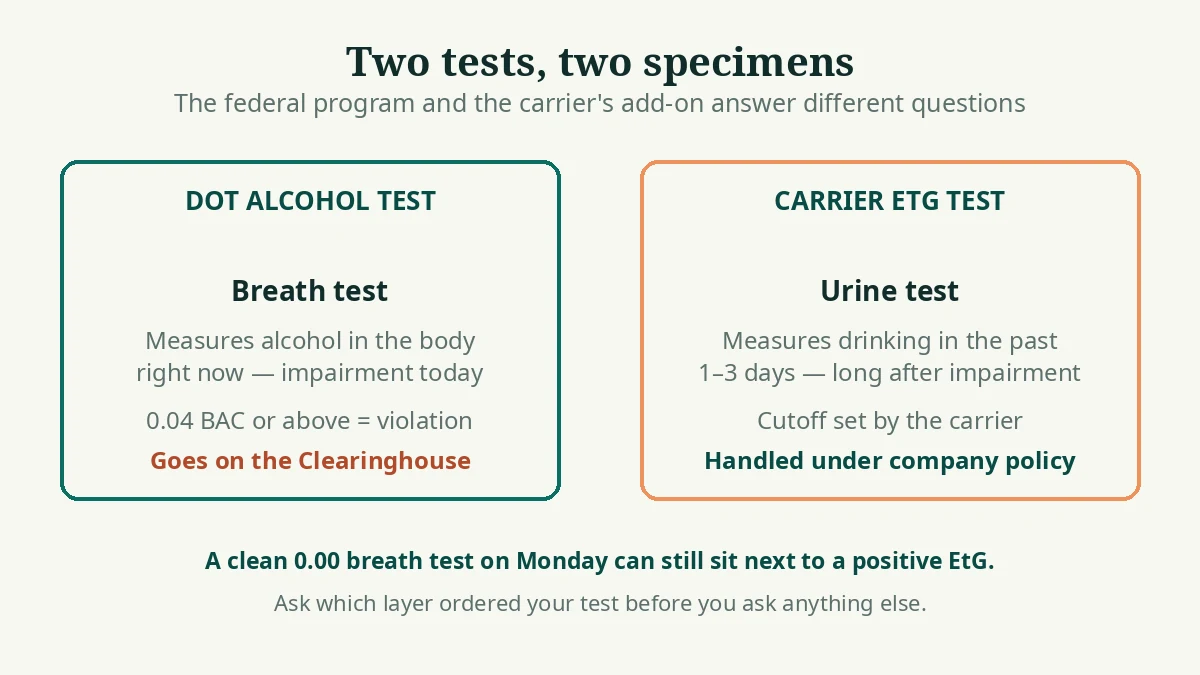
A breath test measures alcohol in the body right now. An EtG test measures whether alcohol was consumed in roughly the past one to three days, long after impairment has passed. A driver can blow a clean 0.00 on a DOT breath test on Monday and still test positive on an EtG test ordered by the carrier the same morning. The consequences differ too: a DOT alcohol violation — 0.04 BAC or above — goes on the FMCSA Clearinghouse record, where it follows the driver for five years and can cost the CDL. An EtG positive under carrier policy is handled under the carrier's rules.
The four-hour rule and the 0.04 line
Two federal rules govern a truck driver's drinking, and both are stricter than the rules for car drivers. First, 49 CFR 392.5 forbids a driver from using alcohol within four hours before going on duty or operating a commercial motor vehicle — and from being on duty with any measured alcohol concentration. Second, 49 CFR 382.201 forbids a driver from reporting for or remaining on duty with an alcohol concentration of 0.04 or greater — half the 0.08 limit for regular drivers.
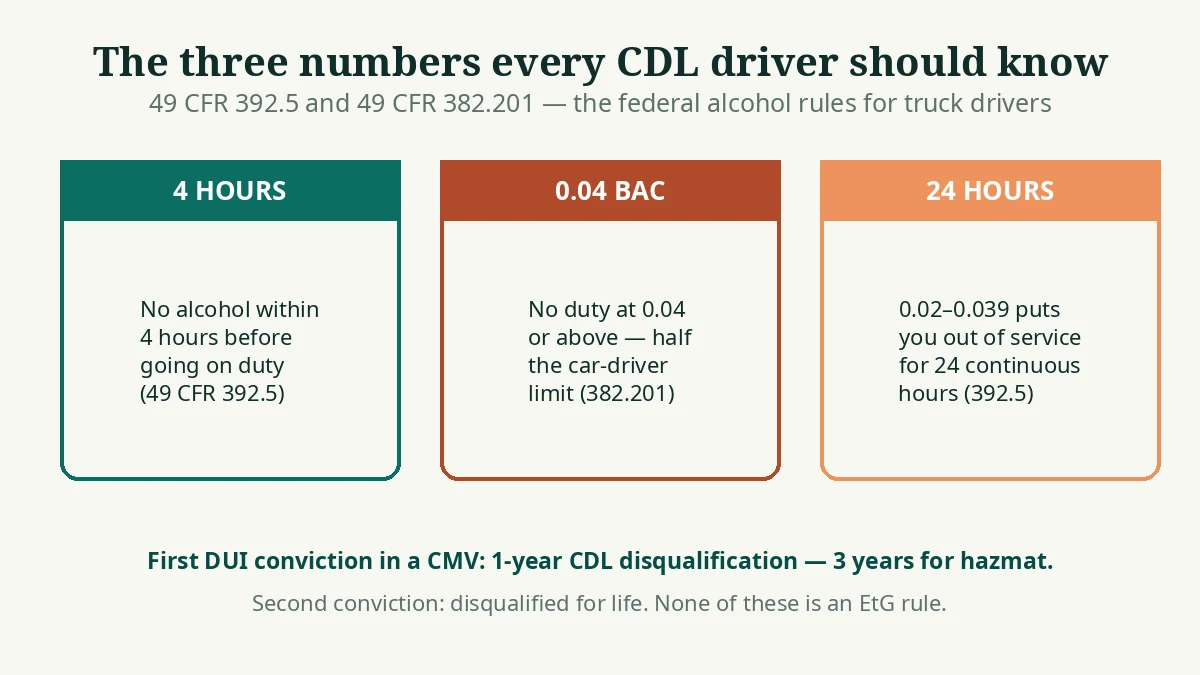
A third number drivers often miss sits between those two lines: a result between 0.02 and 0.039 is below the positive threshold, but it still puts the driver out of service for 24 continuous hours. A first conviction for driving a commercial vehicle under the influence — or at 0.04 or above — disqualifies the CDL for one year, three for hazmat; a second conviction disqualifies it for life. None of these is an EtG rule: a driver who drank on Saturday and reports for duty on Monday with zero alcohol in the blood has broken no federal alcohol rule, but can still fail a carrier-ordered EtG test, because EtG looks back days, not hours. The same rules make sleeper-berth drinking risky: no federal rule explicitly bans a drink during a genuine off-duty rest in the sleeper, but the four-hour rule, the possession ban, and most fleets' no-alcohol policies leave almost no safe room — and an EtG test ordered after an incident does not care where the drink was consumed, only when.
Post-accident testing: the 8-hour and 32-hour clocks
After a crash, testing is not optional and the clock starts at the moment of the accident. Under 49 CFR 382.303, post-accident testing is required whenever a crash involves a fatality — regardless of fault or whether the driver was cited. In a non-fatal crash, testing is required only when the driver receives a citation for a moving violation arising from the crash and someone needed immediate medical treatment away from the scene, or a vehicle was towed.
| Crash outcome | Citation needed? | Testing deadline |
|---|---|---|
| Fatality | No — always tested | Alcohol: 8 hours; drugs: 32 hours |
| Injury, treatment away from scene | Yes, moving violation | Alcohol: 8 hours; drugs: 32 hours |
| Vehicle towed, disabling damage | Yes, moving violation | Alcohol: 8 hours; drugs: 32 hours |
| Minor crash, no injury or tow | No test required | Carrier policy may still test |
Two details catch drivers out. The alcohol clock stops at eight hours: if the test cannot be done within two hours the employer must document why, and after eight hours attempts stop. And the driver must not drink for eight hours after the accident, or until the test is done — whichever comes first. A drink "to calm down" after a crash can turn a clean test into a violation. A carrier investigating a serious crash will often add an EtG test, because EtG can show drinking in the days before the crash that a breath test cannot.
A violation follows you: the Clearinghouse and the SAP road back
Since January 2020, the FMCSA Drug and Alcohol Clearinghouse has kept a national record of CDL violations. Employers must check it before hiring and at least once a year after that. A failed DOT alcohol test stays on the record for five years, and a driver with a prohibited status cannot legally perform safety-sensitive functions until the return-to-duty process is complete.
That process runs through a Substance Abuse Professional, a SAP: an evaluation, the education or treatment the SAP prescribes, and then a return-to-duty test under direct observation — a verified negative drug result and an alcohol result below 0.02. Only then can the driver return to safety-sensitive work, and the SAP's follow-up plan starts the same day: a minimum of six unannounced follow-up tests in the first 12 months, with the plan able to run up to 60 months. Follow-up testing is where EtG most often enters a truck driver's life: EtG shows whether the driver stayed abstinent, and a follow-up test can come at any time, with no warning, for up to five years.
What the EtG test actually measures
Ethyl glucuronide is a direct metabolite of ethanol, made by the liver only after alcohol is consumed, leaving the body in urine. An EtG test does not measure impairment — it measures whether alcohol was consumed in roughly the past one to three days. The SAMHSA advisory puts EtG's detection window at up to about 80 hours, and warns that EtG is "scientifically unsupportable as the sole basis for legal or disciplinary action." Testing runs in two steps: an immunoassay screen flags a sample above the cutoff, and a positive screen is confirmed by LC-MS/MS. The cutoff decides the result: 100 ng/mL is the most sensitive, 500 ng/mL the least, and 200 ng/mL sits between them. No federal agency or state sets a national EtG cutoff — the carrier or program picks one, and the same sample can pass at 500 and fail at 100.
Detection windows by drinks and cutoff
The table below uses the same modeled ranges as our EtG calculator. They are ranges — weight, drinking speed, food, and hydration move the window.
| Drinks (standard) | 100 ng/mL | 200 ng/mL | 500 ng/mL |
|---|---|---|---|
| 1–2 drinks | 23–53 hours | 20–46 hours | 15–36 hours |
| 3–4 drinks | 30–68 hours | 26–59 hours | 20–46 hours |
| 5–7 drinks | 38–85 hours | 33–75 hours | 26–58 hours |
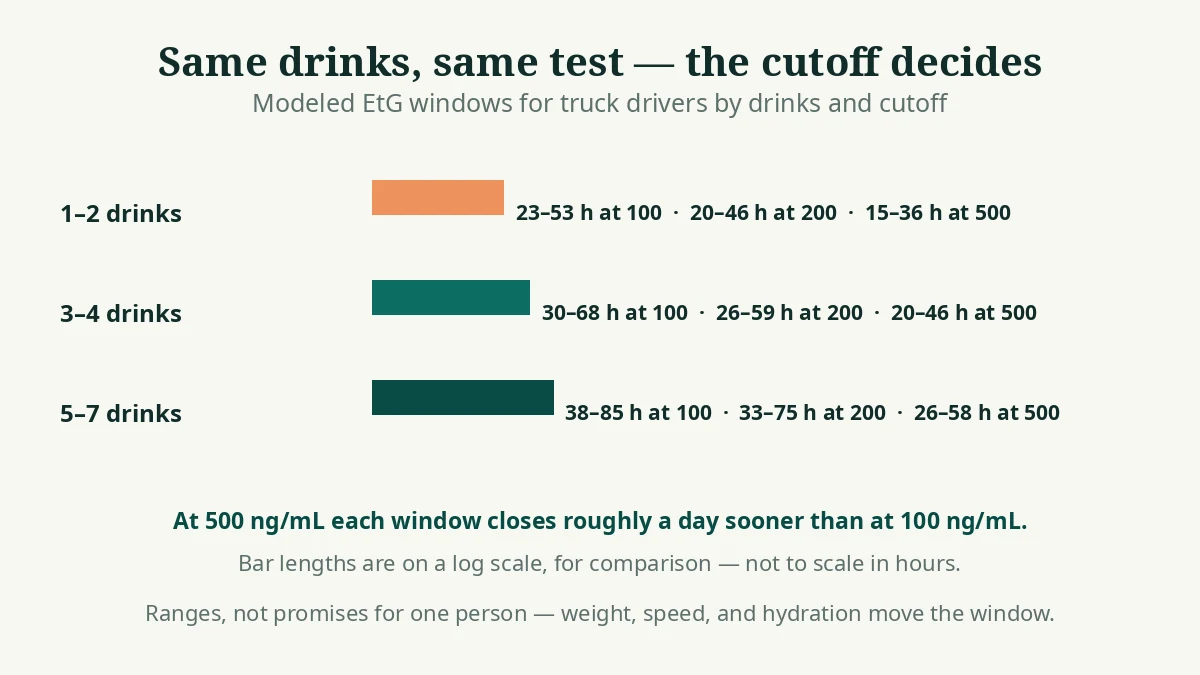
Read the table across, not down: five to seven drinks stays inside the window at 100 ng/mL for up to 85 hours — more than three days — but is past it at 500 ng/mL after 58 hours. So the first question after any positive is "which cutoff?" — ask for it in writing before the test, not after the result.
Real-world scenario: six drinks Saturday, a random test Tuesday
A long-haul driver gets home on Saturday, has six drinks with friends at 10 p.m., and is called for a random test on Tuesday at 10 a.m. — 84 hours after the last drink, with no warning.
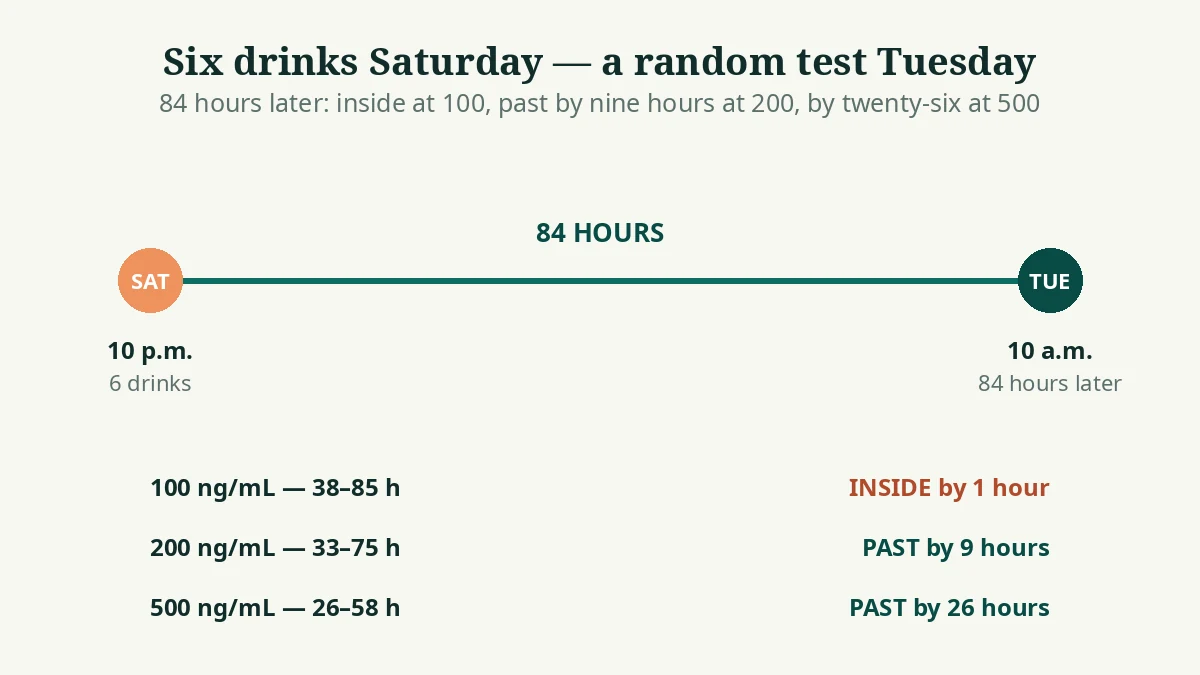
Six drinks is in the 5–7 drink band. At 100 ng/mL the modeled window is 38–85 hours, so 84 hours is inside it — by one hour. At 200 ng/mL the window is 33–75 hours, so 84 hours is past it by nine hours. At 500 ng/mL the window is 26–58 hours, so 84 hours is past it by twenty-six hours. Same driver, same Saturday: positive at one cutoff, negative at the other two. The lesson is not that 500 ng/mL is safe to drink under — the cutoff decides the result, and a random test leaves no room to plan around it.
What to do if you are facing a test
Respond the same day — a random selection has a reporting deadline, and missing it counts as a refusal, treated as a positive. Check the policy first: which program ordered the test, which cutoff, which lab, whether the screen is confirmed by LC-MS/MS, and what the consequence is. A DOT test will be a breath test for alcohol, not EtG — and a DOT violation goes on the Clearinghouse. An EtG test is either a carrier add-on or part of a SAP follow-up plan, and the two carry very different consequences. Do not try to beat the test: water, supplements, and "detox" drinks do not reliably clear EtG, and a dilute sample can be flagged as cheating.
Using the EtG calculator before a test
The EtG calculator estimates the same windows as the tables — read it as a range, never a pass date. Run your numbers.
Frequently asked questions
Do truck drivers get EtG tested?+
Not by the DOT — the DOT alcohol test is a breath test, and Part 40 does not authorize EtG for DOT alcohol testing. A truck driver faces an EtG test when the carrier adds one under its own policy, after an accident, or as part of a SAP return-to-duty follow-up plan. The cutoff is set by the carrier or the plan, usually 100, 200, or 500 ng/mL.
Does the DOT random test include EtG?+
No. The DOT random program requires 50% of the average driver pool for drugs and 10% for alcohol in 2026, but the DOT alcohol test is a breath test. A CDL driver can face a random EtG test only if the carrier's own non-DOT policy adds one. A DOT violation is recorded in the FMCSA Clearinghouse, where a prohibited status can lead to the state downgrading the CDL.
How long after drinking can a truck driver test positive on EtG?+
It depends on how much was drunk and the cutoff. Modeled ranges: 1–2 drinks, 23–53 hours at 100 ng/mL, 20–46 at 200, 15–36 at 500; 3–4 drinks, 30–68 hours at 100, 26–59 at 200, 20–46 at 500; 5–7 drinks, 38–85 hours at 100, 33–75 at 200, 26–58 at 500. These are ranges — weight, drinking speed, food, and hydration move the window for one person.
Can a truck driver drink in the sleeper berth?+
Federal rules do not explicitly ban drinking during a genuine off-duty rest period in the sleeper, but the four-hour rule (no alcohol within four hours of duty), the ban on possessing alcohol while on duty or in physical control of the vehicle, and most carriers' own no-alcohol policies make it risky. An EtG test ordered after an incident does not care where the drink was consumed — only when.
What happens if a truck driver fails a DOT alcohol test?+
A result of 0.04 BAC or above is a DOT violation: the driver is immediately removed from safety-sensitive duties, the violation is recorded in the FMCSA Clearinghouse for five years, and the driver cannot return until completing the SAP return-to-duty process — evaluation, prescribed education or treatment, a negative return-to-duty test under direct observation, and a follow-up plan of at least six unannounced tests in the first 12 months. A first DUI conviction also disqualifies the CDL for one year, three years for hazmat.
What cutoff do trucking companies use for EtG?+
There is no national EtG cutoff for truck drivers. Carriers and SAP follow-up plans typically use 100, 200, or 500 ng/mL. The same sample can pass at 500 ng/mL and fail at 100 ng/mL, so the cutoff is as important as the drinking — ask for it in writing before the test, not after the result.
Do owner-operators get random tested?+
Yes. A one-truck owner-operator is still an employer under Part 382 and must be in a random testing pool, so owner-operators join a consortium — a third-party administrator's pool that selects drivers at random across many small carriers. Selection is unannounced, and a missed random test counts as a refusal, which counts as a positive.
Evidence and limitations
This article summarizes published guidance and research on EtG testing for truck drivers, plus the science of alcohol biomarkers. Group-level findings cannot predict one person’s result, and this article is educational only — it is not legal or medical advice. Testing rules vary by employer, contractor, program, and state; talk to a local attorney about a live case or a termination.
- Fleetive — 49 CFR Part 382 Explained: six required test categories; Clearinghouse check before hire and at least once every 12 months; 2026 random rates 50% drugs / 10% alcohol under § 382.305(b)
- FMCSA Motor Carrier Safety Planner — Follow-Up Testing (Under Direct Observation): a minimum of six follow-up tests in the first 12 months; the SAP may require testing during the 48 months after that
- OTrucking — Post-Accident Drug Testing for CDL Drivers: fatality always triggers testing; injury or tow plus a citation; alcohol within 8 hours, drugs within 32 hours; no alcohol for 8 hours after the accident
- CDL Federal Rules (FMCSA, 49 CFR) — 49 CFR 392.5(a)(1) quoted verbatim: no alcohol within 4 hours before going on duty; 49 CFR 382.201: no duty with an alcohol concentration of 0.04 or greater
- ToolWingz — Commercial Driver (CDL) BAC Limit 0.04% & DOT Rules: 0.02–0.039 puts a driver out of service for 24 hours; a first DUI conviction disqualifies the CDL for one year, three years for hazmat
- Compliant Drivers Program — DOT Alcohol Testing Rules and Limits: DOT uses breath alcohol tests, not urine; a DOT alcohol violation goes on the FMCSA Clearinghouse record for 5 years; a SAP program is required before returning
- SAMHSA Advisory: The Role of Biomarkers in the Treatment of Alcohol Use Disorders (2006, revised 2012) — EtG detectable up to ~80 hours; EtG “scientifically unsupportable as the sole basis for legal or disciplinary action”
- McDonell et al. (2015) — EtG immunoassay cutoff sensitivity in alcohol-dependent outpatients (1,589 samples)
- Mackus et al. (2017) — EtG detection and elimination kinetics after controlled alcohol intake
- Jatlow et al. — EtG and EtS in urine after controlled alcohol administration
- EtG Calculator Pro — ETG Testing for Delivery Drivers: the non-CDL side of the same split — cargo vans under 10,001 lb stay outside the DOT program
- EtG Calculator Pro — ETG Testing for Pilots: the aviation version of the same federal testing split
- EtG Calculator Pro — DOT EtG Test: the DOT/non-DOT split explained
- EtG Calculator Pro — ETG Testing for Employment: consent and consequences in the workplace