The short answer: retail testing is employer policy, not federal law
An ETG test for retail workers is a urine test for ethyl glucuronide, a metabolite of alcohol, showing whether the worker drank in the past one to three days. For a retail worker, the important fact is who orders the test — and the answer is almost always the employer, not the government.
Retail is the largest private-sector employer in the United States — about 15.5 million people work in retail trade, including roughly 3.6 million retail salespersons, 2.6 million cashiers, and 1.8 million stock clerks (Bureau of Labor Statistics). Yet no federal testing program covers any of them. The DOT program that covers truck drivers applies to commercial motor vehicles, not to a cashier or a stocker. OSHA does not require drug or alcohol testing of retail workers at all, and it actually limits when an employer can test after an incident, as the post-accident section explains. A retail EtG test is a creature of company policy, shaped by state law: the handbook, the state's testing statute, and the workers' compensation rules after an injury. Two workers doing the same job at two stores can face completely different regimes — one tested only at hire, the other after every incident.
When an EtG test for retail workers actually happens
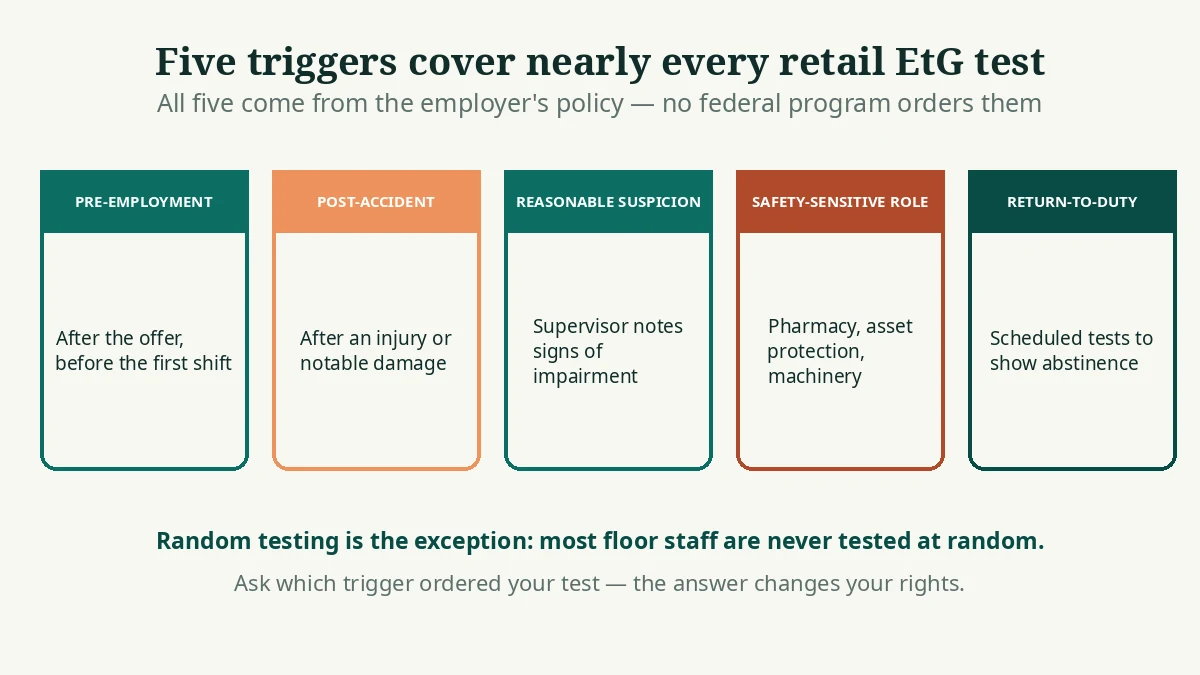
Most retail testing falls into five triggers. Random testing is the exception: for ordinary floor staff it is rare, because no federal rule requires it.
| Trigger | When it happens | What it usually involves |
|---|---|---|
| Pre-employment | After a conditional job offer, before the first shift | Urine panel, sometimes including EtG; a failed test can withdraw the offer |
| Post-accident / post-incident | After an injury or notable property damage | Urine test, often including alcohol; OSHA limits blanket testing |
| Reasonable suspicion | A supervisor documents signs of impairment on duty | Urine test; usually needs a second manager to confirm the observations |
| Safety-sensitive role | Pharmacy, asset protection, machinery operation | More frequent testing; EtG is common because the role is safety-sensitive |
| Return-to-duty / follow-up | After a failed test or a treatment program | Scheduled EtG tests to show continued abstinence |
The pattern: testing is most likely at the two ends of employment — before you start, and after something goes wrong. Mid-employment testing without a reason is uncommon for a cashier.
Walmart: who gets tested, and when
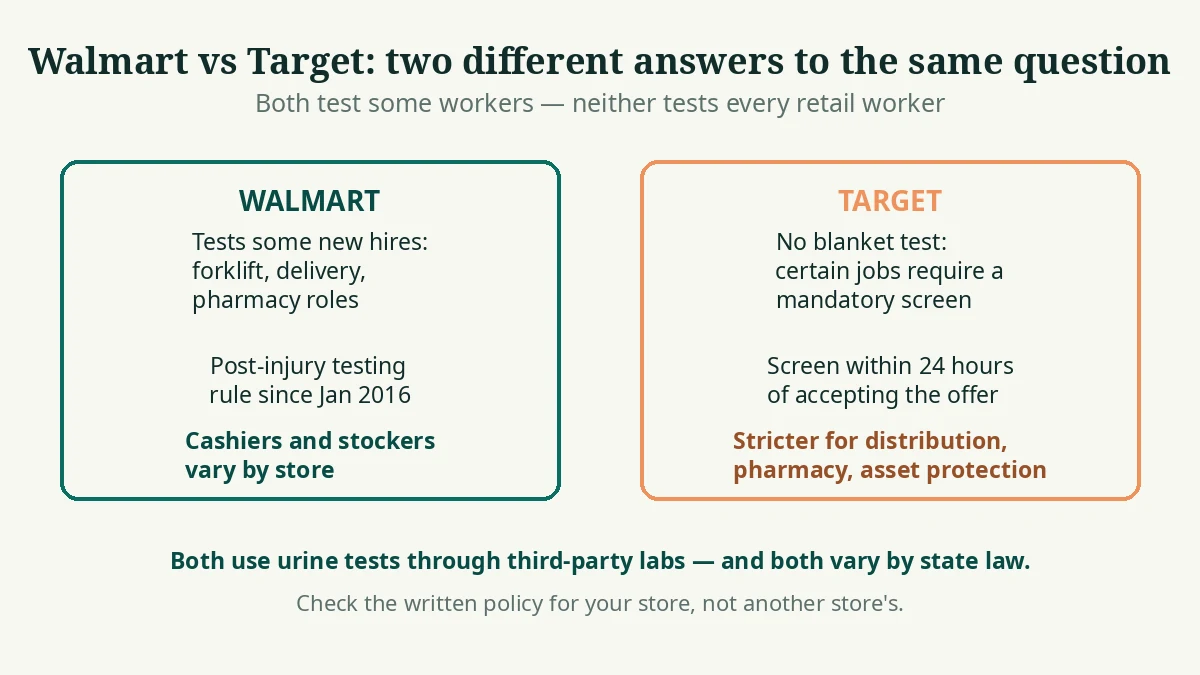
Walmart is the employer most retail workers ask about, and the answer is narrower than the rumors. The largest private employer in the United States does test — but not everyone, and not at random. Pre-employment screening applies to certain positions: forklift drivers and other machinery operators, drivers, and pharmacists. An entry-level cashier or stocker may or may not be tested, depending on the store — the policy is position-specific, not store-wide.
The post-injury side is where Walmart's policy has a documented history. In January 2016 Walmart began requiring a drug or alcohol test whenever an employee suffered a workplace injury that needed treatment from an outside health care provider. That rule produced court cases that still shape the policy. In Arizona, a worker fired after a positive marijuana-metabolite test — a bag of ice had fallen on her wrist — won on liability in 2019, because Walmart produced no evidence she was impaired at work and she was a registered medical marijuana patient under a state law that protects cardholders. In Michigan, a worker with a state medical marijuana card lost the same kind of case in 2012, because that state's law does not regulate private employers. In New Jersey, an applicant who failed a cannabis test for an asset-protection job sued under the state's cannabis law; the courts have split on whether it gives applicants a remedy.
Those cases are about marijuana metabolites, not EtG — but they show what decides a retail test: the employer's written policy, and the state you are in. Tests are usually urine samples sent to a third-party lab.
Target: no blanket test, but some jobs require one
Target's answer is different, and it is written down in the company's own careers FAQ. Target does not drug test all new hires. Under its Drug Free Workplace policy, certain jobs may require a mandatory drug screen as a condition of employment — and if the job you were offered requires one, you are told at the time of the offer. The screen must be completed within 24 hours of accepting the job offer, and failing to complete it in time can withdraw the conditional offer. Screens are run by Target's vendor, Accurate Background, at a testing location near you or on site at your future work location.
Which jobs? The roles most often named involve operating machinery, working in a distribution center, driving a company vehicle, or handling pharmacy medications. For general floor positions — cashier, sales associate — testing is less consistent and varies by location. Asset protection and team-lead roles sit in the middle: they handle cash and security, so they are tested more often than floor staff.
Target does not run random drug tests on floor employees as a matter of policy, but management reserves the right to test on reasonable cause — erratic behavior, witness accounts, or an incident — and after an accident that causes bodily harm or significant property damage. The pattern matches Walmart's: the test follows a trigger, not a calendar. Target's 24-hour window after accepting an offer is short — a candidate who drank the night before accepting has almost no time to wait the test out.
The OSHA limit on blanket post-accident testing
In 2016 OSHA amended its injury recordkeeping rule, 29 CFR 1904.35, to require that injury-reporting procedures be reasonable and not deter employees from reporting. In the comments, OSHA said blanket post-injury drug testing deters proper reporting — testing should be limited to situations in which drug use likely contributed to the incident and the test can show impairment.
OSHA's own examples make the boundary concrete: it would not be reasonable to drug test an employee who reports a bee sting, a repetitive strain injury, or an injury caused by a machine malfunction. The rule does not ban post-incident testing — testing required by a workers' compensation law is expressly not retaliatory — but an employer cannot use the threat of a test as a punishment for reporting an injury.
A cashier who strains a wrist scanning for eight hours, a stocker who hurts a back lifting a box, a sales associate who slips on an unmopped wet floor — in each case the injury has a visible cause that has nothing to do with drinking, and a test after the report looks like the blanket testing OSHA described. A loading-dock incident with a pallet jack is closer to the line. But even there, the EtG problem remains. OSHA's test is whether the method can accurately identify impairment caused by drug use. An EtG test does not do that: it shows whether alcohol was consumed in the past one to three days, long after impairment has passed. A worker who drank on Saturday and was injured by a faulty pallet jack on Tuesday was not impaired — but an EtG test would still come back positive. That does not make the test illegal in every case, but it is the strongest argument a retail worker has when a post-incident test follows an injury drinking could not have caused.
What the EtG test actually measures
Ethyl glucuronide is a direct metabolite of ethanol, made by the liver only after alcohol is consumed, leaving the body in urine. An EtG test does not measure impairment — it measures whether alcohol was consumed in roughly the past one to three days. The SAMHSA advisory puts EtG's detection window at up to about 80 hours, and warns that EtG is "scientifically unsupportable as the sole basis for legal or disciplinary action." Testing runs in two steps: an immunoassay screen, then LC-MS/MS confirmation. The cutoff decides the result — 100 ng/mL is the most sensitive, 500 the least — and no agency or state sets a national cutoff: the employer picks one.
Detection windows by drinks and cutoff
The table below uses the same modeled ranges as our EtG calculator — ranges, not promises: weight, drinking speed, food, and hydration move the window.
| Drinks (standard) | 100 ng/mL | 200 ng/mL | 500 ng/mL |
|---|---|---|---|
| 1–2 drinks | 23–53 hours | 20–46 hours | 15–36 hours |
| 3–4 drinks | 30–68 hours | 26–59 hours | 20–46 hours |
| 5–7 drinks | 38–85 hours | 33–75 hours | 26–58 hours |

Read the table across, not down: five to seven drinks stays inside the window at 100 ng/mL for up to 85 hours — more than three days — but is past it at 500 ng/mL after 58 hours. The first question after any positive is "which cutoff?" — ask for it in writing before the test.
Real-world scenario: five drinks Saturday, a test Tuesday
A retail associate finishes the Saturday shift, has five drinks with friends at 10 p.m., and is called for a post-accident EtG test on Tuesday at 7 a.m. — 57 hours after the last drink — because a pallet jack clipped a shelf and a coworker was hurt.
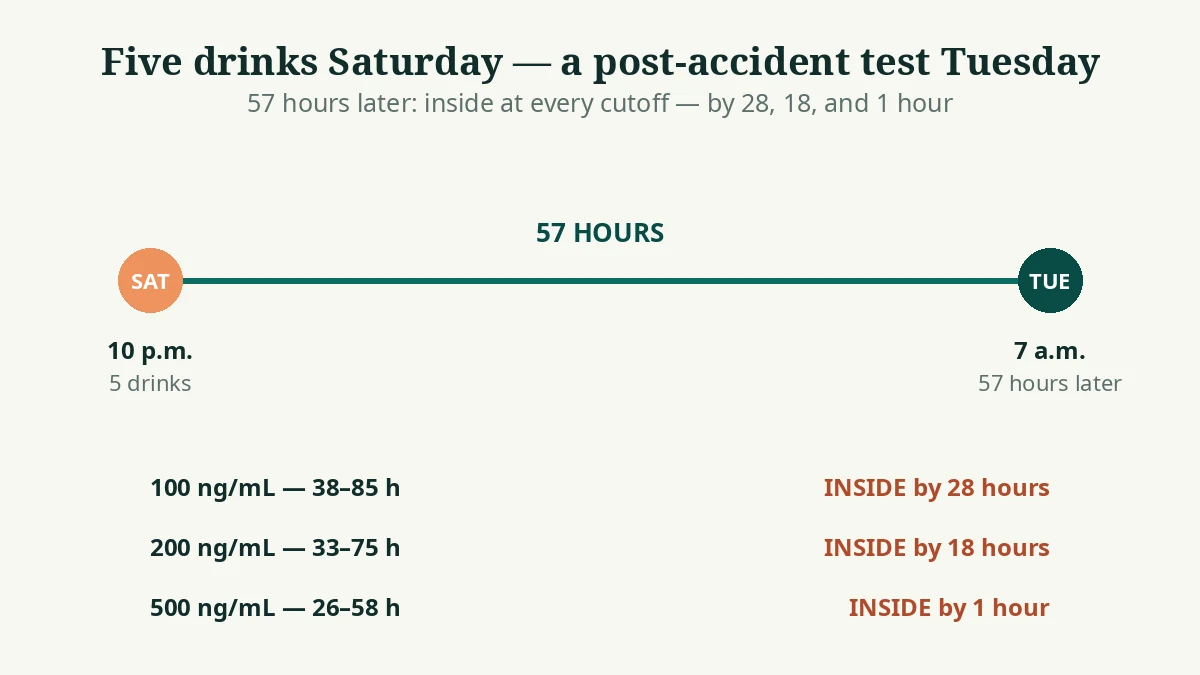
At 100 ng/mL the window for five to seven drinks is 38–85 hours, so 57 hours is inside it by twenty-eight hours. At 200 the window is 33–75 hours, inside by eighteen. At 500 the window is 26–58 hours, inside by one hour. Positive at all three cutoffs, but only just at 500 — a test a few hours later would have flipped it.
Did the drinking have anything to do with the pallet jack clipping the shelf? If the jack's brakes failed, OSHA's guidance says the test should not have followed the injury report at all.
What to do if you are facing a test
Respond the same day — a pre-employment test has a deadline, and a missed test counts as a refusal, which is treated as a positive. At Target that deadline is 24 hours from accepting the offer. Check the policy first: which trigger ordered the test, which cutoff, which lab, whether the screen is confirmed by LC-MS/MS, and what the consequence is. Ask for the cutoff in writing before the test. If the test follows an injury, note what caused it and whether drinking could plausibly have contributed — that is the OSHA question. Do not try to beat the test: water, supplements, and "detox" drinks do not reliably clear EtG, and a dilute sample can be flagged as cheating. EtG shows past use, not impairment — a positive does not prove you were impaired at work.
Using the EtG calculator before a test
The EtG calculator estimates the same windows as the tables — read it as a range, never a pass date. Run your numbers.
Frequently asked questions
Do retail workers get EtG tested?+
Yes, but only under the employer's own policy — there is no federal EtG testing program for retail work. The usual triggers are pre-employment screening, post-accident testing, reasonable suspicion, and safety-sensitive roles. Random testing is rare for ordinary floor staff. The cutoff is set by the employer, usually 100, 200, or 500 ng/mL.
Does Walmart drug test retail workers?+
Walmart tests some new hires — roles that operate heavy machinery such as forklift drivers, roles that involve driving, and pharmacy roles that handle controlled substances. An entry-level cashier or stocker may or may not be tested, depending on the store. Walmart has also required a drug or alcohol test after workplace injuries needing outside medical treatment since January 2016. Tests are usually urine samples sent to a third-party lab, and a failed pre-employment test usually withdraws the offer.
Does Target drug test new hires?+
Target has no blanket test for all new hires. Under its Drug Free Workplace policy, certain jobs may require a mandatory drug screen as a condition of employment — you are told at the time of the offer, and the screen must be completed within 24 hours of accepting the offer. Cashier and sales associate roles are generally not tested pre-employment; distribution center, pharmacy, and asset protection roles are tested more often. Screens are run by Target's vendor, Accurate Background.
Can my employer test me after any workplace accident?+
Not automatically. OSHA's 2016 recordkeeping rule, 29 CFR 1904.35, says blanket post-incident testing deters injury reporting, and testing should be limited to situations where drug use likely contributed to the incident and the test can show impairment. EtG shows past drinking, not impairment, so a test after an injury drinking could not have caused — a wrist strain from scanning, a back injury from lifting, a slip on an unmopped floor — is hard to justify. Testing required by a state workers' compensation law is a separate matter.
How long after drinking can a retail worker test positive on EtG?+
It depends on how much was drunk and the cutoff. Modeled ranges: 1–2 drinks, 23–53 hours at 100 ng/mL, 20–46 at 200, 15–36 at 500; 3–4 drinks, 30–68 hours at 100, 26–59 at 200, 20–46 at 500; 5–7 drinks, 38–85 hours at 100, 33–75 at 200, 26–58 at 500. These are ranges — weight, drinking speed, food, and hydration move the window for one person.
What happens if I fail an EtG test at a retail job?+
It depends on the trigger and the employer's policy. A failed pre-employment test usually withdraws the job offer. A failed test during employment can lead to discipline or termination, and a refusal to test is generally treated the same as a failure. A positive EtG result shows past drinking, not impairment at work — that distinction matters in a dispute, and an employment attorney in your state can advise whether the test itself was properly ordered.
What cutoff do retail employers use for EtG?+
There is no national EtG cutoff for retail workers. Employers and programs typically use 100, 200, or 500 ng/mL. The same sample can pass at 500 ng/mL and fail at 100 ng/mL, so the cutoff is as important as the drinking — ask for it in writing before the test, not after the result.
Evidence and limitations
This article summarizes published guidance and research on EtG testing for retail workers, plus the science of alcohol biomarkers. Group-level findings cannot predict one person’s result, and this article is educational only — it is not legal or medical advice. Testing rules vary by employer, site, program, and state; talk to a local attorney about a live case or a termination.
- Target Careers FAQs — certain jobs may require a mandatory drug screen as a condition of employment; the screen must be completed within 24 hours of accepting the job offer; screens managed by Accurate Background
- GB Times — Does Walmart Have Drug Tests?: position-specific pre-employment screening (forklift, delivery, pharmacy), post-accident and reasonable-suspicion testing, urine tests through third-party labs
- Barneys Farm — Does Walmart Drug Test?: Walmart’s January 2016 post-injury testing rule; the Arizona, Michigan, and New Jersey court cases; Costco’s stricter pre-employment policy
- U.S. Bureau of Labor Statistics — Retail Trade (NAICS 44-45): about 15.5 million workers in retail trade; 3,550,380 retail salespersons, 2,552,720 cashiers, 1,828,300 stock clerks and order fillers (2025)
- Mondaq — Post-Incident Drug Testing May Be Retaliation: 29 CFR 1904.35; blanket post-injury testing deters reporting; limit testing to where drug use likely contributed and the test can identify impairment
- Lexology — The Effects of OSHA’s Final Rule on Post-Accident Drug Testing: the three requirements for post-accident testing, and the bee-sting / repetitive-strain / machine-failure examples
- SAMHSA Advisory: The Role of Biomarkers in the Treatment of Alcohol Use Disorders (2006, revised 2012) — EtG detectable up to ~80 hours; EtG “scientifically unsupportable as the sole basis for legal or disciplinary action”
- McDonell et al. (2015) — EtG immunoassay cutoff sensitivity in alcohol-dependent outpatients (1,589 samples)
- Mackus et al. (2017) — EtG detection and elimination kinetics after controlled alcohol intake
- Jatlow et al. — EtG and EtS in urine after controlled alcohol administration
- EtG Calculator Pro — ETG Testing for Warehouse Workers: the same employer-policy pattern in fulfillment centers, Amazon rules, and forklift testing
- EtG Calculator Pro — ETG Testing for Employment: consent and consequences in the workplace
- EtG Calculator Pro — ETG Testing for Delivery Drivers: the DOT / non-DOT split for drivers