The short answer: an ETG test for life insurance checks recent drinking — it is not a routine underwriting step
An ETG test for life insurance is a urine test for ethyl glucuronide, a direct metabolite of alcohol. It answers one question: has this person drunk alcohol in roughly the past one to three days? It does not measure impairment. In life insurance underwriting, it is not a test every applicant gets.
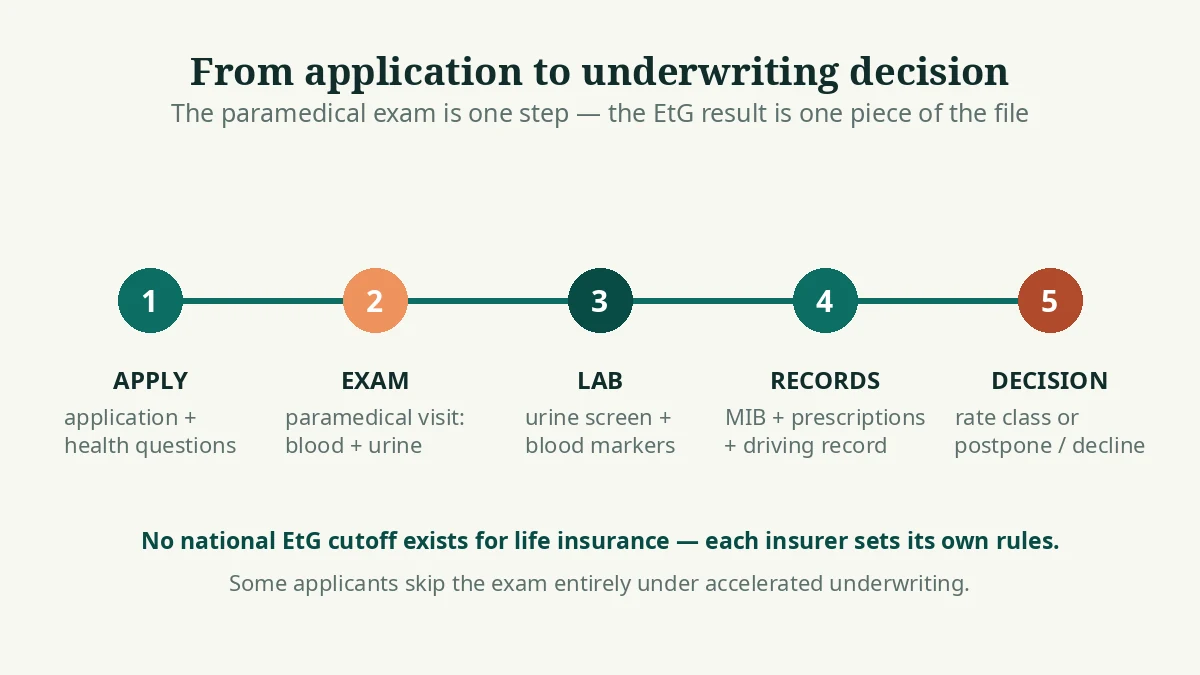
Most fully underwritten policies do require a medical exam. A paramedical examiner — usually at your home or office — records your height, weight, blood pressure, and pulse, and collects blood and urine. The urine is screened for nicotine and drugs; the blood work checks cholesterol, blood sugar, and liver and kidney function. EtG enters that picture only when the insurer has a reason to look at recent drinking — it is not a standard item on every panel.
What the paramedical exam actually checks
The paramedical exam verifies the health picture on your application with measurements and lab work, before the insurer sets a price. ExamOne, one of the largest paramedical exam providers in the United States, describes it as a personal interview about your medical history plus physical measurements and — depending on the insurer's guidelines — blood, urine, oral fluid, and an electrocardiogram.
| Exam step | What it looks for |
|---|---|
| Personal history interview | Medical history, medications, and lifestyle — including alcohol use and smoking. |
| Height, weight, blood pressure, pulse | Build and cardiovascular basics for the rate class. |
| Blood draw | Cholesterol, blood sugar, liver and kidney function — and alcohol markers such as GGT, CDT, and sometimes PEth. |
| Urine sample | Kidney function, nicotine and cotinine, drugs and prescription medications — and EtG, when ordered. |
| Driving record and MIB check | DUIs and reckless driving, plus coded underwriting information from past insurance applications. |
| Prescription history | Pharmacy records, checked against the application. |
The exam is one input, not the whole of underwriting. ExamOne asks applicants to avoid alcohol for at least 12 hours before the appointment — but 12 hours is about the exam, not EtG. Alcohol leaves the blood in hours; EtG lingers in urine for days.
When an EtG test enters the picture
Whether you face any exam at all depends on the policy. Fully underwritten term and whole life policies include the paramedical exam. Simplified issue policies skip the exam but ask health questions, and they usually cost more for less coverage. The National Association of Insurance Commissioners (NAIC) puts it plainly: less health information usually means higher premiums and less coverage.
Accelerated underwriting can skip the exam entirely. The NAIC describes it as a fully underwritten program that lets some applicants forgo the exam and fluid samples, if they meet set thresholds. Instead, the insurer pulls prescription history, motor vehicle records, credit reports, and the MIB file, and runs them through predictive models — cutting the decision time from weeks to about 48 hours for applicants who clear it. But thin data or a risk flag can still send an applicant back to traditional underwriting — exam and all.
EtG is ordered when alcohol use is already a question. The standard urine panel screens for drugs and nicotine. EtG — a test specifically for recent drinking — is typically added when something raises the question: an alcohol history on the application, a past DUI, a prior application flagged in the MIB file, or elevated liver enzymes. Our employment EtG guide covers the same pattern.
There is no national EtG cutoff for life insurance. Each insurer writes its own guidelines. The two cutoffs are the same ones used everywhere EtG is tested — 100 ng/mL where abstinence must be verified strictly, and 500 ng/mL where the program wants to screen out incidental exposure, the level SAMHSA's 2012 advisory recommended.
How an EtG test works in this setting
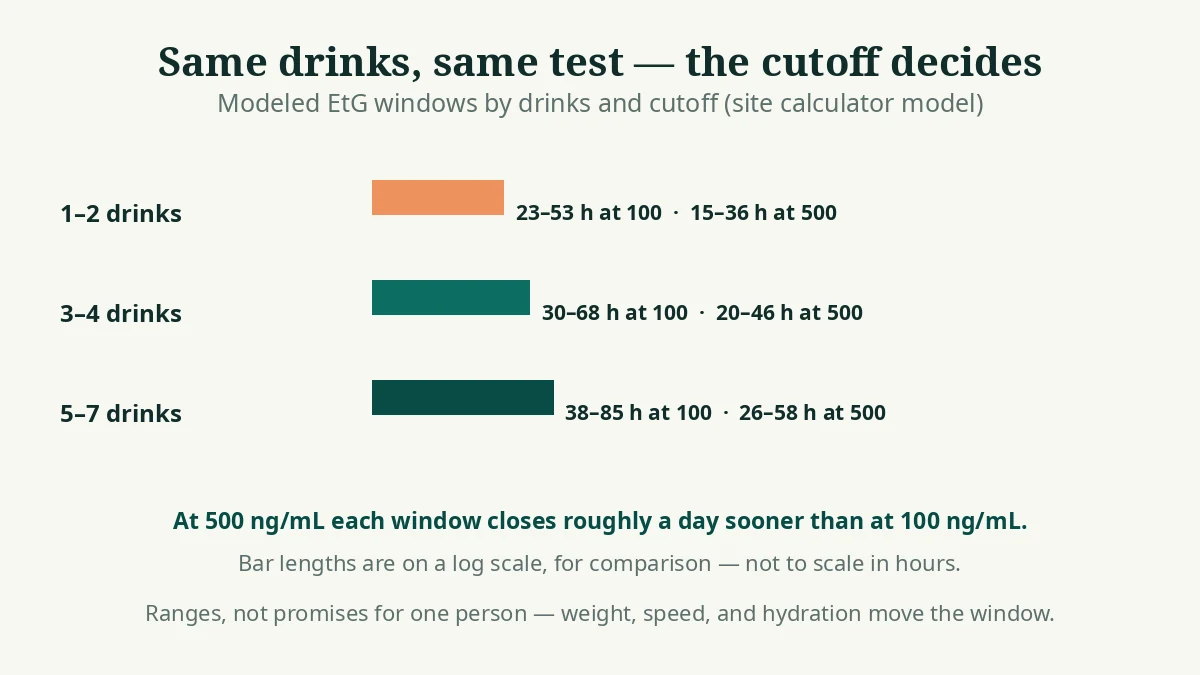
EtG forms only when alcohol is consumed, and clears in urine over roughly one to three days. SAMHSA's 2012 advisory puts the window at up to about 80 hours after heavy drinking. The table below uses our calculator's ranges — the same model our EtG calculator uses.
| Drinks | 100 ng/mL | 200 ng/mL | 500 ng/mL |
|---|---|---|---|
| 1–2 drinks | 23–53 hours | 20–46 hours | 15–36 hours |
| 3–4 drinks | 30–68 hours | 26–59 hours | 20–46 hours |
| 5–7 drinks | 38–85 hours | 33–75 hours | 26–58 hours |
| 8–12 drinks | 50–105 hours | 44–92 hours | 34–71 hours |
| More than 12 drinks | 65–130 hours | 57–114 hours | 44–88 hours |
Three limits matter. First, SAMHSA's advisory cautions that EtG is “scientifically unsupportable as the sole basis for legal or disciplinary action” — one low-level result is not proof of a drinking problem. Second, incidental exposure can matter at 100 ng/mL: heavy use of alcohol-based hand sanitizer or mouthwash can cross the threshold; at 500 ng/mL that is unlikely. Disclose it before the sample. Third, labs check creatinine — drinking water does not erase EtG, and a dilute sample reads as a problem, not a pass. Our guide to reading EtG results explains the levels, and our 100 vs 500 ng/mL cutoff guide explains why the same urine can be positive at one cutoff and negative at the other.
What a positive result can mean
A positive EtG result is evidence of drinking inside the window, not a verdict on an application.
A higher rate class. Most insurers use four to six tiers, from preferred plus down to substandard. A positive EtG that fits occasional drinking — disclosed honestly, with no history of abuse and clean blood markers — is more likely to move an applicant down a class than to end the application.
A postponement. If the picture looks like recent heavy drinking, the insurer may postpone the application until the applicant can show a period of sobriety. This is the common outcome when a positive arrives with other flags, such as a recent DUI. A postponement is not a denial.
A decline. For alcohol alone, a decline usually needs more: a pattern of heavy use across markers, a recent DUI, a treatment history that was not disclosed, or an MIB code that contradicts the application. One low-level EtG result alone is a weak basis for a decline.
One factor weighs more than the result itself: honesty. A past DUI disclosed upfront, with treatment completed, is a manageable fact. The same DUI discovered through the motor vehicle report or the MIB file, after a denial on the application, becomes a second problem: the drinking history plus a credibility problem. Our security-clearance testing guide covers a parallel process with the same honesty standard.
Real-world scenario: five drinks Saturday, a paramedical exam Wednesday
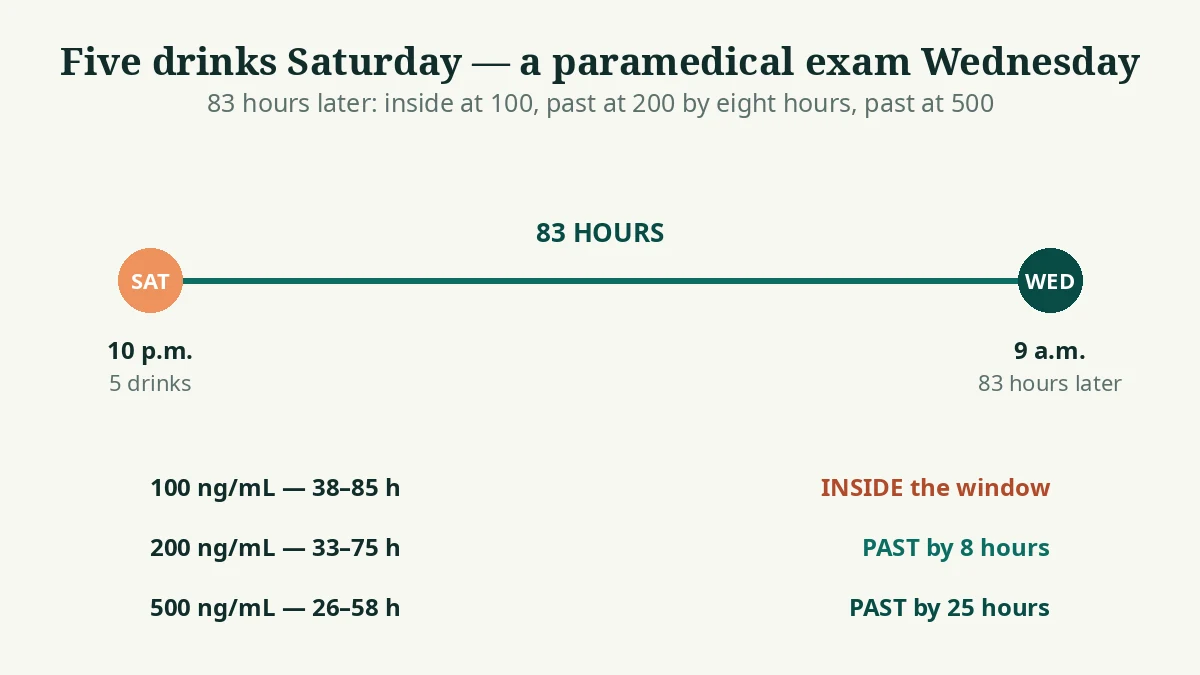
A 38-year-old applies for a $500,000 term policy. On Saturday evening he has five drinks at a wedding, the last at 10 p.m. The examiner arrives Wednesday at 9 a.m. — 83 hours later.
At 100 ng/mL, five to seven drinks are modeled at 38 to 85 hours — 83 hours is inside, so a positive is likely. At 200 ng/mL (33 to 75 hours) the window closed eight hours earlier — a negative is likely. At 500 ng/mL (26 to 58 hours) it closed twenty-five hours earlier.
But the EtG answer is not the whole answer. A PEth blood test drawn the same Wednesday would still show the Saturday drinking — PEth reflects the past two to four weeks, and five drinks can push it above 20 ng/mL. And if the applicant had disclosed occasional drinking honestly, a positive EtG would confirm what the insurer already knew — a very different outcome from the same result arriving as a surprise. Our PEth calculator guide explains the longer window and the 20 / 200 ng/mL bands.
EtG is one marker among many — and not the one underwriters trust most
EtG answers a narrow question about the last few days. Underwriters care about patterns over months and years, so the blood markers matter more.
PEth (phosphatidylethanol). Formed only when alcohol is consumed, detectable in blood for two to four weeks. A 2025 study of 619 life insurance applicants found PEth positive in 23% at a 200 ng/mL threshold, while CDT was positive in only 11% at 1.5% — and concluded PEth may be the more sensitive marker, useful as a reflex test in underwriting. A September 2025 Optimum Re white paper for underwriters puts the bands at under 20 ng/mL for abstinence, 20 to 200 ng/mL for moderate drinking, and above 200 ng/mL for heavy intake — and notes that hand sanitizer does not raise PEth, because only drinking does.
CDT (carbohydrate-deficient transferrin). An indirect marker that rises after sustained heavy drinking. Less sensitive than PEth, and affected by other medical conditions — underwriters treat it as supporting evidence.
GGT (gamma-glutamyl transferase). A liver enzyme in the standard blood panel. Elevated GGT suggests chronic heavy alcohol use and takes four to five weeks to return to normal after drinking stops — but it can rise for other reasons, so underwriters read it with the rest of the liver panel.
A clean EtG does not prove abstinence to an underwriter who also has a PEth result, and a positive EtG does not prove a drinking problem to one who has clean PEth, CDT, and GGT.
What helps if alcohol comes up in your application
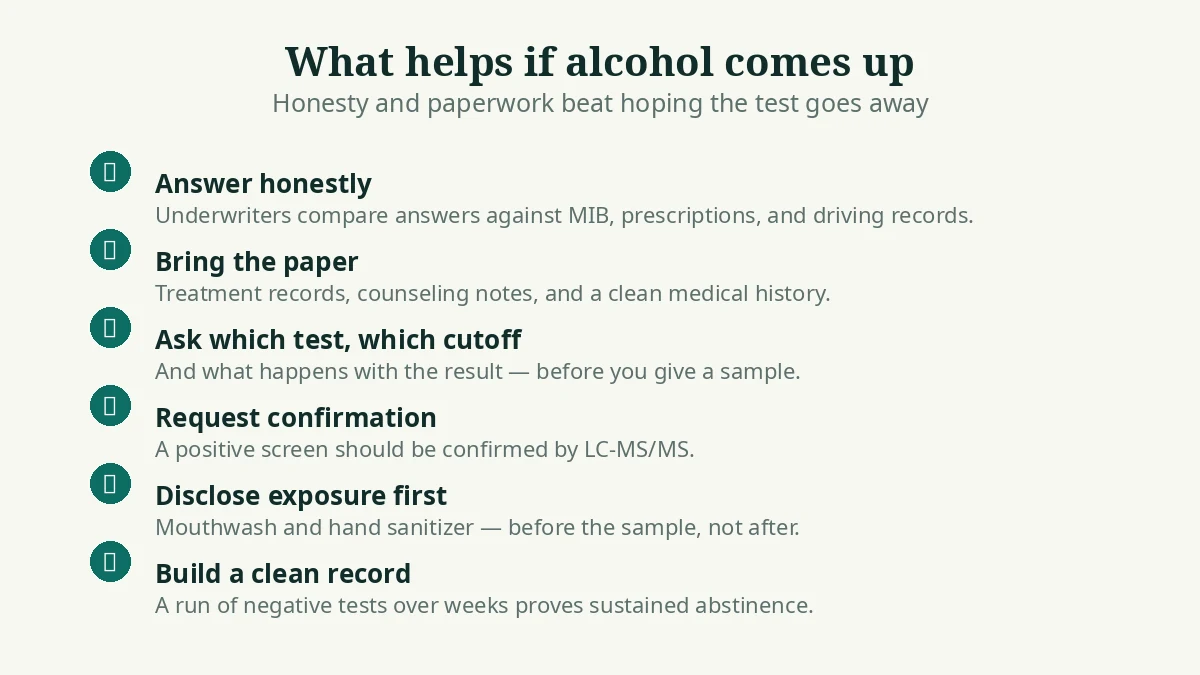
Answer honestly, and completely. Underwriters compare your answers against the MIB file and driving record — a gap is harder to explain than the fact itself. Bring the paper: treatment completion certificates, counseling records, and medical reports are what an underwriter weighs.
If a test is ordered, ask three questions first: which test, which cutoff, and what happens with the result. Ask for LC-MS/MS confirmation of any positive screen. Disclose mouthwash and hand sanitizer use before the sample, not after. And remember the timing: 12 hours without alcohol is not enough for EtG to clear — the modeled windows above are measured in days, not hours.
If the application is postponed, a run of negative tests over weeks is the strongest evidence — and PEth, not EtG, proves sustained abstinence over that span. Do not dilute a sample: labs check creatinine, and a dilute result reads as a problem, not a pass. If the outcome is a decline or a rating you think is wrong, you have rights: under the Fair Credit Reporting Act you can request your MIB file and dispute inaccuracies.
This article is educational only — not legal, medical, or financial advice. Underwriting rules vary by insurer and by state.
Using the EtG calculator before a test
The EtG calculator estimates the same detection windows the table above uses. Read the result as a range, never a pass date — it cannot tell you what your insurer will decide. Run your numbers through the calculator.
Frequently asked questions
Does every life insurance application include an EtG test?+
No. A standard life insurance urine test screens for nicotine, illicit drugs, and prescription medications — EtG is not on every insurer's standard panel. It is typically added when something in the file raises a question about recent drinking, such as an alcohol history on the application, a past DUI, a prior application flagged in the MIB file, or elevated liver enzymes. Some applicants skip the exam entirely under accelerated underwriting, where the insurer checks records instead of collecting fluids.
What EtG cutoff do life insurance companies use?+
No national EtG cutoff exists for life insurance. No regulator or federal rule sets one — each insurer writes its own underwriting guidelines, including which tests it orders and at which cutoff. The two cutoffs used everywhere EtG is tested are 100 ng/mL, where abstinence must be verified strictly, and 500 ng/mL, where the program wants to screen out incidental exposure, the level SAMHSA's 2012 advisory recommended. The same urine can be positive at 100 and negative at 500.
How long after drinking will an EtG test for life insurance be positive?+
It depends on how much was drunk and the cutoff. At 100 ng/mL, our modeled ranges are: 1–2 drinks, 23–53 hours; 3–4 drinks, 30–68 hours; 5–7 drinks, 38–85 hours; 8–12 drinks, 50–105 hours; more than 12 drinks, 65–130 hours. At 500 ng/mL the same amounts clear roughly a day sooner. These are ranges, not promises for one person — weight, drinking speed, and hydration all move the window. A PEth blood test can still show drinking from two to four weeks earlier, long after EtG has cleared.
Will a positive EtG test stop me getting life insurance?+
Not automatically. Underwriting weighs the whole file: how recent the drinking was, whether it was a single incident or a pattern, what treatment or support is in place, and how honest the applicant has been. A positive more often leads to a higher rate class or a postponement until the applicant can show a period of sobriety than to a denial. A decline for alcohol alone usually needs more: a pattern of heavy use across markers, a recent DUI, or a treatment history that was not disclosed.
Does life insurance use PEth instead of EtG?+
Sometimes, alongside EtG rather than instead of it. PEth is a direct alcohol biomarker in blood, detectable for two to four weeks, and underwriters increasingly use it because it reflects patterns over weeks, not days. A 2025 study of 619 life insurance applicants found PEth positive in 23% at a 200 ng/mL threshold, while CDT was positive in only 11% — and concluded PEth may be the more sensitive marker. The usual bands are under 20 ng/mL for abstinence, 20 to 200 ng/mL for moderate drinking, and above 200 ng/mL for heavy intake.
Can mouthwash or hand sanitizer cause a positive EtG on a life insurance exam?+
At the sensitive 100 ng/mL cutoff, yes — heavy use of alcohol-based hand sanitizer or mouthwash can produce low EtG levels that cross the threshold. At 500 ng/mL that is unlikely. If your insurer orders a test, disclose that exposure before the sample, not after the result, and ask for LC-MS/MS confirmation of any positive screen. Note that PEth is not affected by hand sanitizer or mouthwash — only drinking raises it.
What should I do if my insurer asks about alcohol use?+
Answer honestly, and bring the paper. Ask which test and which cutoff was ordered, and what happens with the result. Bring treatment completion certificates, counseling records, and medical reports — documented evidence is what an underwriter weighs. Ask for LC-MS/MS confirmation of any positive screen. If the application is postponed, a run of negative tests over weeks is the strongest evidence — and PEth, not EtG, proves sustained abstinence over that span. Do not dilute a sample — labs check creatinine. This is general information, not legal, medical, or financial advice; a live application deserves a licensed agent or qualified counsel.
Evidence and limitations
This article summarizes published underwriting guidance and public records on EtG testing for life insurance, plus the science of alcohol biomarkers. Group-level findings cannot predict one person’s result, and this article is educational only — it is not legal, medical, or financial advice. Underwriting rules vary by insurer and by state; check your own insurer’s current requirements and consider a licensed agent or qualified counsel for a live application.
- ExamOne — Frequently Asked Questions About Life Insurance Exams: paramedical exam includes height, weight, blood pressure, pulse, and may include blood, urine, oral fluid, and EKG; refrain from alcohol at least 12 hours before the appointment
- ExamOne Blog — Demystifying the life insurance medical requirement process: paramedical exam plus Motor Vehicle Report, Attending Physician Statements, and prescription history; specimens sent to the laboratory, results forwarded to the insurer
- NAIC — Accelerated Underwriting (Dec 2019): some applicants may forgo the medical or paramedical exam and fluids; decision time can drop from 2–12 weeks to about 48 hours; uses prescription history, motor vehicle records, credit reports, and the MIB
- MoneyGeek — Life Insurance Drug Test: What to Expect in 2026: fully underwritten term and permanent policies require drug testing at the medical exam; positive results for hard drugs usually lead to denial, though some insurers offer postponement
- LegalClarity — Does Life Insurance Require a Drug Test?: fully underwritten policies collect blood and urine screened for nicotine, drugs, and markers of heavy alcohol use; GGT is the primary alcohol marker, taking four to five weeks to return to normal
- LegalClarity — How Do Life Insurance Companies Check Medical Backgrounds?: insurers check questionnaires, pharmacy records, exams, physician files, and the MIB; prescription databases pull up to seven years of records
- Insurance & Estates — What Is the Medical Information Bureau (MIB)?: nonprofit clearinghouse of coded underwriting data from past applications, not medical records; codes can flag excessive alcohol consumption; records active seven years; insurers cannot deny based solely on an MIB report
- Phosphatidylethanol Levels in a Group of Life Insurance Applicants Tested for Carbohydrate-Deficient Transferrin (2025): 619 applicants; PEth positive in 23% at 200 ng/mL, CDT positive in 11% at 1.5%; PEth may be a more sensitive marker, useful as a reflex test in the life insurance setting
- Optimum Re — A New Alcohol Marker For Life Insurance Underwriting (White Paper, Sep 2025): PEth bands under 20 ng/mL abstinence, 20–200 ng/mL moderate, above 200 ng/mL heavy; hand sanitizer and alcohol wipes do not raise PEth
- SAMHSA Advisory: The Role of Biomarkers in the Treatment of Alcohol Use Disorders (2006, revised 2012) — EtG detectable up to ~80 hours; EtG “scientifically unsupportable as the sole basis for legal or disciplinary action”
- McDonell et al. (2015) — EtG immunoassay cutoff sensitivity in alcohol-dependent outpatients (1,589 samples)
- Mackus et al. (2017) — EtG detection and elimination kinetics after controlled alcohol intake
- Jatlow et al. — EtG and EtS in urine after controlled alcohol administration
- EtG Calculator Pro — ETG Testing for Employment: how workplace EtG testing works, and the same ordered-for-a-reason pattern
- EtG Calculator Pro — ETG Testing for Security Clearance: another whole-file review where honesty and the record decide the outcome
- EtG Calculator Pro — PEth Calculator: how PEth complements EtG with a longer detection window, and how the 20 / 200 ng/mL bands are read