The short answer: an ETG test for flight attendants is real, but it is almost never the DOT test
An ETG test for flight attendants is a urine test for ethyl glucuronide, a direct metabolite of alcohol — it answers one question: has this flight attendant drunk alcohol in roughly the past one to three days?
Cabin crew sit in an unusual position: they are safety-sensitive employees, so their airline must run a drug and alcohol testing program covering them — but the federal alcohol test is a breath test, and urine EtG is not part of it. When a flight attendant faces an EtG test, it almost always comes from somewhere else: the airline's own non-DOT policy, return-to-duty or follow-up monitoring, or a treatment program. Which program ordered the test decides the rules, cutoff, and consequences.
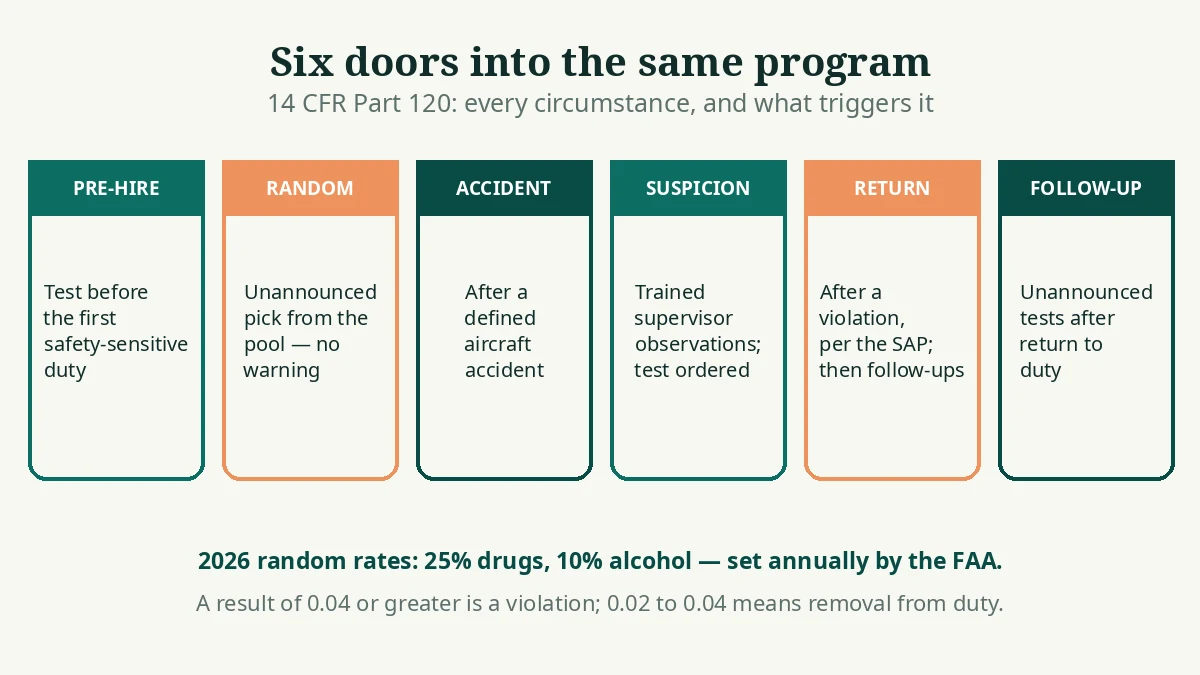
Flight attendants are safety-sensitive employees under 14 CFR Part 120
Under 14 CFR Part 120, the FAA drug and alcohol testing program, flight attendant duties are a listed safety-sensitive function — alongside flight crew, dispatch, maintenance, and air traffic control. Part 121 and Part 135 airlines must test those who perform these functions, with procedures following 49 CFR Part 40, the DOT testing rule. Coverage extends to direct and contract employees.
| Circumstance | Drugs | Alcohol | Trigger |
|---|---|---|---|
| Pre-employment | Required | Optional | Before first safety-sensitive duty |
| Random | Required | Required | Unannounced, spread across the year |
| Post-accident | Required | Required | After a defined aircraft accident |
| Reasonable suspicion / cause | Required | Required | Trained supervisor observations |
| Return-to-duty | Required | Required | After a violation, per the SAP's direction |
| Follow-up | Required | Required | Unannounced, per the SAP's plan |
For 2026, the FAA's minimum random testing rates are 25 percent of covered employees for drugs and 10 percent for alcohol (Federal Register notice, December 5, 2025). Rates are set annually and can change, but the structure does not: a flight attendant can be picked at random at any point in the year, with no warning. A result of 0.04 or greater is a violation; 0.02 to 0.04 requires removal from duty, though not itself a violation. The drug test is the DOT five-panel urine test — marijuana, cocaine, amphetamines, opioids, PCP — not an EtG test. For the cockpit side, see our guide to ETG testing for pilots.
The DOT/non-DOT split: why the EtG test is almost never the DOT test
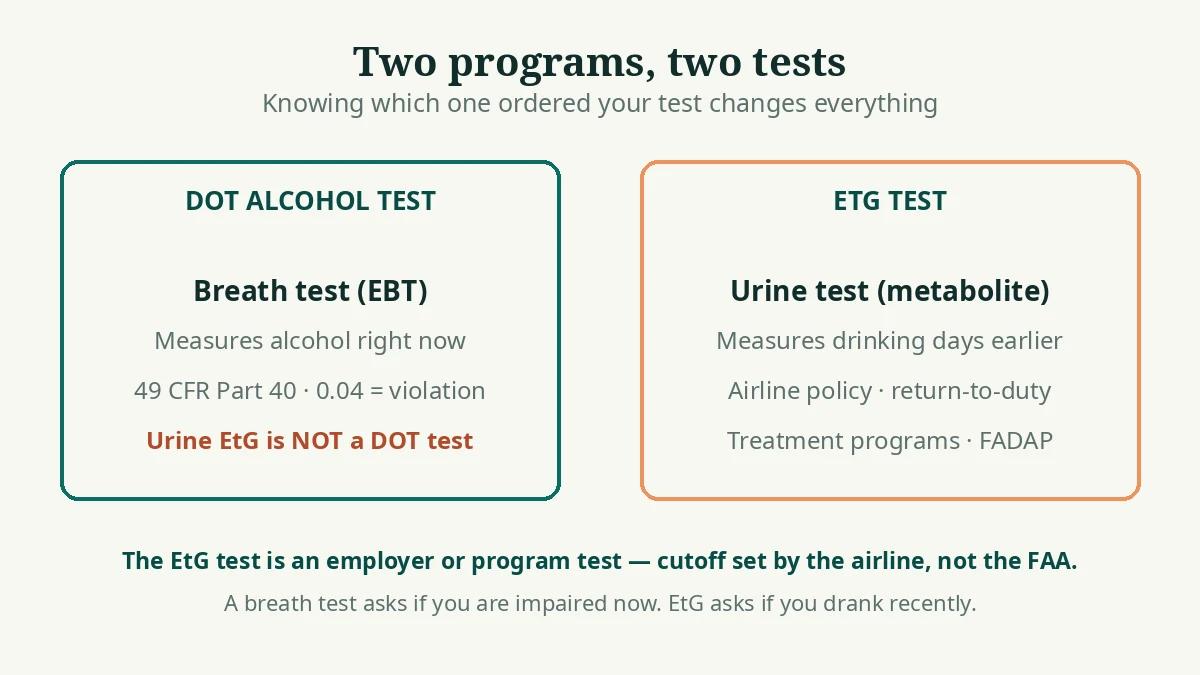
The most misunderstood fact about flight attendant alcohol testing: the DOT does not use urine EtG. DOT alcohol testing under 49 CFR Part 40 runs on breath. A screening test uses an approved breath or saliva device, and a screening result of 0.02 or higher must be confirmed on an evidential breath testing device (EBT). Urine, blood, and hair are not authorized specimens for DOT alcohol testing. EtG measures a metabolite from days earlier; the DOT test measures alcohol in the breath right now.
So where does EtG come in? Three places. First, the airline's own non-DOT policy: an airline can run its own program alongside the DOT one, with its own triggers and cutoffs — especially after an incident or complaint. Second, return-to-duty and follow-up monitoring: after a DOT violation, the Substance Abuse Professional's plan can include abstinence monitoring, where EtG's multi-day window is the natural tool. Third, treatment programs: a flight attendant in recovery may be tested regularly under a monitoring agreement. In all three cases the EtG test is an employer or program test, not a DOT test — the cutoff, lab, and consequences are set by the airline or program, not the regulation. The same split is explained in our DOT EtG testing guide.
"Bottle to throttle": 14 CFR 91.17 and the 8-hour rule
Separate from the testing program, 14 CFR 91.17 — the "bottle-to-throttle" rule — bars anyone from acting as a crewmember within 8 hours of drinking, while under the influence, while using a drug that affects their faculties, or at 0.04 alcohol concentration or greater. Each condition applies on its own: passing 8 hours does not help if you are still over 0.04, and being under 0.04 does not help if fewer than 8 hours have passed.
But 8 hours is a legal minimum, not a safety standard. The FAA's Aeronautical Information Manual recommends at least 12 to 24 hours between drinking and flying, and the FAA's alcohol brochure suggests 24 hours as the more conservative approach. And none of this is what an EtG test measures: a flight attendant can be well past the 8-hour rule, blow zero on a breath test, and still test positive on an EtG test for drinking two days earlier. The breath test asks whether you are impaired now; the EtG test asks whether you drank recently. That gap is why the EtG test exists in monitoring programs.
What cutoff applies to a flight attendant's EtG test
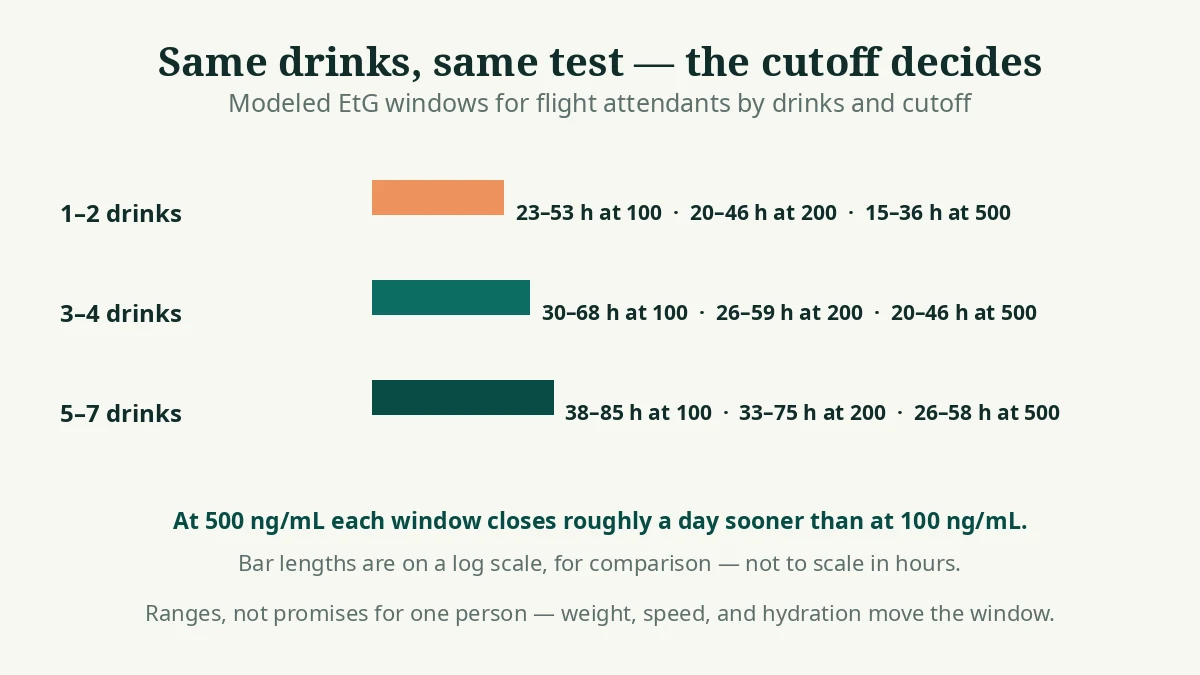
There is no national EtG cutoff for flight attendants: the airline, its return-to-duty program, or its treatment program picks one, usually 100, 200, or 500 ng/mL.
| Drinking | At 100 ng/mL | At 200 ng/mL | At 500 ng/mL |
|---|---|---|---|
| 1–2 drinks | 23–53 hours | 20–46 hours | 15–36 hours |
| 3–4 drinks | 30–68 hours | 26–59 hours | 20–46 hours |
| 5–7 drinks | 38–85 hours | 33–75 hours | 26–58 hours |
These are modeled ranges, not promises for one person. The pattern matters: at 500 ng/mL, each window closes roughly a day sooner than at 100, so the same weekend's drinking can be positive at 100 and negative at 500 by Tuesday morning. That is why the first question after any result should be "which cutoff was used?" Per the SAMHSA advisory, EtG is "scientifically unsupportable as the sole basis for legal or disciplinary action" — which is why a responsible program confirms a positive screen with LC-MS/MS before acting on it. The full comparison is in our 100 vs 500 ng/mL cutoff guide.
How long EtG stays detectable before a flight attendant's test
EtG can be detected in urine for up to about 80 hours after drinking, per the SAMHSA advisory.
How much was drunk, the cutoff, and the individual all move the window — no formula predicts one person's result. Drinking water before a test does not help: labs measure the EtG-to-creatinine ratio to catch dilution, and a dilute sample can be flagged. There is no reliable way to shorten the window. EtG is not a breathalyzer: a breath test measures alcohol right now, while EtG measures a metabolite from days ago. A flight attendant can blow zero on Tuesday and still test positive for Saturday night's drinks. See our realistic detection times guide and EtG calculation formula for the full picture.
Real-world scenario: four drinks Saturday, a random test Tuesday
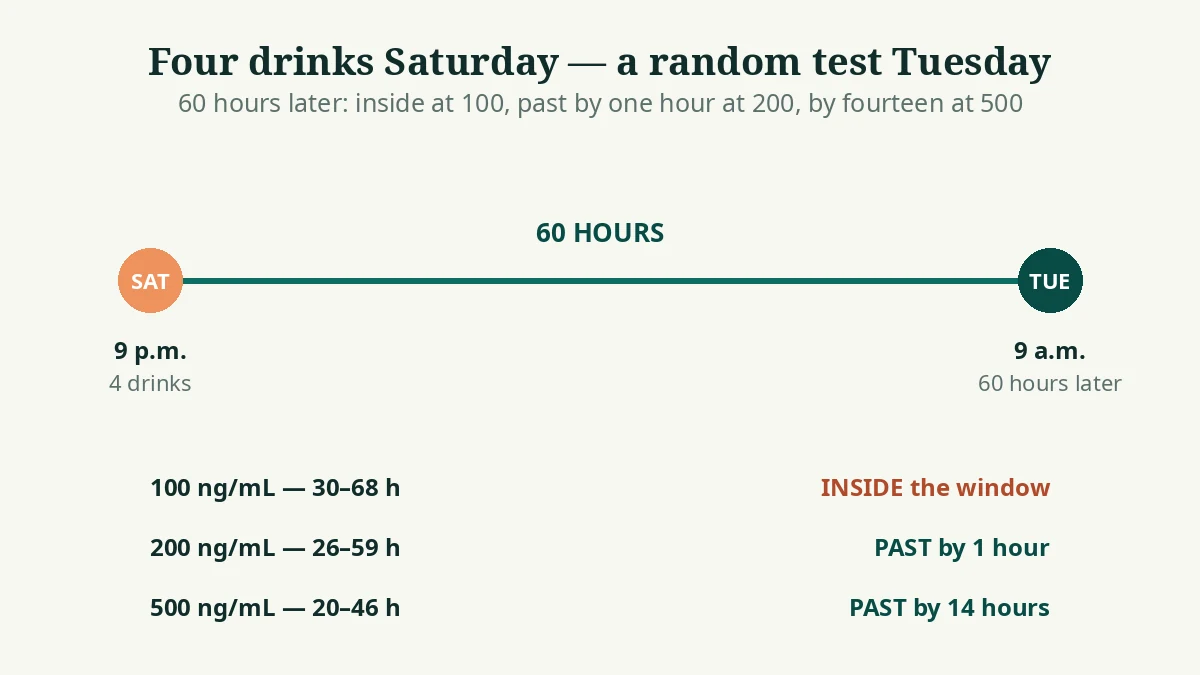
Lena, a Dallas-based flight attendant, gets home from a Saturday trip at 9 p.m. and has four drinks. On Tuesday at 9 a.m. she is called for a random test — 60 hours after her last drink.
At 100 ng/mL, the modeled window for three to four drinks is 30–68 hours — Lena is inside it. At 200 ng/mL (26–59 hours) she is past it by a single hour; at 500 ng/mL (20–46 hours) she is past it by fourteen hours, and a screen is likely negative. One weekend, one random draw, three outcomes from a number she was never told. The lesson is not that 500 ng/mL is safe to drink under — the cutoff decides the result as much as the drinking does.
The layover problem: hotel bars, crew rest, and the random call
The risk for cabin crew is not a wild night out — it is the ordinary rhythm of the job. A layover ends at a hotel bar; crew rest is measured in hours, not days. A flight attendant can be legal under the 8-hour rule, rested, and fit to fly — and still carry EtG from a drink two nights earlier into a random test.
Three features of the job make it worse. First, the schedule is unpredictable: reserve crew can be called with a few hours' notice, so no evening is reliably "safe". Second, drinking is social and built into crew culture — the layover dinner, the hotel bar, the drink after a long day. Third, the random pool never sleeps: the FAA's 10 percent annual alcohol rate means roughly one in ten covered employees is selected each year. The only reliable protection is knowing the policy: your airline's cutoff, whether its non-DOT program tests, and what a positive costs.
What a positive — or a refusal — can cost a flight attendant
The immediate cost is removal from safety-sensitive duty: a flight attendant with a confirmed DOT alcohol violation at 0.04 or above cannot fly until a Substance Abuse Professional evaluates them and return-to-duty is completed. For a non-DOT EtG positive, the airline's own policy decides — but the practical outcome is usually the same: pulled off the line, and often terminated, because an airline will not carry a crewmember with a drinking violation on its certificate.
Refusal is not a way around this: most policies treat it as a positive, with the same discipline. The protections worth using: ask for the cutoff and lab, whether the screen was confirmed by LC-MS/MS, and whether a split-sample retest is available. For the wider workplace picture, see our EtG testing for employment guide.
FADAP: the recovery path for flight attendants
FADAP — the Flight Attendant Drug and Alcohol Program, at fadap.org — is the recovery path built for cabin crew. Created by the flight attendant profession and funded by the FAA, it has run since September 2010, helping flight attendants reclaim their personal and professional lives through awareness, referral, and a flight-attendant-specific recovery support system.
What it offers: a confidential 24/7 helpline, (855) 333-2327, answered by a flight attendant peer; self- or peer-referral to treatment that understands the profession; and after treatment, a recovering flight attendant as a peer mentor — a "buddy" with at least two years of solid recovery. It is open to all FAA-certified flight attendants — the cabin-crew counterpart to the HIMS program for pilots. Calling FADAP is not reporting yourself to your airline — a confidential, peer-led route into treatment, and for many the way back to the cabin.
What to do if you are selected for a test
Respond the same day — a random selection has a reporting deadline; missing it counts as a refusal. Check the policy first — program, cutoff, lab, confirmation, consequence — then give the sample. If the result is positive, ask three questions in writing: which cutoff, whether the screen was confirmed by LC-MS/MS, and whether a split-sample retest is available.
Do not try to beat the test: water, supplements, and "detox" drinks do not reliably clear EtG, and a dilute sample can be flagged as cheating — punished more harshly than a positive by many policies. The simplest protection: know the policy and cutoff, and do not drink in the days before a possible test.
Using the EtG calculator before a test
The EtG calculator estimates the same windows as the tables — read it as a range, never a pass date. Run your numbers.
Frequently asked questions
Do flight attendants get EtG tested?+
Yes — flight attendants are safety-sensitive employees under the FAA's drug and alcohol testing program (14 CFR Part 120), so airlines must test them at hire, at random, after an accident, on reasonable suspicion, and on return to duty. But the DOT alcohol test itself is a breath test, not an EtG test. EtG testing enters through the airline's own non-DOT policy, return-to-duty monitoring, or a treatment program.
Is an EtG test part of the FAA or DOT testing program?+
No. DOT alcohol testing under 49 CFR Part 40 uses a breath test (or a saliva screen followed by a breath confirmation) — urine EtG is not a DOT test at all. A flight attendant's EtG test comes from the airline's non-DOT policy, a return-to-duty or follow-up monitoring schedule, or a treatment program such as FADAP. If someone tells you a DOT test uses EtG, they are confusing the DOT program with an employer's own testing.
How does the 8-hour bottle-to-throttle rule relate to an EtG test?+
Under 14 CFR 91.17, no crewmember may act as a crewmember within 8 hours of drinking, while under the influence, or with an alcohol concentration of 0.04 or greater. The 8 hours is a legal minimum, not a safety standard — the FAA's own guidance recommends at least 12 to 24 hours between drinking and flying. EtG, by contrast, can detect drinking from days earlier, long after the 8-hour window has passed.
What EtG cutoff applies to flight attendants?+
There is no national EtG cutoff for flight attendants. The airline, its return-to-duty program, or its treatment program sets it, usually 100, 200, or 500 ng/mL. The cutoff decides the result as much as the drinking does: four drinks are modeled at 30–68 hours at 100 ng/mL but only 20–46 hours at 500 ng/mL, so the same weekend can be positive at one cutoff and negative at another.
How long after drinking will a flight attendant test positive on an EtG test?+
It depends on how much was drunk and the cutoff. Modeled windows from the site's calculator: one to two drinks, 23–53 hours at 100 ng/mL and 15–36 hours at 500; three to four drinks, 30–68 hours at 100 and 20–46 at 500; five to seven drinks, 38–85 hours at 100 and 26–58 at 500. SAMHSA's advisory puts the outer limit at about 80 hours. These are ranges, not predictions for one person.
What is FADAP and how does it help a flight attendant?+
FADAP — the Flight Attendant Drug and Alcohol Program (fadap.org) — is a peer-support and treatment-referral program created by the flight attendant profession and funded by the FAA, running since September 2010. It offers a confidential 24/7 helpline, self- or peer-referral to treatment, and a recovering flight attendant as a peer mentor after treatment. It is the cabin-crew counterpart to the HIMS program for pilots. Calling FADAP is not the same as reporting yourself to your airline.
What happens if a flight attendant refuses an EtG test?+
Most airline policies treat a refusal as a positive, with the same discipline — usually removal from safety-sensitive duty and, often, termination. A refusal also removes your best evidence: the sample itself. If you believe a test was ordered unfairly, take the test and challenge the process afterward in writing, asking for the cutoff, the lab, LC-MS/MS confirmation, and whether a split-sample retest is available. A confirmed DOT alcohol violation at 0.04 or above requires evaluation by a Substance Abuse Professional before any return to duty.
Evidence and limitations
This article summarizes published guidance and research on EtG testing for flight attendants, plus the science of alcohol biomarkers. Group-level findings cannot predict one person’s result, and this article is educational only — it is not legal or medical advice. Testing rules vary by airline, program, and state; talk to a local attorney about a live case or a termination.
- Aviatize — Aviation Drug & Alcohol Testing (DOT/FAA): 14 CFR Part 120 covers flight attendant duties as a safety-sensitive function; testing types (pre-employment, random, post-accident, reasonable cause, return-to-duty, follow-up); 2026 minimum random rates 25% drugs / 10% alcohol (Federal Register notice, December 5, 2025); 0.04 violation, 0.02–0.039 removal
- National Drug Screening — FAA Regulation 49 CFR Part 120: covered employees include flight attendant duties; drug test types and alcohol test types; 8-hour pre-duty alcohol rule for flight crewmember, flight attendant, and air traffic controller duties; two-supervisor reasonable-cause rule for drugs, one trained supervisor for alcohol
- CTSYS — 14 CFR Part 120: Drug & Alcohol Testing Program Guide: Part 120 applicability (Part 119 certificate holders, Parts 121/135), testing under 49 CFR Part 40 procedures, 2026 random rates 25% / 10%
- Student Pilot — 8 Hours Bottle to Throttle: The FAA Alcohol Rule (91.17): 14 CFR 91.17(a) bars acting as a crewmember within 8 hours of drinking, while under the influence, or at 0.04 or greater; AIM recommends at least 12 to 24 hours; FAA brochure suggests 24 hours
- Gleim FAR/AIM — § 91.17 Alcohol or drugs: full regulation text (8 hours, under the influence, 0.04 in blood or breath)
- American Screening Corp — EBT Alcohol Test: Cutoffs and Detection Windows Compared: an evidential breath testing device is the only method DOT accepts for a confirmation result; saliva screens are DOT-permitted for screening only; urine EtG is not part of DOT testing
- AlcoPro — Breathalyzer vs Saliva Alcohol Tests for the Workplace: under 49 CFR Part 40, confirmation must use an approved EBT; Part 40 does not authorize blood, urine, EtG, or another specimen for alcohol testing
- FADAP — Flight Attendant Drug and Alcohol Program (fadap.org): substance-abuse prevention program created and promoted for and by the flight attendant profession and funded by the FAA; open to all flight attendants regardless of status (active, furloughed, on leave)
- National Academies (NCBI Bookshelf) — Substance Misuse Programs in Commercial Aviation, Ch. 2: FADAP established September 2010, endorsed by flight attendant peers and managers from 25 carriers at the March 2009 “Return to the Cabin” Summit; FAA funds the program and contracts with AFA-CWA for administration; self/peer referral, treatment referral, peer mentorship
- FADAP — Flight Attendant in Recovery: peer-mentor volunteers are active flight attendants with at least two years of solid recovery; confidential 24/7 helpline (855) 333-2327
- SAMHSA Advisory: The Role of Biomarkers in the Treatment of Alcohol Use Disorders (2006, revised 2012) — EtG detectable up to ~80 hours; EtG “scientifically unsupportable as the sole basis for legal or disciplinary action”
- McDonell et al. (2015) — EtG immunoassay cutoff sensitivity in alcohol-dependent outpatients (1,589 samples)
- Mackus et al. (2017) — EtG detection and elimination kinetics after controlled alcohol intake
- Jatlow et al. — EtG and EtS in urine after controlled alcohol administration
- EtG Calculator Pro — ETG Testing for Pilots: the cockpit side of the same FAA program
- EtG Calculator Pro — DOT EtG Test: the DOT/non-DOT split explained
- EtG Calculator Pro — ETG Testing for Employment: consent and consequences in the workplace