The short answer: an ETG test in sober living checks recent drinking — and a positive can cost you the bed
An ETG test in sober living is a urine test for ethyl glucuronide, a direct metabolite of alcohol. It answers one question: has this person drunk alcohol in roughly the past one to three days?
A recovery residence is a shared, substance-free home where people in early recovery live together after treatment and before living independently. Residents pay rent, work or study, do chores, follow a curfew, and submit to drug testing — testing enforces the house rules that keep everyone safe.
A probation EtG test is ordered by a court; an employment EtG test by an employer. A sober living EtG test is ordered by the house itself, under rules the residents agreed to when they moved in — and the consequence is usually losing the bed, not a legal sanction.
What a sober living home is — and why it tests
The national framework comes from the National Alliance for Recovery Residences (NARR), founded in 2011. NARR sets the standards and accredits state-level affiliates — Florida's FARR, Texas's TARR, Ohio's ORH, and others — which certify the homes. Certification is voluntary, but it signals a home held to published standards.
NARR classifies recovery residences in four levels. Level I is peer-run, with no paid staff — the Oxford House model. Level II is monitored, with a house manager, structured rules, regular drug testing, and required meeting attendance — the most common level. Levels III and IV add staff and, at Level IV, treatment on site. At every level, a drug- and alcohol-free environment is required, and certified homes must have a written drug testing policy covering tests, frequency, selection, chain of custody, consequences, and documentation. SAMHSA's Best Practices for Recovery Housing (October 2023) agrees: a substance-free environment is a core requirement, and drug testing is a primary tool for meeting it.
In the best-known outcomes study, 245 residents followed for 18 months saw abstinence rise from 17% at entry to 49.1% at 12 months, while arrests fell — testing is part of the accountability structure behind those numbers.
How sober living EtG testing actually works
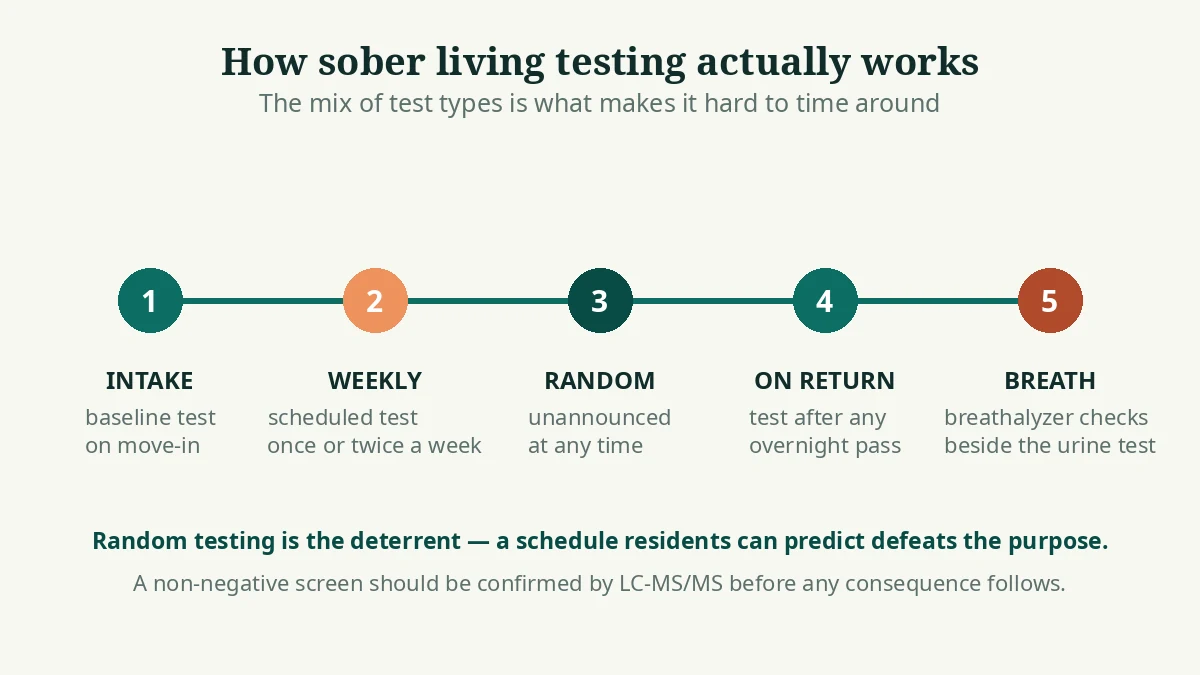
Most homes use a mix of test types: a scheduled weekly test catches regular use, and a random test catches the drink timed between scheduled tests. The deterrent value of testing depends on unpredictability — a schedule residents can anticipate defeats the purpose.
| Test type | When it happens | What it is for |
|---|---|---|
| Intake test | Before or immediately on move-in | Confirms the resident enters sober. |
| Scheduled test | Weekly in most homes; twice weekly in some | Routine accountability. |
| Random test | Unannounced, at any time | Catches drinking timed between scheduled tests. |
| Cause-for-concern test | When staff suspect use | Checks a specific suspicion. |
| Return-from-pass test | On return from an overnight pass | Confirms nothing happened off-site. |
| Breathalyzer | Alongside urine tests | Catches very recent drinking. |
Bridges Sober Living requires at least one weekly urine screen plus three breathalyzer checks; Eudaimonia Recovery Homes tests residents twice a week, about 80 hours apart, screening for more than 70 substances and using EtG and EtS for alcohol.
Collection is usually observed, and the sample is often run first as an instant immunoassay cup. A non-negative screen should be confirmed by LC-MS/MS — in a house where a positive means discharge, ask at move-in whether the house confirms positives.
Which cutoff does an ETG test sober living home use?
There is no national EtG cutoff for sober living. Each house writes its own testing policy, including the cutoff — and the cutoff often decides the outcome, because the same urine can be positive at 100 ng/mL and negative at 500 ng/mL.
The three cutoffs in common use are 100, 200, and 500 ng/mL. At 100 ng/mL the test is at its most sensitive. At 500 ng/mL it is deliberately less sensitive, so incidental exposure — mouthwash, hand sanitizer, some medicines — is less likely to produce a positive. SAMHSA's 2012 advisory recommended 500 ng/mL where a result carries legal or disciplinary consequences, to cut false positives from incidental exposure.
For sober living, the 2026 testing-protocol guidance most operators follow makes the same recommendation: use the 500 ng/mL cutoff to reduce false positives from incidental exposure, and run EtG weekly or biweekly alongside random breathalyzer checks. Some houses test at 100 ng/mL for the strictest abstinence check. Ask the house which cutoff it uses before you move in.
How long does alcohol show up on a sober living EtG test?
EtG is detectable in urine for up to about 80 hours after drinking — which is why sober living homes use it: a breathalyzer goes back to zero within hours, but EtG still shows a weekend drink on a Monday or Tuesday test. The ranges below come from this site's calculator model.
| Drinks | 100 ng/mL | 200 ng/mL | 500 ng/mL |
|---|---|---|---|
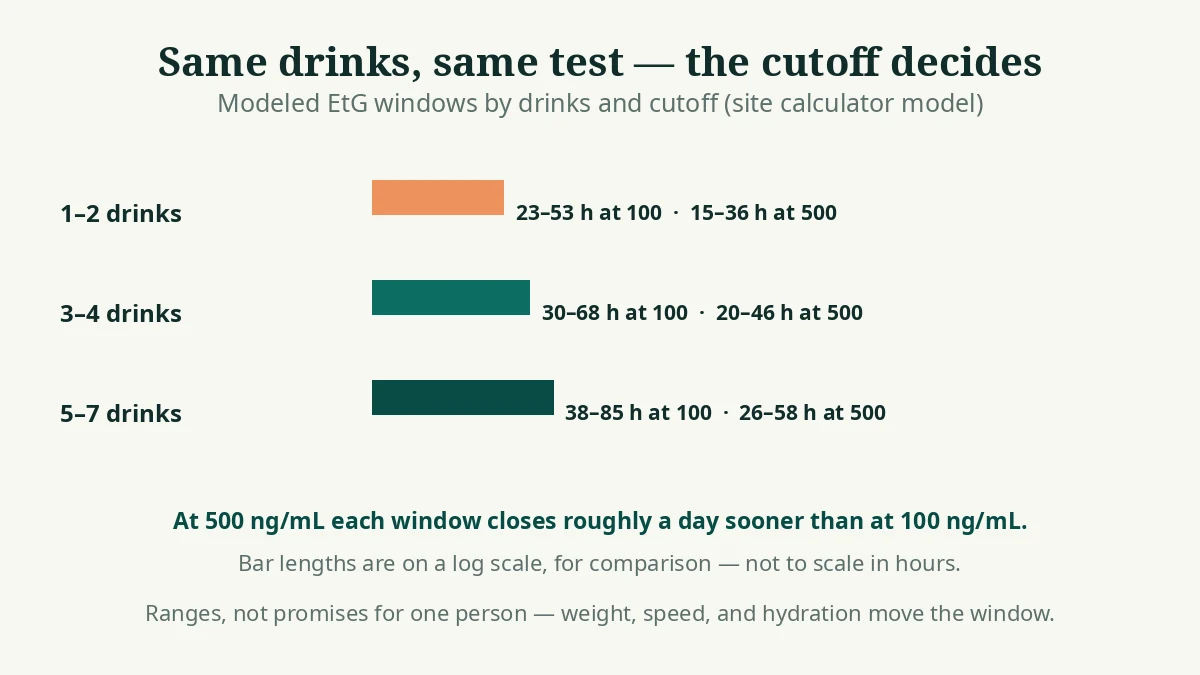
| 1–2 drinks | 23–53 hours | 20–46 hours | 15–36 hours |
| 3–4 drinks | 30–68 hours | 26–59 hours | 20–46 hours |
| 5–7 drinks | 38–85 hours | 33–75 hours | 26–58 hours |
| 8–12 drinks | 50–105 hours | 44–92 hours | 34–71 hours |
| More than 12 drinks | 65–130 hours | 57–114 hours | 44–88 hours |
Read these as ranges, not promises for one person: weight, drinking speed, and hydration all move the window. At 500 ng/mL every window closes roughly a day sooner than at 100 ng/mL — the reason a resident should never guess at a pass date.
Real-world scenario: four drinks on Saturday, a random test on Tuesday
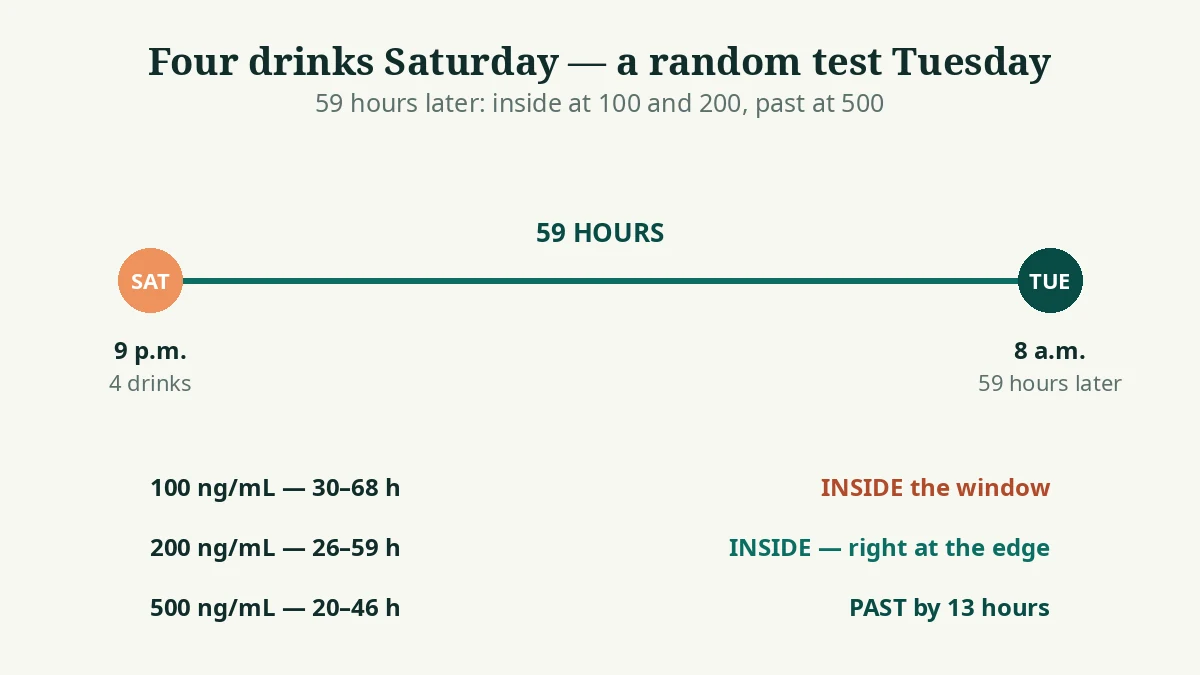
A resident has four drinks at a family gathering on Saturday at 9 p.m. and says nothing. On Tuesday at 8 a.m., 59 hours later, the house manager calls a random test.
Four drinks gives a modeled window of 30–68 hours at 100 ng/mL, 26–59 hours at 200 ng/mL, and 20–46 hours at 500 ng/mL. At 59 hours he is inside at 100 ng/mL, inside at 200 ng/mL — right at the top edge — and past at 500 ng/mL by 13 hours. In a 100 or 200 ng/mL house, the test is likely positive; in a 500 ng/mL house, likely negative.
Nothing about the drinking changed — the house's cutoff decided whether he keeps his bed. The right question is "clear at which cutoff, in this house" — only the house manager can answer it.
What happens if you test positive in sober living?
The consequence is set by the house, not by a lab or a court — and it is usually severe, because the house is protecting every other resident's recovery. In many homes a positive test means leaving: Bridges Sober Living states that any client who tests positive must leave the premises. Some homes are more graduated — a first positive brings increased monitoring, with discharge reserved for a second. Which version a house follows is in its written policy.
Oxford House, the largest peer-run model, is the strictest version: any resident who returns to using must be expelled immediately — and the house can lose its charter if it does not. The membership contract is explicit: refusal to submit a sample is considered a relapse, an absence of more than three days that was not pre-arranged may be considered a relapse, and a majority of house members can vote a resident out even without a definitive test. Section 2036 of the Anti-Drug Abuse Act of 1988 requires the houses to prohibit alcohol and drugs, expel violators, share expenses equally, and decide democratically.
Two things surprise people: there is no landlord-tenant due process — members exclude themselves from it when they sign — and the house may notify the resident's Community Correction Officer that the person no longer lives there, and state the reason. For a resident also on probation, a failed house test can reach the probation officer the same day. None of this is a court finding — a house test is a house decision, so ask for LC-MS/MS confirmation before accepting an unconfirmed screen.
Incidental exposure: mouthwash, hand sanitizer, and medicines
EtG is extremely sensitive at low cutoffs, and it can detect incidental alcohol exposure — the alcohol in mouthwash, hand sanitizer, and some medicines. That is why the 500 ng/mL cutoff exists: at that level, ordinary incidental exposure rarely produces a positive, while at 100 ng/mL it can.
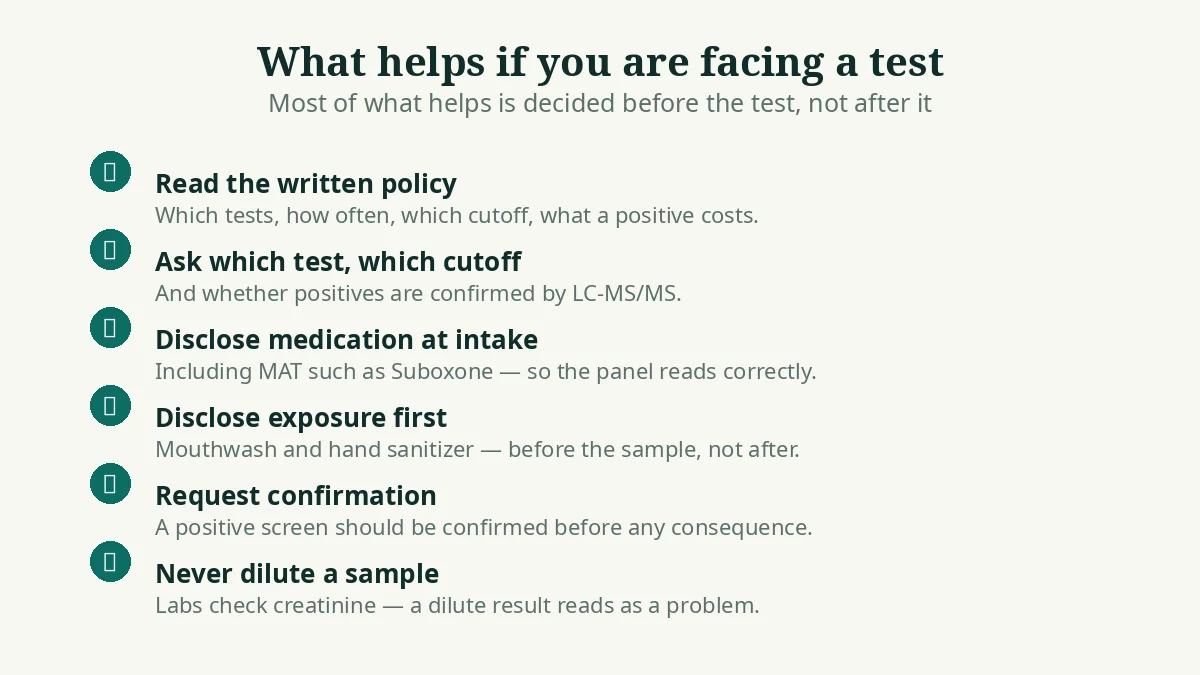
Disclose exposure before the sample, not after — a disclosure made after a positive reads very differently. If a screen comes back positive and you believe it was incidental, ask for LC-MS/MS confirmation and for the result to be read alongside EtS — a genuine drink raises both, while incidental exposure patterns differ. Our mouthwash guide covers the exposure science in detail.
What helps if you are facing a test in sober living
Most of what helps is decided before the test, not after it. Read the house's written testing policy at move-in — which tests, how often, which cutoff, what a positive costs, and whether positives are confirmed.
Disclose prescribed medications, including medication-assisted treatment such as Suboxone, at intake so the panel can be read correctly. And do not dilute a sample: labs check creatinine, and a dilute result can be treated the same as a refusal — in an Oxford House, a refusal is a relapse.
If you did drink, tell the house manager before the test, not after the result. Some houses will still discharge you, but a self-report is the difference between leaving with a referral to treatment and leaving with a discharge the next house will ask about.
How sober living testing differs from probation and court testing
The test is the same urine EtG test, but almost everything around it is different. A probation test is ordered by a court, with consequences that can include a violation hearing. A sober living test is ordered by the house, under house rules, with consequences that end at the front door. There is no hearing, no appeal to a judge, and — in the Oxford House model — no landlord-tenant due process.
The two systems overlap often, because many sober living residents are also on probation, in drug court, or under a family-court order — and then the resident faces two testing regimes at once, each with its own cutoff and consequences. A failed house test can trigger a probation consequence if the house reports it, and a failed probation test can cost the resident the house.
This article is educational only — not legal or medical advice.
Using the EtG calculator before a test
The EtG calculator estimates the same detection windows the table above uses. Read the result as a range, never a pass date — it cannot tell you what your house will decide. Run your numbers through the calculator.
Frequently asked questions
Do all sober living homes drug test residents?+
Almost all do, and certified homes must. NARR standards require certified recovery residences to have a written drug testing policy, and SAMHSA's 2023 Best Practices for Recovery Housing treats maintaining a substance-free environment as a core requirement, with testing as a primary tool. The exact mix — intake, scheduled, random, cause-for-concern, and return-from-pass tests — varies by house, so read the written policy before moving in.
How often are EtG tests done in sober living?+
Weekly scheduled testing is the most common pattern, plus random unannounced tests. Some homes test twice a week — Eudaimonia Recovery Homes tests residents twice weekly, about 80 hours apart, matching EtG's detection window so the two tests together cover nearly the whole week. Breathalyzer checks are often more frequent, several times a week, because they catch very recent drinking that EtG testing would also catch days later.
What EtG cutoff do sober living homes use?+
There is no national cutoff for sober living — each house sets its own. The three cutoffs in common use are 100, 200, and 500 ng/mL. The 2026 testing-protocol guidance most operators follow recommends 500 ng/mL to reduce false positives from incidental exposure such as mouthwash and hand sanitizer. Some houses use 100 ng/mL for the strictest abstinence check. The same urine can be positive at 100 and negative at 500, so ask the house which cutoff it uses.
Can mouthwash or hand sanitizer make you fail a sober living EtG test?+
Yes, at low cutoffs — EtG is sensitive enough to detect incidental alcohol exposure from mouthwash, hand sanitizer, and some medicines. That is why the 500 ng/mL cutoff exists: at that level, ordinary incidental exposure rarely produces a positive. Disclose any exposure before the sample, not after, and ask for LC-MS/MS confirmation of any positive screen — a genuine drink raises both EtG and EtS, while incidental exposure patterns differ.
What happens if you fail an EtG test in sober living?+
In many homes you must leave — Bridges Sober Living states that any client who tests positive must leave the premises, to protect the other residents' recovery. Some homes are more graduated: a first positive brings increased monitoring and more frequent testing, with discharge on a second positive. In an Oxford House, any resident who returns to drinking must be expelled immediately, and the house can lose its charter if it does not expel them. The consequence is set by the house's written policy.
Can a sober living home test you without warning?+
Yes — random, unannounced testing is the point. The deterrent value of testing depends on unpredictability, and a schedule residents can anticipate defeats the purpose. Refusing a test is usually treated the same as failing one: in the Oxford House membership contract, refusal to submit a sample is considered a relapse, and a majority of house members can vote a resident out even without a definitive test.
How long after drinking will an EtG test be positive in sober living?+
EtG is detectable in urine for up to about 80 hours after drinking, depending on how much was consumed and the cutoff. In our modeled ranges, 3–4 drinks gives 30–68 hours at 100 ng/mL, 26–59 hours at 200 ng/mL, and 20–46 hours at 500 ng/mL; heavier drinking extends past 80 hours at the 100 ng/mL cutoff. These are ranges, not promises for one person — weight, drinking speed, and hydration all move the window.
Evidence and limitations
This article summarizes published guidance and public records on EtG testing in sober living homes, plus the science of alcohol biomarkers. Group-level findings cannot predict one person’s result, and this article is educational only — it is not legal or medical advice. House rules vary by home and by state; check your own house’s written testing policy and consider a qualified counsellor or attorney for a live situation.
- One Step Software — NARR Standards for Recovery Residences: the four levels, from peer-run Level I to clinical Level IV, and drug screening at every level
- SoberFriend — NARR Compliance Guide for Sober Living Homes: founded 2011, state affiliates certify homes, a written drug testing policy is required
- Tennessee Association of Recovery Residences — High-Quality Recovery Housing: SAMHSA’s Best Practices for Recovery Housing (October 2023) and the NARR standards as an evidence-based model
- One Step Software — How to Randomize Drug Testing in Your Sober Living Home: NARR testing guidelines, SAMHSA 2023 best practices, and why unpredictability is the deterrent
- Sober Living App — Sober Living Home Drug Testing Protocols (2026): EtG/EtS up to 80 hours; the 500 ng/mL cutoff recommended to reduce false positives from incidental exposure
- Eudaimonia Recovery Homes — Drug Testing in Sober Living: intake, scheduled, random, and cause-for-concern tests; twice-weekly testing about 80 hours apart
- Eudaimonia Recovery Homes — Drug & Alcohol Screening: 70+ substances, EtG and EtS for alcohol, lab confirmation within 72 hours
- Bridges Sober Living — FAQs: minimum one weekly urine screen and three breathalyzers; any client who tests positive must leave the premises
- Oxford House (Virginia) — Membership Contract: refusal to submit a sample is considered a relapse; majority vote can expel without a definitive test; no landlord-tenant due process; §2036 of the Anti-Drug Abuse Act of 1988
- Oxford House (South Carolina) — Guest Expectations: the house can lose its charter if a resident who uses alcohol or drugs is not expelled immediately
- Lantana Recovery — Sober Living Homes: What They Are and How They Work: the four NARR levels and the Polcin et al. (2010) 18-month outcomes study of 245 residents
- SAMHSA Advisory: The Role of Biomarkers in the Treatment of Alcohol Use Disorders (2006, revised 2012) — EtG detectable up to ~80 hours; EtG “scientifically unsupportable as the sole basis for legal or disciplinary action”
- McDonell et al. (2015) — EtG immunoassay cutoff sensitivity in alcohol-dependent outpatients (1,589 samples)
- Mackus et al. (2017) — EtG detection and elimination kinetics after controlled alcohol intake
- Jatlow et al. — EtG and EtS in urine after controlled alcohol administration
- EtG Calculator Pro — ETG Testing in Recovery Programs: how treatment programs set their cutoffs
- EtG Calculator Pro — ETG Testing for Probation: the court side of testing
- EtG Calculator Pro — Can Mouthwash Cause a Positive EtG Test?: the incidental-exposure science in detail