The short answer: railroad EtG testing is company policy, not federal law
An ETG test for railroad workers is a urine test for ethyl glucuronide, an alcohol metabolite, showing whether the worker drank in the past one to three days. If you work on the railroad, you are already tested — but probably not with EtG. Federal railroad testing under 49 CFR Part 219 uses breath for alcohol and urine for drugs. EtG appears only when a railroad adds its own non-DOT urine test on top.
About 149,600 people work in rail transportation in the United States, per the Bureau of Labor Statistics — roughly 31,840 locomotive engineers and 40,760 conductors and yardmasters. Nearly all are covered by the federal testing program — but none by a federal EtG requirement, because none exists. Whether you face one depends on your railroad's policy, your role, and which of five triggers applies.
Who Part 219 covers — and who it does not
The Federal Railroad Administration's drug and alcohol rule, 49 CFR Part 219, applies to railroads and their contractors on the general system, and names three groups of covered employees.
| Covered group | Who it is | Covered since |
|---|---|---|
| Covered service | Train, dispatching, and signal employees | Long-standing |
| Maintenance-of-way | Roadway workers as defined in 49 CFR 214.7 | June 12, 2017 |
| Mechanical | Employees who inspect rolling equipment under Parts 215–299 | March 4, 2022 |
Two exceptions matter. A railroad with 15 or fewer hours-of-service employees and no joint operations with another railroad (except for interchange) is exempt from the reasonable-cause, random-testing, and referral-program parts — though pre-employment and post-accident testing still apply. Office staff are outside Part 219 entirely, while contractors performing covered service are covered like the railroad's own employees.
The two-track system: federal breath tests vs company EtG urine tests
Two separate testing systems apply to railroad workers, with different specimens, rules, and consequences.
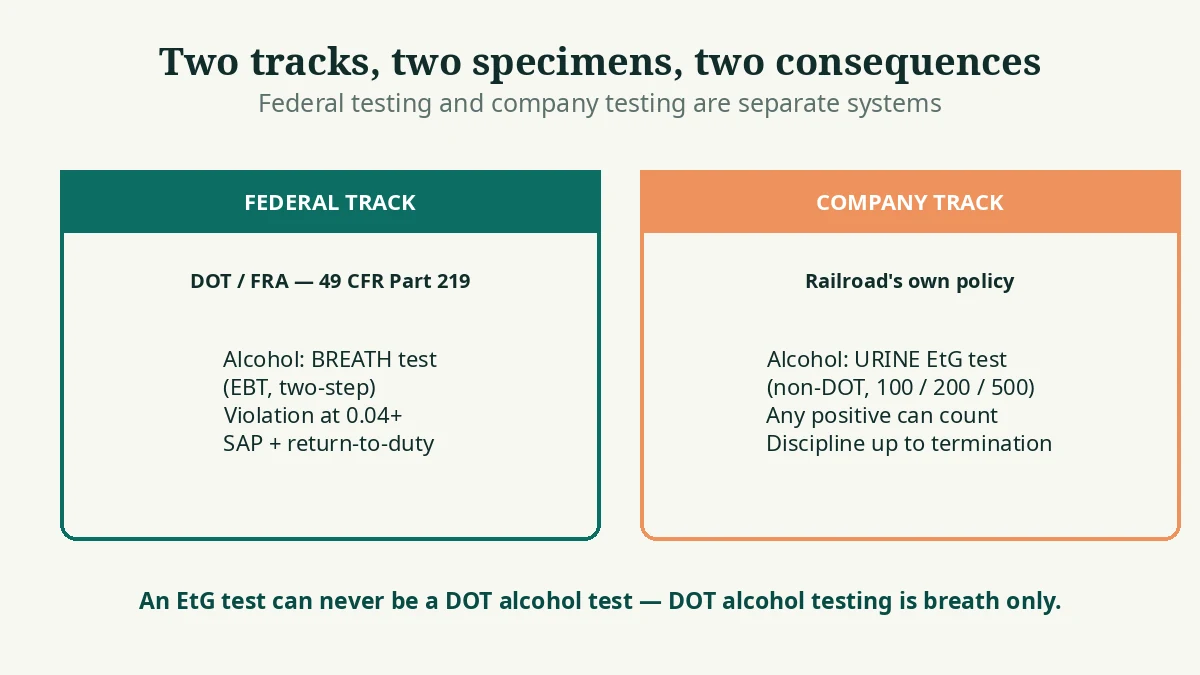
| Federal (DOT / FRA) track | Company-authority track | |
|---|---|---|
| Authority | 49 CFR Part 219 + Part 40 | The railroad's own policy |
| Alcohol specimen | Breath (evidential breath test device) | Urine — EtG is possible here |
| Alcohol violation | 0.04 or above; 0.02–0.039 means removal for 8 hours | Set by the railroad — any positive EtG can count |
| Consequences | Federal sanctions, SAP process, possible engineer decertification | Company discipline up to termination |
DOT alcohol testing does not use urine at all. Under 49 CFR Part 40, alcohol is measured by breath in two steps: a screening test, then a confirmation test on an evidential breath testing device if the screen reads 0.02 or higher. EtG and its sister metabolite EtS are urine metabolites — so an EtG test can never be a DOT alcohol test. The DOT's own railroad employee handout says it plainly: federal testing follows Parts 40 and 219, and "any other testing would be conducted under company authority."
That split decides what a positive means. A federal breath test at 0.04 or above is a federal violation. A company EtG positive is a company-policy violation: the railroad decides the penalty, and it can be termination on the first positive. The EtG result goes on no federal record — but the company can still end the employment.
When railroads actually test
Railroad testing happens under five triggers — three federal, two either federal or company depending on how the railroad runs them.
| Trigger | When it happens | Which track |
|---|---|---|
| Pre-employment | Before the first covered service | Drug test mandatory; alcohol test optional |
| Random | Unannounced, any shift, no reason needed | Federal; EtG only if the railroad adds one |
| Reasonable suspicion | A trained supervisor notes signs of impairment | Federal, on specific observations |
| Post-accident | After a qualifying accident or incident | Federal FRA toxicology: blood + urine |
| Return-to-duty / follow-up | After a federal violation | Federal, with a SAP evaluation |
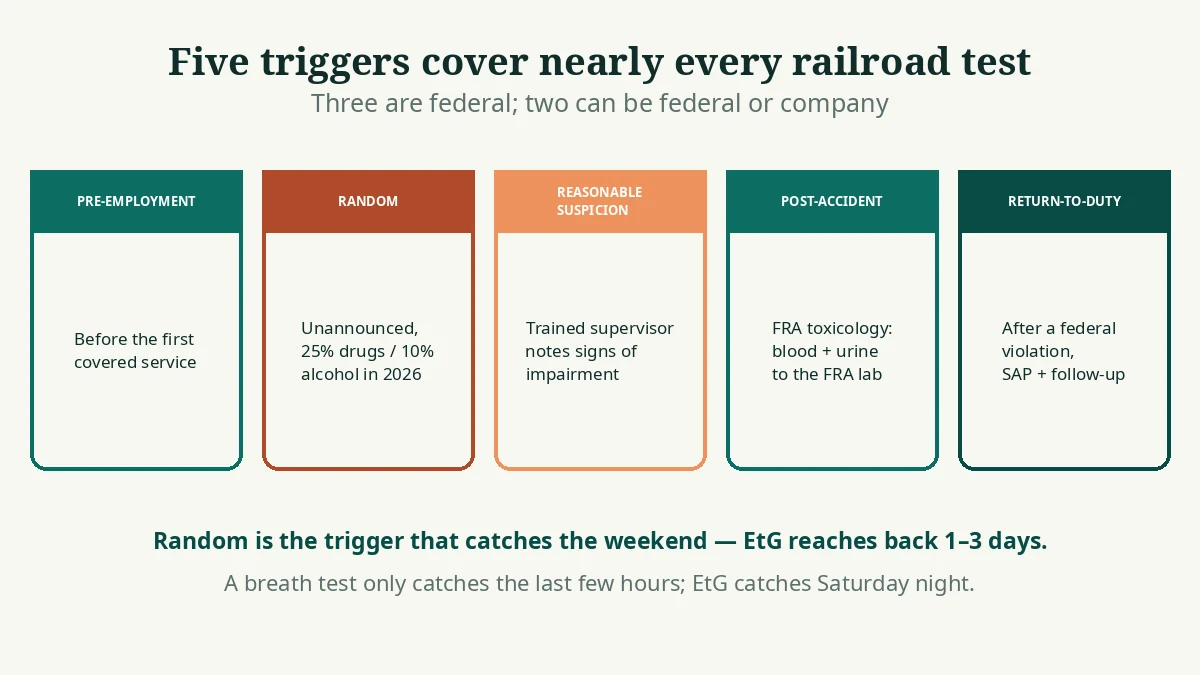
Pre-employment is the sharpest split. A drug test is mandatory before a covered employee's first covered service. A pre-employment alcohol test is optional: if the railroad does one, it must test every covered employee the same way after a contingent offer, and the employee may not begin covered service at 0.04 or above. Random testing runs on set annual rates — 25 percent for drugs and 10 percent for alcohol in 2026 — and every covered employee must be in the pool. Reasonable suspicion testing follows a trained supervisor's specific, contemporaneous observations; a drug test needs two supervisors to observe, at least one trained.
Post-accident testing is the one federal railroad test that uses urine for alcohol-related purposes — but it is not an EtG test. After a qualifying accident, the FRA requires blood and urine specimens sent to its own laboratory for full toxicological screening, with a mandatory urine split sample. A company can also run its own post-accident EtG test alongside the federal one — and that company test is the one that can catch drinking from days earlier, long after a breath test would read zero.
Which railroad jobs get tested most
Locomotive engineers and conductors are tested the most: they are in the random pool every year, first tested after any accident, and an engineer faces decertification under Part 240 after a federal violation. Dispatchers and signal employees are covered the same way — a dispatcher's error can move two trains onto the same track. Maintenance-of-way workers joined in 2017 and mechanical inspectors in 2022, so track gangs and car inspectors are now in the same random pools as train crews. Roles outside Part 219 — office staff and managers who do not perform covered service — face the least federal testing, though a railroad's general policy can still test them, including with EtG.
What an EtG test for railroad workers actually measures
EtG, or ethyl glucuronide, is a direct metabolite of alcohol. When you drink, a small share of the alcohol is converted into EtG, which leaves the body in urine over the next one to three days. A breath test measures alcohol in your breath right now; an EtG test measures whether you drank recently. That is why railroads add EtG to their company testing: a breath test at the start of a shift cannot see Saturday night, but an EtG urine test on Monday can.
EtG cannot show impairment. A conductor who drank off duty on Saturday can test positive on a Monday random test while fully sober. SAMHSA's advisory says EtG can be detected for up to about 80 hours after heavy drinking, and warns that disciplinary action based solely on a positive EtG is "inappropriate and scientifically unsupportable." A positive screen should always be confirmed by a laboratory test first. False positives also happen — most famously from hand sanitizer or mouthwash — and confirmation is the protection against them.
Detection windows by drinks and cutoff
How long EtG stays detectable depends on how much was drunk and the cutoff used — a lower cutoff catches smaller amounts for longer.
| Drinks | 100 ng/mL | 200 ng/mL | 500 ng/mL |
|---|---|---|---|
| 1–2 drinks | 23–53 hours | 20–46 hours | 15–36 hours |
| 3–4 drinks | 30–68 hours | 26–59 hours | 20–46 hours |
| 5–7 drinks | 38–85 hours | 33–75 hours | 26–58 hours |
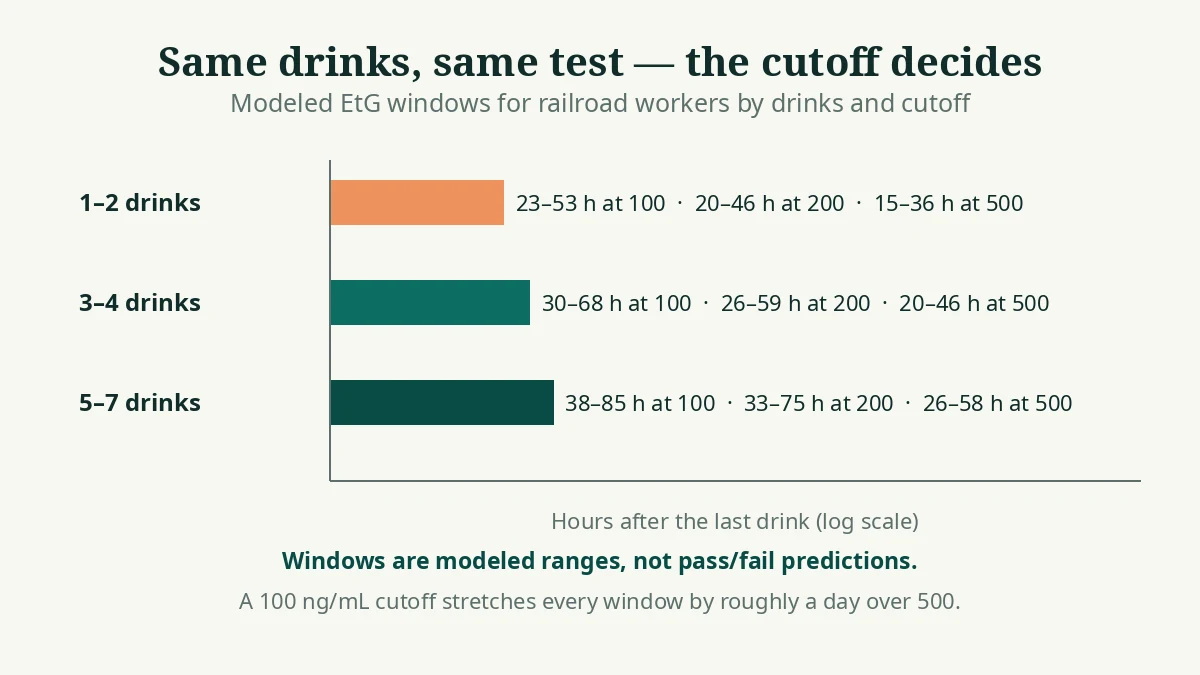
The gap between cutoffs is the pattern to remember. At 100 ng/mL, a heavy night can stay detectable for roughly three and a half days; at 500 ng/mL, the same night clears in about two. That is why the first question about any EtG test is which cutoff it uses — a 100 ng/mL company test and a 500 ng/mL company test are, in practice, two different tests. These are modeled ranges, not pass dates: weight, hydration, drinking speed, and duration all shift the real number.
Real-world scenario: four drinks Saturday, a random test Monday
A conductor finishes a Friday-night run and has four drinks with friends, the last one at 1 a.m. on Saturday. He is sober by Saturday afternoon and works a normal Sunday. On Monday at 9 a.m., his name comes up in the random pool and he is sent for a company urine test that includes EtG — 56 hours after the last drink.
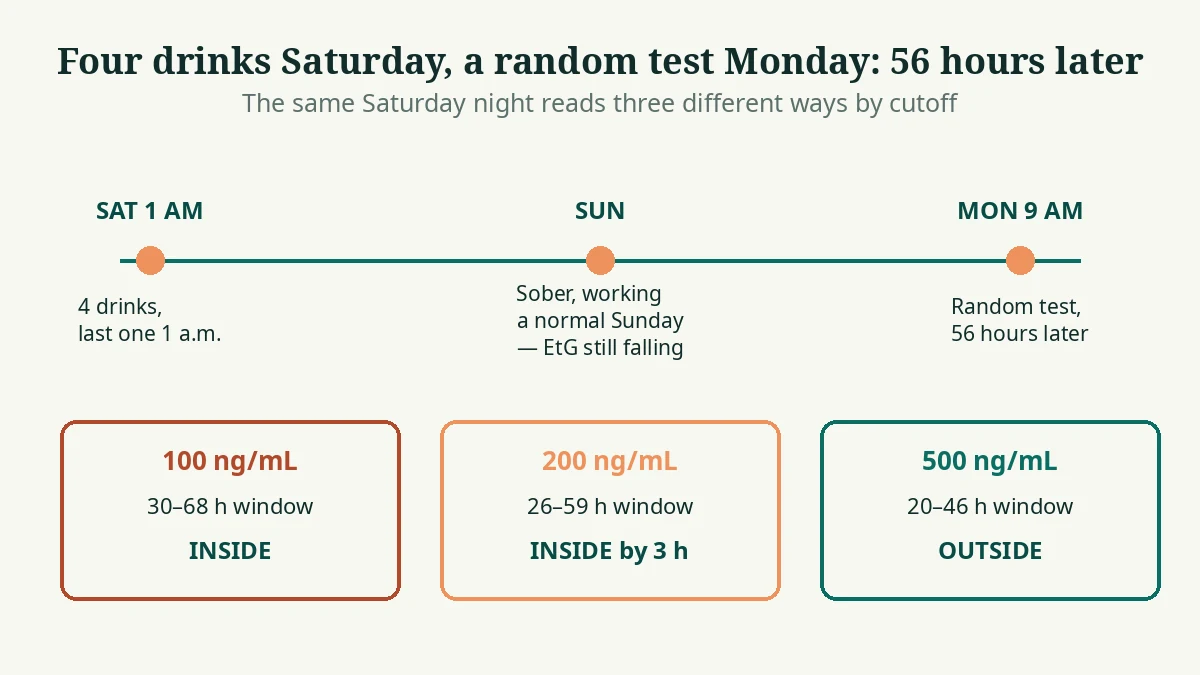
At a 100 ng/mL cutoff, the modeled window for four drinks is 30–68 hours, so 56 hours is inside it — a positive is likely. At 200 ng/mL, the window is 26–59 hours, so 56 hours is still inside, but only by three hours. At 500 ng/mL, the window is 20–46 hours — a negative is likely. Same Saturday night, same conductor, same test: three different results, decided entirely by the cutoff. A federal breath test on Monday morning would read zero in every case. That is exactly why a railroad that wants to see weekend drinking adds EtG to its company testing.
What a positive test can cost
The cost of a positive depends on which track produced it. A federal alcohol violation — a breath test at 0.04 or above, a positive federal drug test, or a refusal — means immediate removal from covered service, a substance abuse professional evaluation, a return-to-duty test, and follow-up testing for up to five years, with at least six tests in the first year. Refusing a federal test costs nine months out of regulated service. For an engineer, a federal violation can also mean decertification under Part 240. A result of 0.02 to 0.039 is not a violation, but the railroad must still remove the employee from covered service for eight hours.
A company EtG positive is different in law but can be just as costly. The railroad sets the penalty in its own policy, and many terminate on the first positive — especially for safety-sensitive roles. It triggers no federal return-to-duty process and goes on no federal record, but it can still end the job. Two things matter first: a positive screen should be confirmed by a laboratory test before any employment decision, and your union agreement and railroad policy may give you rights — including a hearing — that a non-union worker lacks.
What to do if you are facing a test
If a test is coming, the useful steps are practical. Do not try to dilute the sample: drinking large amounts of water lowers EtG concentration but also lowers creatinine, and laboratories flag dilute samples. Do not use someone else's urine or a detox product; both are detectable and both are usually treated as a refusal, which is worse than a positive.
Find out which cutoff the test uses, whether the test is federal or company-authority, whether the result will be confirmed by a laboratory, and what the railroad's written policy says about a positive result. If you are in a treatment program, tell the medical review officer — not your supervisor — with documentation. And if you drank over the weekend and a random test lands on Monday, remember: EtG shows past drinking, not impairment, and a positive screen deserves a confirmation test and a fair reading first.
Using the EtG calculator before a test
To understand your own window, run the numbers. The EtG calculator takes the number of drinks, the hours since your last drink, and the cutoff, and returns a modeled detection window as a range — an estimate, not a pass/fail prediction. For the federal side, see our DOT EtG testing guide and the truck drivers guide, which covers the FMCSA version of the same two-track system.
Frequently asked questions
Do railroad workers get EtG tested?+
Sometimes, under company authority — never as a federal test. The FRA and the DOT test alcohol with breath, not urine, and EtG is a urine test, so no federal rule can require it. A railroad may add EtG to its own non-DOT urine testing under its drug-free workplace policy, usually at a 100, 200, or 500 ng/mL cutoff. Check your railroad's written policy and your union agreement, not the federal rule, to find out whether your railroad does.
Does the FRA require EtG testing for railroad workers?+
No. The FRA's rule, 49 CFR Part 219, requires breath alcohol testing under DOT procedures and urine drug testing for a five-drug panel. EtG is an alcohol metabolite found in urine, and DOT alcohol testing under Part 40 does not use urine at all. Any EtG test for a railroad worker is a company-authority test, and the cutoff, the triggers, and the consequences are set by the railroad, not by the FRA.
How long after drinking can a railroad worker test positive on EtG?+
It depends on how much was drunk and the cutoff. For three to four drinks, the modeled window is roughly 30–68 hours at a 100 ng/mL cutoff, 26–59 hours at 200 ng/mL, and 20–46 hours at 500 ng/mL. SAMHSA notes EtG can be detected for up to about 80 hours after heavy drinking. These are ranges, not pass dates — weight, hydration, and drinking speed all shift the real number.
Can an EtG test show I was drunk at work?+
No. EtG shows that alcohol was consumed in the past one to three days; it cannot show impairment during a shift. A conductor who drank off duty on Saturday can test positive on a Monday random test while fully sober. SAMHSA's advisory says EtG is scientifically unsupportable as the sole basis for legal or disciplinary action, which is why a positive screening result should be confirmed by a laboratory test before any employment decision is made.
What happens if I fail a railroad alcohol test?+
It depends on the test. A federal breath test at 0.04 or above is a federal violation: removal from covered service, a substance abuse professional evaluation, a return-to-duty test, and follow-up testing for up to five years. A result of 0.02 to 0.039 means removal for at least 8 hours but is not a violation. Refusing a federal test costs nine months out of regulated service. A company EtG positive is a company-policy matter — the railroad sets the penalty, and many railroads terminate on the first positive for safety-sensitive roles.
Does a standard railroad drug test include EtG?+
No. The federal drug test is a five-drug urine panel — marijuana, cocaine, opiates, amphetamines, and PCP — plus a medical review officer, and it does not look for EtG. EtG has to be ordered as a separate, non-DOT test. If your railroad adds EtG, it is usually because the railroad specifically wants to see alcohol use from days earlier, which the federal panel and a breath test cannot detect at all.
What should I do if I am facing an EtG test at my railroad?+
Ask which cutoff the test uses, whether the test is federal or company-authority, and what the written policy says about a positive result. Do not try to dilute the sample — laboratories flag low-creatinine samples — and do not use a detox product or someone else's urine, which is usually treated as a refusal. If you are in a treatment program or take prescribed medication, tell the medical review officer with documentation. And remember that EtG shows past drinking, not impairment, so a positive screening result deserves a confirmation test and a fair reading.
Evidence and limitations
This article summarizes published guidance and research on EtG testing for railroad workers, plus the science of alcohol biomarkers. Group-level findings cannot predict one person’s result, and this article is educational only — it is not legal or medical advice. Testing rules vary by railroad, state, and program; talk to a local attorney about a live case or a termination.
- 49 CFR Part 219 §219.607 — Railroad random alcohol testing programs (FRA approval, unannounced tests spread through the year)
- 49 CFR Part 219 Subpart F — Pre-employment drug testing mandatory (§219.501); pre-employment alcohol testing optional (§219.502); no covered service at 0.04 or above
- FRA Drug Testing Requirements: 49 CFR Part 219 for Employers (2026) — covered roles, maintenance-of-way since 2017, mechanical since March 2022, small-railroad exception, 9-month refusal consequence
- U.S. DOT, What You Need to Know About Federal Drug and Alcohol Testing (railroad employee handout) — federal vs company authority, 0.02/0.04 thresholds, 8-hour removal, SAP + return-to-duty + follow-up, Part 240 decertification
- DOT Alcohol Testing: EBT, BAT & What Employers Need to Know (2026) — DOT alcohol testing uses breath only; urine, blood, and hair alcohol testing are not accepted under 49 CFR Part 40
- DOT Drug & Alcohol Testing Requirements — 2026 random testing rates: FRA drug 25%, alcohol 10%
- FRA Post-Accident Toxicological Testing; Amended Procedures — Appendix C, mandatory urine split sample, optional breath alcohol testing
- BLS Rail Transportation (NAICS 482) — about 149,600 employees (Oct 2026); locomotive engineers 31,840; railroad conductors and yardmasters 40,760 (2025)
- SAMHSA Advisory: The Role of Biomarkers in the Treatment of Alcohol Use Disorders (2006, revised 2012, SMA 12-4686) — EtG detectable up to ~80 hours; legal or disciplinary action based solely on a positive EtG “inappropriate and scientifically unsupportable”
- McDonell et al. (2015) — EtG immunoassay cutoff sensitivity in alcohol-dependent outpatients (1,589 samples)
- Mackus et al. (2017) — EtG detection and elimination kinetics after controlled alcohol intake
- Jatlow et al. (2014) — EtG and EtS assays: interpretation and limitations by dose and cutoff
- EtG Calculator Pro — ETG Testing for Truck Drivers: the FMCSA version of the same two-track system
- EtG Calculator Pro — DOT EtG Testing: federal breath testing vs company urine tests