The short answer: hotel EtG testing is employer policy, not a law
An ETG test for hotel workers is a urine test for ethyl glucuronide, a metabolite of alcohol, showing whether the worker drank in the past one to three days. There is no single answer to "will I be tested?" — no federal rule requires it and no hotel brand mandates it.
About 1.94 million people work in hotels and other accommodation in the United States, per the Bureau of Labor Statistics, and maids and housekeeping cleaners are the single largest hotel occupation, with roughly 418,500 in accommodation alone. Almost none of them are covered by a testing mandate the way truck drivers or pilots are — yet all of them can be tested under an employer's drug-free workplace policy. Whether you face one depends on who operates your hotel, your role, and which of four triggers applies.
Who decides whether you get tested — the operator, not the brand
The name on the building does not decide the testing policy. Marriott, Hilton, Hyatt, and IHG own very few of the hotels that carry their names. The typical property is owned by one company, operated by another, and branded by a third — and the testing policy belongs to the operator.
That split produces three very different answers. At corporate-managed Marriott and Hilton properties, standard roles — front desk, housekeeping, food and beverage, bell staff — are generally hired without a pre-employment drug screen. Franchise properties are different: a Hampton Inn or Courtyard run by a local management company can set its own policy, and many do require testing. Job postings from Davidson Hospitality Group, which operates Hilton, Hyatt, Kimpton, and Marriott properties, state: "Davidson Hospitality is a drug free workplace. Pre-employment drug test and background check required."
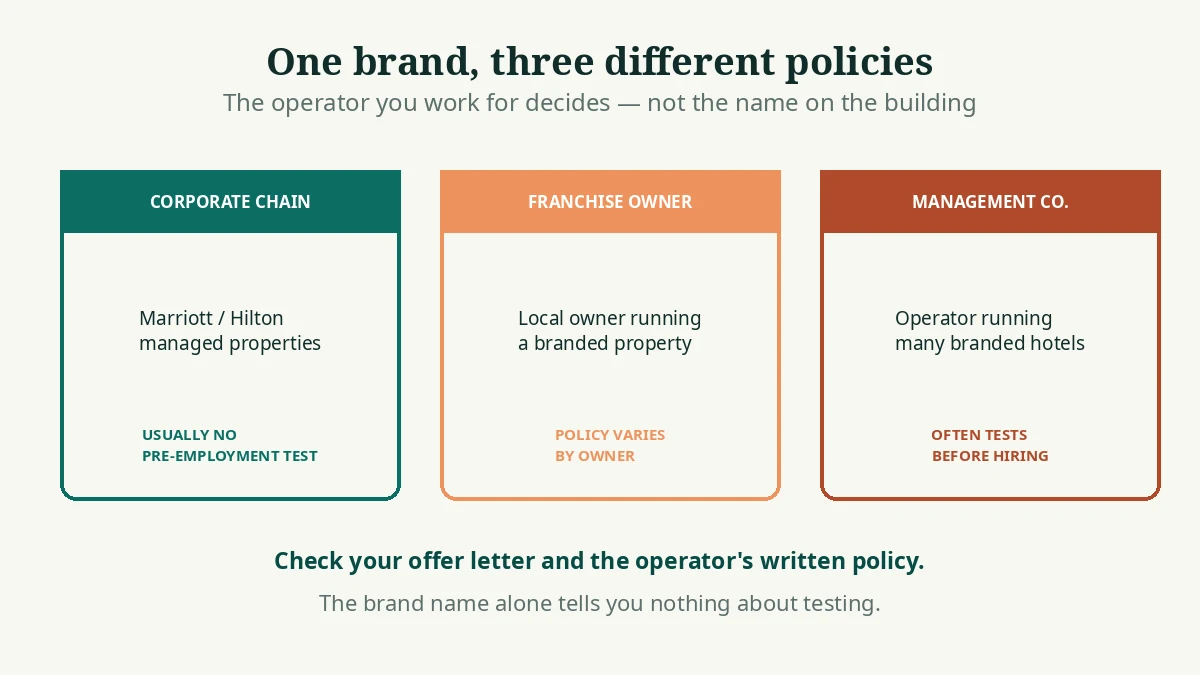
Seasonal hiring shows the same pattern in writing: Marriott Resorts Hospitality Corporation's Department of Labor job orders for housekeepers require "pre-employment, post injury or incident and reasonable suspicion drug test," with the cost paid by the employer. Check who operates your property and what your offer letter says — the brand name alone tells you nothing.
When hotels actually test
Hotel EtG testing happens under the same four triggers as most workplace testing — and random testing is the one that catches people who drank days earlier.
| Trigger | When it happens | What it usually involves |
|---|---|---|
| Pre-employment | After a conditional job offer, before the first shift | Urine panel, sometimes with EtG; a failed test can withdraw the offer |
| Random | Unannounced, any shift, no reason needed | EtG reaches back 1–3 days, so a weekend drink can surface on Tuesday |
| Reasonable suspicion | A supervisor notes signs of impairment on shift | Immediate test, often with a breath test; refusal can mean termination |
| Post-accident | After an injury, a guest incident, or property damage | Drug and alcohol screen tied to the workers' comp claim |

Random testing is the trigger most hotel workers underestimate. A breath test only catches the last few hours, so a worker who drank Saturday night and is sober by Monday has nothing to fear from a breathalyzer. EtG is different: it detects drinking from one to three days earlier, so the same Saturday night can still show up on a Tuesday random test — which is exactly why employers add it to a standard panel. Post-accident testing is the other surprise: a slip or a back injury can trigger a screen as part of the injury report, and a positive EtG can complicate a claim even when the drinking had nothing to do with the accident.
Which hotel jobs get tested most
Testing is not spread evenly across a hotel. The roles most likely to be tested are the ones where the employer sees the most risk.
Housekeeping is the largest group and the most commonly tested. Room attendants work alone in guest rooms, handle guest property, and suffer the highest injury rates in the hotel — slips, strains, and cuts are everyday risks. That combination is why housekeeping postings so often carry the drug-test requirement. Maintenance and engineering staff are next: they work with chemicals, ladders, and heavy equipment, and many properties test these roles as a condition of hire even when front desk staff are not tested. Shuttle and van drivers are a special case: if the vehicle requires a commercial driver's license, the driver falls under federal Department of Transportation testing rules, which use breath alcohol testing rather than EtG. Front desk agents are the least likely to be tested before hiring at corporate properties; the exception is reasonable suspicion, which applies to every role.
What an EtG test for hotel workers actually measures
EtG is a direct metabolite of ethanol: your liver converts a small fraction of the alcohol you drink into ethyl glucuronide, excreted in urine. A standard workplace drug panel does not look for it — EtG has to be ordered separately, which is why many hotel workers have never heard of it until the day they are asked to take one.
The test reports one of two outcomes against a cutoff: 100, 200, or 500 nanograms per milliliter. Below the cutoff is negative; at or above it is positive. The cutoff is the single most important fact about your test, and most hotel workers are never told what it is. A 100 ng/mL cutoff is the most sensitive; a 500 ng/mL cutoff is the federal workplace standard. The same urine sample can be negative at 500 and positive at 100.
What EtG cannot do matters as much as what it can. It cannot show that you were drunk at work, it cannot show how much you drank, and it cannot show when exactly you drank — only that you drank within roughly the last one to three days. SAMHSA's advisory on alcohol biomarkers states that EtG can be detected for up to about 80 hours after heavy drinking, and that taking legal or disciplinary action based solely on a positive EtG test is "inappropriate and scientifically unsupportable."
Detection windows by drinks and cutoff
The window depends on how much you drank and which cutoff your employer uses. The table below uses the modeled ranges from the EtG calculator on this site, and shows why the cutoff matters more than the drink count.
| Drinks (one evening) | 100 ng/mL cutoff | 200 ng/mL cutoff | 500 ng/mL cutoff |
|---|---|---|---|
| 1–2 drinks | 23–53 hours | 20–46 hours | 15–36 hours |
| 3–4 drinks | 30–68 hours | 26–59 hours | 20–46 hours |
| 5–7 drinks | 38–85 hours | 33–75 hours | 26–58 hours |
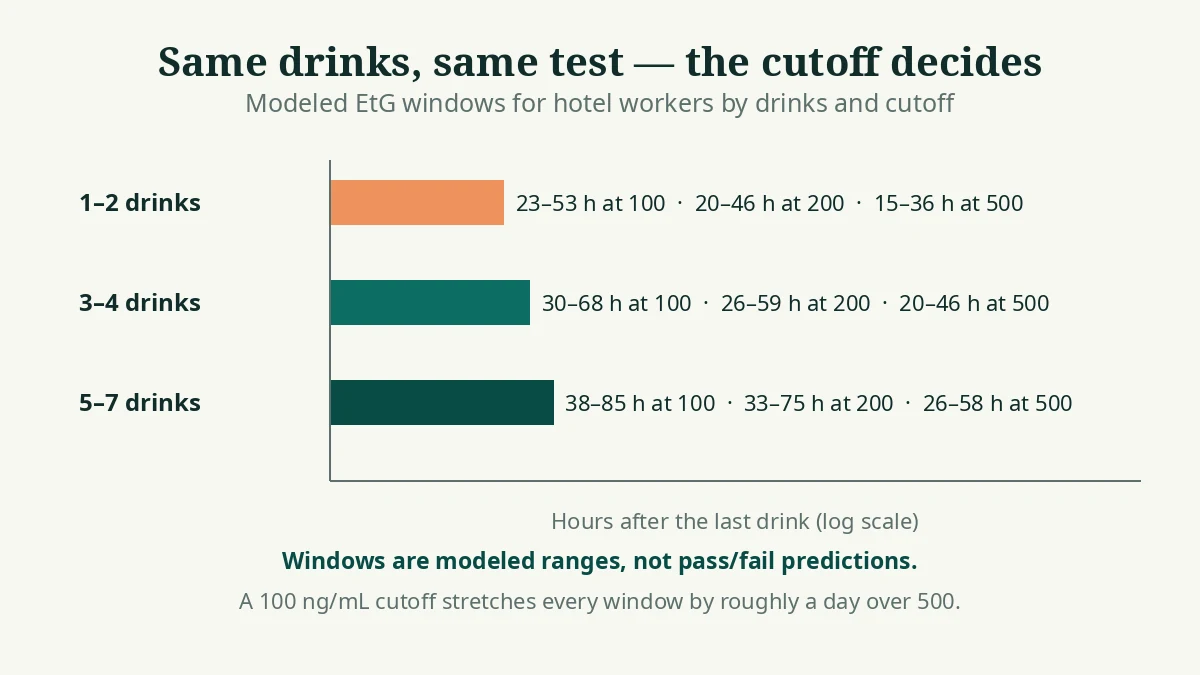
The 100 ng/mL cutoff adds roughly a full day to every window over 500 ng/mL. SAMHSA's "up to 80 hours" figure is the top end for heavy drinking at a low cutoff — not the typical case. These are modeled ranges, not pass dates: body weight, drinking speed, and hydration all shift the real number.
Real-world scenario: four drinks Saturday, a random test Monday
Take a front desk agent — call her Maria — on the night audit shift at a mid-size hotel in Ohio. Saturday is her night off. She has four drinks with friends between 9 p.m. and 1 a.m., then is back at the desk Sunday night, sober and working normally. Monday morning at 8 a.m., her name comes up in the property's random testing pool.
The test is 57 hours after her last drink. At 100 ng/mL, the modeled window for three to four drinks is 30–68 hours — she is inside it, and the test is likely positive. At 200 ng/mL, the window is 26–59 hours — still inside, but only just, by about two hours. At 500 ng/mL, the window is 20–46 hours — she is outside it, and the test is likely negative.
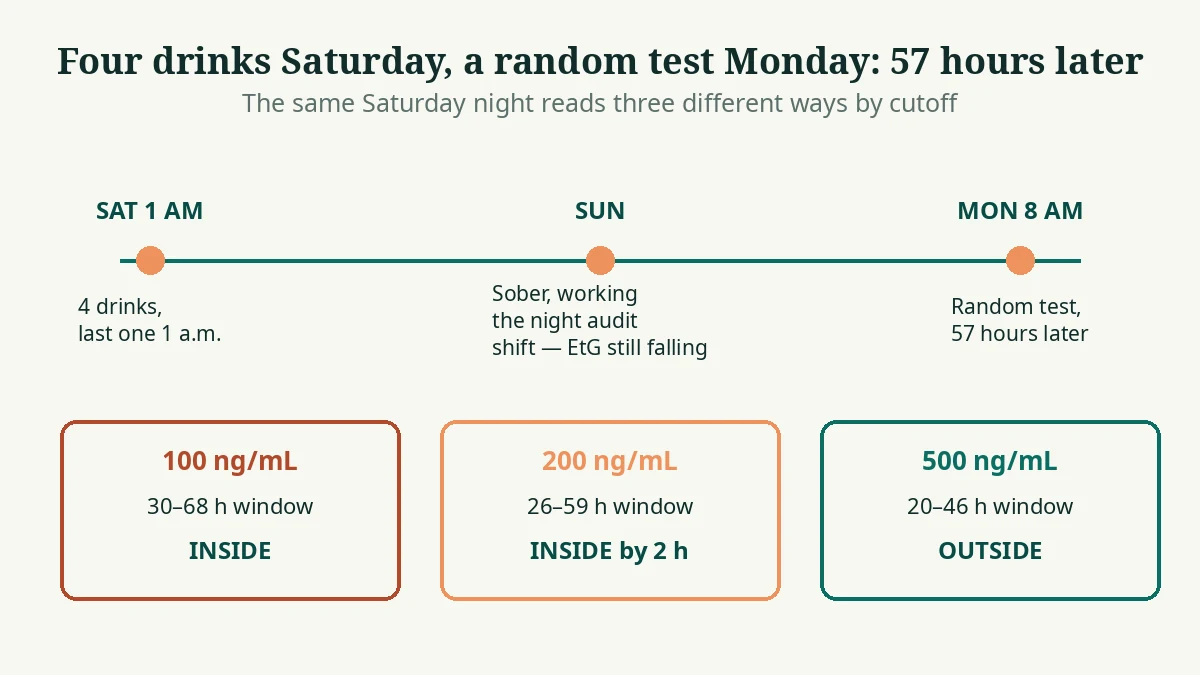
Nothing about Maria changed between those three outcomes. The only thing that changed was the cutoff, and she was never told which one her hotel uses. That is why the first question after any positive result should be "what cutoff was used, and was the result confirmed?"
Why hotels test at all
Hotels test for the same reasons most employers do: guest safety, theft prevention, and workplace injuries. A housekeeper alone in a guest room has access to luggage and laptops; a maintenance worker on a ladder has a fall risk; a front desk agent handles credit cards and room keys. Alcohol use on the job is a genuine risk in all three roles.
The industry's numbers explain why the question comes up so often. In the Substance Abuse and Mental Health Services Administration's survey of full-time workers, the accommodations and food services industry had the highest past-year substance use disorder rate of any industry measured — 16.9%, against 9.5% across all workers — and the highest past-month illicit drug use, 19.1%. Those figures are from 2008–2012 data, and SAMHSA notes the pattern is partly driven by the industry's young workforce.
What a positive test can cost
A positive EtG test in a hotel job can cost the job itself. At the pre-employment stage, a failed test means the offer is withdrawn, with no appeal process. For a current employee, the consequence depends on the policy: some hotels terminate on the first positive, while others offer a last-chance agreement or an employee assistance program referral.
Two things are worth knowing before that moment arrives. First, a positive screening result should be confirmed by a laboratory test — usually LC-MS/MS — before any employment decision is made. False positives happen, most famously from incidental alcohol exposure such as hand sanitizer or mouthwash, and a confirmation test is the protection against them. Second, state law varies widely: some states limit when an employer can test or require written notice of the policy. Those rules are state-specific, and this article is educational, not legal advice.
What to do if you are facing a test
If you know a test is coming — a job offer, a random pool, a post-accident report — the useful steps are practical. Do not try to dilute the sample: drinking large amounts of water lowers EtG concentration but also lowers creatinine, and laboratories flag dilute samples. Do not use someone else's urine or a detox product; both are detectable and both are usually treated as a refusal, which is worse than a positive.
Find out the facts you are entitled to: which cutoff the test uses, whether the result will be confirmed by a laboratory, and what the employer's written policy says about a positive result. If you are in a treatment program, tell the medical review officer — not your supervisor — with documentation. And if you drank over the weekend and a random test lands on Monday, remember: EtG shows past drinking, not impairment. A positive result does not prove you were drunk at work. That does not mean the test cannot cost you the job, but the result deserves a confirmation test and a fair reading first.
Using the EtG calculator before a test
The fastest way to understand your own window is to run the numbers. The EtG calculator on this site takes the number of drinks, the hours since your last drink, and the cutoff, and returns a modeled detection window as a range. It is an estimate, not a pass/fail prediction. Use it to understand the risk, not to gamble on it.
Frequently asked questions
Do hotel workers get EtG tested?+
Sometimes, and it is the employer's decision, not a legal requirement. No federal law requires EtG testing for hotel workers. Corporate Marriott and Hilton properties generally do not drug-test standard roles before hiring, but franchise operators and hotel management companies often do — Davidson Hospitality Group, for example, requires a pre-employment drug test at the properties it operates. Check your offer letter and the operator's written policy, not the brand name on the building.
Which hotel jobs are most likely to be drug tested?+
It depends on the role and the operator. Housekeeping and maintenance staff are tested most often, because they work unsupervised in guest rooms or with chemicals and heavy equipment, and because post-accident testing is common after slips and injuries. Front desk agents are rarely tested before hiring at corporate properties, but reasonable-suspicion testing applies to every role. Shuttle drivers who need a commercial driver's license fall under federal DOT testing rules instead.
How long after drinking can a hotel worker test positive on EtG?+
It depends on how much was drunk and the cutoff. For three to four drinks, the modeled window is roughly 30–68 hours at a 100 ng/mL cutoff, 26–59 hours at 200 ng/mL, and 20–46 hours at 500 ng/mL. SAMHSA notes EtG can be detected for up to about 80 hours after heavy drinking. These are ranges, not pass dates — weight, hydration, and drinking speed all shift the real number.
Can an EtG test show I was drunk at work?+
No. EtG shows that alcohol was consumed in the past one to three days; it cannot show impairment during a shift. A housekeeper who drank off duty on Saturday can test positive on a Monday random test while fully sober. SAMHSA's advisory says EtG is scientifically unsupportable as the sole basis for legal or disciplinary action, which is why a positive screening result should be confirmed by a laboratory test before any employment decision is made.
Why would a hotel drug test me after a workplace injury?+
Usually it is the employer's drug-free workplace policy, and many operators include a post-accident screen in their injury-reporting process. A slip, a cut, or a back injury can trigger a drug and alcohol test as part of the workers' compensation claim. A positive EtG can complicate a claim even when the drinking had nothing to do with the accident, so keep the lab report, the cutoff used, and the confirmation result.
Does a standard hotel drug test include EtG?+
No. A standard workplace urine panel does not look for EtG — it has to be ordered as a separate test. Most panels screen for marijuana, cocaine, opiates, amphetamines, and PCP. If your hotel adds EtG, it is usually because the employer specifically wants to see alcohol use from days earlier, which a standard panel cannot detect at all.
What should I do if I am facing an EtG test at my hotel?+
Ask which cutoff the test uses, whether the result will be confirmed by a laboratory test, and what the written policy says about a positive result. Do not try to dilute the sample — laboratories flag low-creatinine samples — and do not use a detox product or someone else's urine, which is usually treated as a refusal. If you are in a treatment program or take prescribed medication, tell the medical review officer with documentation. And remember that EtG shows past drinking, not impairment, so a positive screening result deserves a confirmation test and a fair reading.
Evidence and limitations
This article summarizes published guidance and research on EtG testing for hotel workers, plus the science of alcohol biomarkers. Group-level findings cannot predict one person’s result, and this article is educational only — it is not legal or medical advice. Testing rules vary by employer, state, and program; talk to a local attorney about a live case or a termination.
- BLS National Employment Matrix 2025–2035 (via Digital Collar) — accommodation (hotels, motels, resorts, casino hotels): about 1,935,700 US jobs in 2025; maids and housekeeping cleaners in accommodation about 418,500
- U.S. Department of Labor, SeasonalJobs — Marriott Resorts Hospitality Corporation housekeeper job order: pre-employment, post-injury or incident, and reasonable-suspicion drug testing required, cost paid by employer
- Davidson Hospitality Group front desk posting (Cape Rey Carlsbad Beach, a Hilton Resort & Spa) — “Davidson Hospitality is a drug free workplace. Pre-employment drug test and background check required.”
- Does Marriott International Drug Test? — generally no pre-employment testing for most hotel positions; reasonable-suspicion and post-accident testing apply; shuttle drivers may face DOT testing
- Does Hilton Drug Test? — generally no pre-employment testing for most hotel positions; franchise properties set their own policies
- SAMHSA Short Report 1959 — Accommodations and food services: highest past-year substance use disorder of any industry, 16.9% (2008–2012 data); past-month illicit drug use 19.1%; heavy alcohol use 12%
- SAMHSA Advisory: The Role of Biomarkers in the Treatment of Alcohol Use Disorders (2006, revised 2012, SMA 12-4686) — EtG detectable up to ~80 hours; legal or disciplinary action based solely on a positive EtG “inappropriate and scientifically unsupportable”
- McDonell et al. (2015) — EtG immunoassay cutoff sensitivity in alcohol-dependent outpatients (1,589 samples)
- Mackus et al. (2017) — EtG detection and elimination kinetics after controlled alcohol intake
- Jatlow et al. (2014) — EtG and EtS assays: interpretation and limitations by dose and cutoff
- EtG Calculator Pro — ETG Testing for Bartenders: Alcohol Testing Around the Bar
- EtG Calculator Pro — ETG Testing for Employment: consent and consequences in the workplace