The short answer: casino EtG testing is employer policy, not a licensing rule
An ETG test for casino workers is a urine test for ethyl glucuronide, a metabolite of alcohol, showing whether the worker drank in the past one to three days. The important fact is who orders the test — almost always the employer, not the gaming regulator.
About 146,500 people work in gambling services in the United States, according to the Bureau of Labor Statistics, and gambling dealers — about 88,900 of them — are the largest single occupation. Every one of them works in one of the most heavily licensed industries in the country. Yet the license that lets a dealer touch the cards is not a drug test. It is a background check.
The gaming license is a background check, not a drug test
Before a dealer can deal a hand, the state has to know who they are. In Nevada, the law is blunt: no one may work as a gaming employee unless temporarily registered or registered with the Nevada Gaming Control Board. The Board investigates every applicant, and a complete set of fingerprints goes to the Central Repository for Nevada Records of Criminal History and to the FBI. The covered roles are wide — table games, cage and count room, slots, keno, race and sports book, security, and pit bosses. Nothing in the statute mentions a drug test or an EtG test.
| Jurisdiction | What the license/registration is | What it checks |
|---|---|---|
| Nevada | Gaming employee registration (Gaming Control Board), NRS 463.335 | Fingerprints to state repository + FBI; criminal history |
| New Jersey | Casino employee registration (Division of Gaming Enforcement); key employee license (Casino Control Commission) | Background investigation; key applicants must show financial stability and good character |
| Pennsylvania | Gaming employee occupation permit (Gaming Control Board), 4 Pa.C.S. 1318 | Criminal-history background investigation before starting |
| Tribal casinos | Tribal gaming license for key employees and primary management officials (25 CFR 556) | Five-year employment history, references, felony/misdemeanor history, fingerprints; NIGC notified of results |
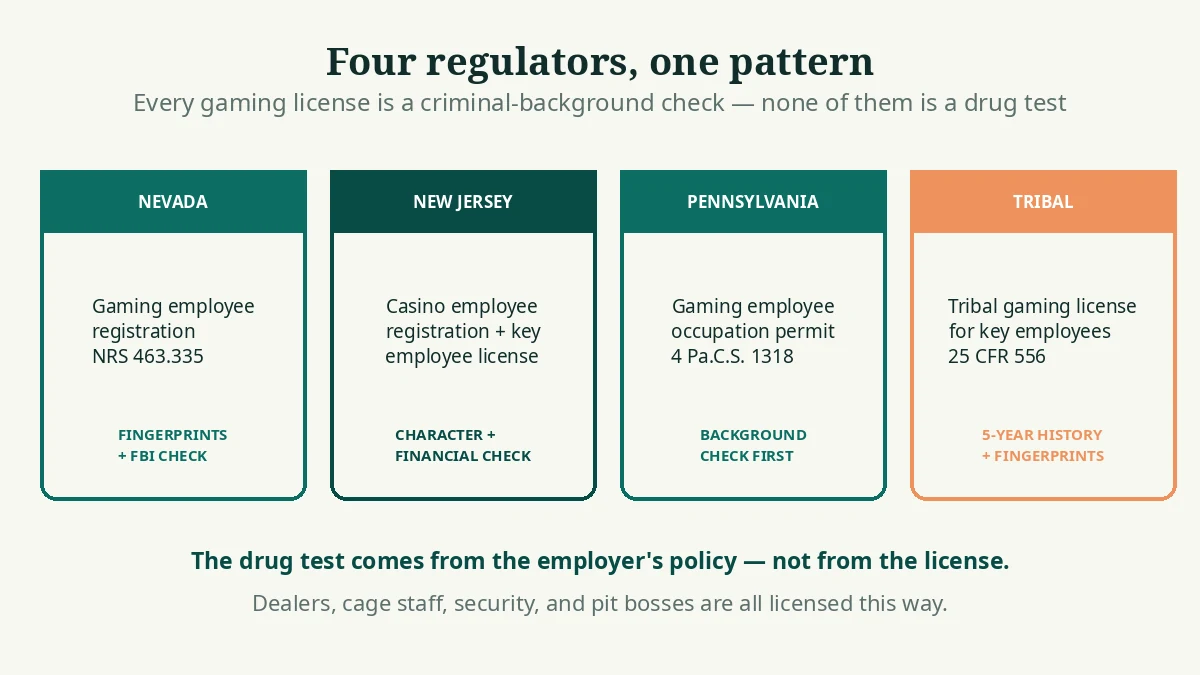
New Jersey runs the same pattern in two tiers. No one may start as a casino employee without a valid registration on file with the Division of Gaming Enforcement, and supervisors — pit bosses, shift bosses, credit executives, cashier supervisors, security managers — need a Casino Key Employee License from the Casino Control Commission, proving financial stability and good character, honesty, and integrity. Pennsylvania requires a gaming employee occupation permit before starting. On tribal land, the Indian Gaming Regulatory Act requires tribes to background-investigate and license key employees and primary management officials — dealers, pit bosses, count-room supervisors, security chiefs, and surveillance custodians — with five years of employment history, references, and fingerprints, and the National Indian Gaming Commission notified of the results. In every jurisdiction the license is a suitability check. The drug test lives somewhere else entirely: in the employer's handbook.
When casinos actually test
Casinos test because they are allowed to, and because their industry has the numbers to justify it. Federal survey data found accommodations and food services — the industry category casinos fall under — had the highest past-year substance use disorder of any industry, 16.9%, against 9.5% across all full-time workers. Those figures are from 2008–2012 data, but they explain why a casino's drug-free workplace policy is usually written in bold. Live job postings show the pattern in plain language: a dealer posting at Cocopah Casino in Arizona requires applicants to pass "a pre-employment and on-going random drug and alcohol test"; a dealer posting at Tortoise Rock Casino in California requires "periodic random drug screens" alongside a tribal gaming license; a posting at North Star Mohican Casino Resort requires pre-employment screening plus participation in the "employee random drug testing program"; an officer posting at Wind River Hotel & Casino in Wyoming requires passing "a pre-employment and random drug test" and holding a gaming license.
| Trigger | When it happens | What it usually involves |
|---|---|---|
| Pre-employment | After a conditional job offer, before the first shift | Urine panel, sometimes with EtG |
| Random | Unannounced, throughout employment | Urine panel, often with alcohol |
| Reasonable suspicion | When a supervisor notes signs of impairment | Immediate test, often with a breath test |
| Post-incident | After a cash-handling error, an injury, or a guest incident | Urine test, often with alcohol |

Random testing is the trigger that separates casino work from most other jobs. A bartender is usually tested at hire or after an incident; a dealer can be tested on any Tuesday, for no reason at all. That is also why EtG matters here: a breath test only catches drinking from the last few hours, while EtG reaches back one to three days. A random test on Tuesday is, in practice, a test of the weekend.
What an EtG test for casino workers actually measures
EtG is a metabolite the body makes when it processes alcohol. It appears in urine within hours of drinking and can be detected for roughly 80 hours after heavy drinking — far longer than alcohol itself, which leaves the blood in hours. That long window is why an employer might order the test: it catches weekend drinking that a Monday breath test would miss. It is also why the test is controversial. A dealer who drank six drinks on Saturday night is sober by Sunday, but their EtG can still be positive on Tuesday. The test shows past use, not impairment: a 2017 study found urine EtG elevated the day after drinking but uncorrelated with hangover severity or drink count.
The result also depends heavily on the cutoff, and there is no national EtG cutoff for casino workers. Employers choose 100, 200, or 500 ng/mL. At 100 ng/mL the test is at its most sensitive; at 500 ng/mL, the SAMHSA-recommended screening level, it catches heavier or more recent drinking. The same urine sample can be positive at one casino and negative at another, purely because of the number the employer picked. In a study of 1,589 samples, a 100 ng/mL cutoff had the highest sensitivity but the lowest specificity, and the authors recommended 200 ng/mL for detecting drinking more than a day earlier. SAMHSA's advisory puts the fairness point bluntly: legal or disciplinary action based solely on a positive EtG is "inappropriate and scientifically unsupportable," because EtG cannot distinguish beverage alcohol from incidental exposure such as hand sanitizer or mouthwash. Confirmation by LC-MS/MS is the standard second step — ask whether the screen was confirmed.
Detection windows by drinks and cutoff
The table below uses the same modeled ranges as the EtG calculator on this site — ranges, not pass dates.
| Drinks | 100 ng/mL | 200 ng/mL | 500 ng/mL |
|---|---|---|---|
| 1–2 drinks | 23–53 hours | 20–46 hours | 15–36 hours |
| 3–4 drinks | 30–68 hours | 26–59 hours | 20–46 hours |
| 5–7 drinks | 38–85 hours | 33–75 hours | 26–58 hours |
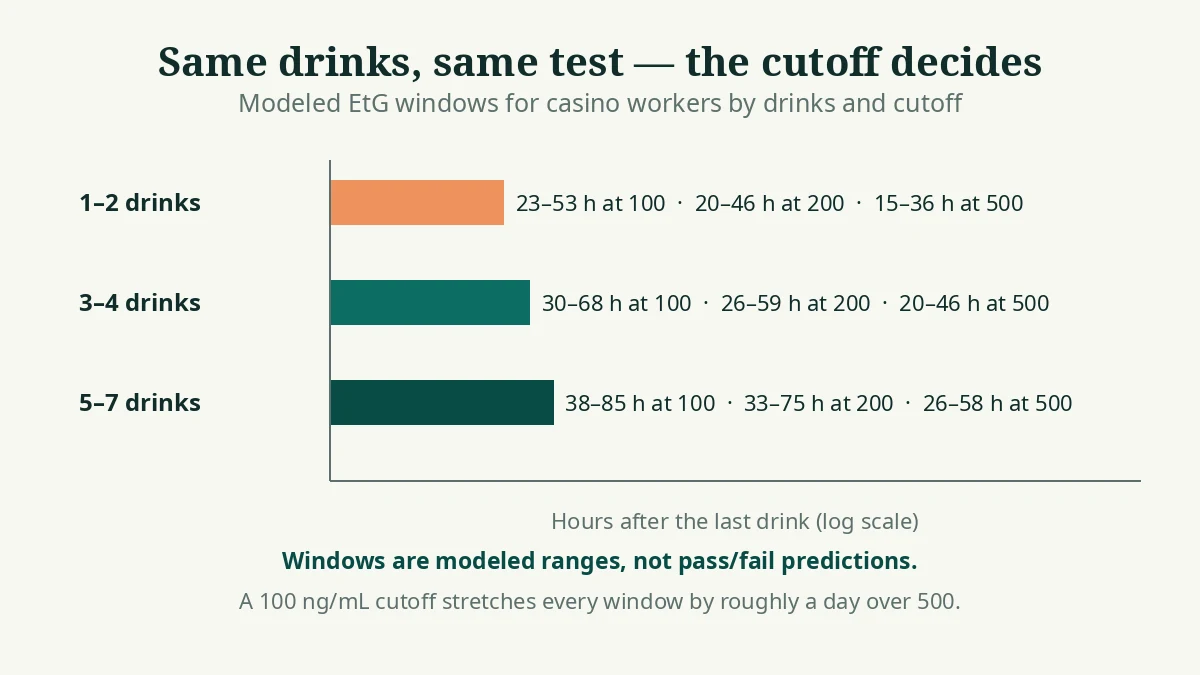
The 100 ng/mL cutoff adds roughly a full day to every window over 500 ng/mL. The "up to 80 hours" figure is a heavy-drinking ceiling, not a promise.
Real-world scenario: six drinks Saturday, a random test Tuesday
A blackjack dealer has six drinks with friends on Saturday night, the last one at 1 a.m. She is sober by Sunday and works Sunday and Monday without incident. Tuesday at 9 a.m., her name comes up in the property's random pool. That is 80 hours after the last drink.
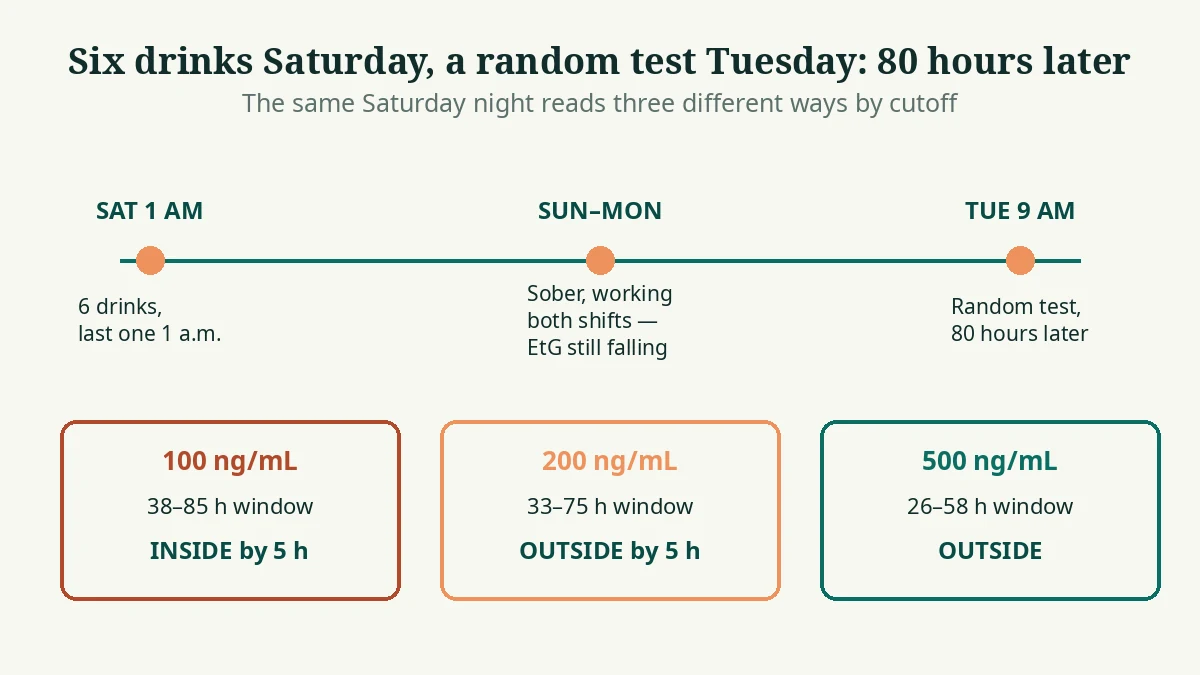
At a 100 ng/mL cutoff, the modeled window for five to seven drinks is 38–85 hours — she is inside it at 80 hours, so the test is likely positive. At 200 ng/mL, the window is 33–75 hours — she is outside it by five hours, and the test is likely negative. At 500 ng/mL, the window is 26–58 hours — she is outside it by more than a day. One weekend, one random draw, three different outcomes — and the difference is a number she never chose. The test is not measuring her fitness to deal cards on Tuesday; it is measuring her Saturday night.
The marijuana trap
Cannabis is legal in Nevada and New Jersey — the two biggest commercial casino states — and that fools people. Gaming employers still include cannabis in their drug-free workplace panels, and they can: marijuana remains a Schedule I controlled substance under federal law, and gaming commissions expect licensees to comply with all applicable laws. Several state gaming boards have warned that involvement with the cannabis industry is inconsistent with the standards expected of licensees. A positive marijuana test can cost a gaming job and potentially a license, even where the use was legal under state law. Some properties carve out non-safety-sensitive roles — one Wyoming tribal posting notes non-safety-sensitive positions are not tested for cannabis — but that is the exception, not the rule. Dealers, security, cage staff, and surveillance are safety-sensitive by any definition. Do not assume a legal dispensary receipt protects you at work.
What a positive test can cost
A failed test can cost a casino worker the job under the employer's drug-free workplace policy — that part is straightforward. The gaming license is a separate track, and it works differently than most workers assume. A failed employer drug test does not automatically revoke a state registration, because the registration is about criminal history and suitability, not about a urine result. But the two tracks are connected: a drug-related arrest or conviction would reach the regulator through the criminal-history channel, and licensees have reporting obligations that can surface conduct the test revealed. The practical risk is that the job goes first, and the license questions follow. Keep the paperwork if a test ever happens — the cutoff, the lab report, the confirmation result, and the policy section that ordered the test. If the result is positive, ask whether it was confirmed, request the lab report, and check whether the property offers a treatment or return-to-duty path before discipline — many large operators do.
What to do if you are facing a test
Respond the same day — a pre-employment test has a deadline, and a missed test counts as a refusal, which is treated as a positive. Check the policy first: which trigger ordered the test, which cutoff, which lab, whether the screen is confirmed by LC-MS/MS, and what the consequence is. Do not try to beat the test: water, supplements, and "detox" drinks do not reliably clear EtG, and a dilute sample can be flagged as cheating. Remember the two tracks: the employer decides the job, the regulator decides the license, and the paperwork you keep now is what both will ask for later.
Using the EtG calculator before a test
The EtG calculator estimates the same windows as the tables — read it as a range, never a pass date. Run your numbers. If you work around alcohol the way bartenders do, the same honest-range rules apply.
Frequently asked questions
Do casino workers get EtG tested?+
Sometimes, and it is the employer's decision, not a licensing requirement. Casinos run pre-employment and random drug-and-alcohol programs under drug-free workplace policies, and EtG is often added because a standard urine panel does not detect alcohol use from days earlier. No gaming regulator requires an EtG test as part of licensing.
Is a drug test part of getting a gaming license?+
No. A gaming license or registration is a fingerprint and criminal-history check. In Nevada, gaming employees must be registered with the Gaming Control Board under NRS 463.335, with fingerprints sent to the state repository and the FBI. New Jersey requires a casino employee registration with the Division of Gaming Enforcement, Pennsylvania requires an occupation permit, and tribal casinos license key employees under federal rules — all of them check your record, not your urine.
What jobs in a casino need a gaming license?+
Any role that touches gaming operations or gaming revenue: dealers and croupiers, pit and floor managers, cage and count-room staff, slot technicians, keno and sports-book staff, security, surveillance operators, gaming accounting and IT staff, and hosts who extend credit. Supervisors in New Jersey need a Casino Key Employee License; in tribal casinos, dealers and pit bosses are 'key employees' under federal rules and must be licensed by the tribal gaming authority.
How long after drinking can a casino worker test positive on EtG?+
It depends on how much was drunk and the cutoff. For five to seven drinks, the modeled window is roughly 38–85 hours at a 100 ng/mL cutoff, 33–75 hours at 200 ng/mL, and 26–58 hours at 500 ng/mL. SAMHSA notes EtG can be detected for up to about 80 hours after heavy drinking. These are ranges, not pass dates — weight, hydration, and drinking speed all shift the real number.
Can an EtG test show I was drunk at work?+
No. EtG shows that alcohol was consumed in the past one to three days; it cannot show impairment during a shift. A dealer who drank off duty on Saturday can test positive on a Tuesday random test while fully sober. Research found EtG elevated the day after drinking but uncorrelated with hangover severity or drink count, and SAMHSA's advisory says EtG is scientifically unsupportable as the sole basis for legal or disciplinary action.
Can I lose my gaming license for failing a drug test?+
A failed employer drug test does not automatically revoke a gaming registration, because the license is about criminal history and suitability, not a urine result. But the tracks are connected: a drug-related arrest or conviction would reach the regulator through the criminal-history channel, and licensees have reporting obligations. The job is at risk from the test itself; the license is at risk from what the test reveals or from related criminal conduct. Keep the cutoff, the lab report, and the confirmation result.
Does legal cannabis in Nevada or New Jersey protect casino workers?+
No. Marijuana remains a Schedule I controlled substance under federal law, and gaming employers still include cannabis in their drug-free workplace panels. Several state gaming boards have warned that involvement with the cannabis industry is inconsistent with the standards expected of licensees. A positive marijuana test can cost a gaming job and potentially a license, even where the use was legal under state law. A few properties carve out non-safety-sensitive roles, but dealers, security, cage, and surveillance staff are safety-sensitive by any definition.
Evidence and limitations
This article summarizes published guidance and research on EtG testing for casino workers, plus the science of alcohol biomarkers. Group-level findings cannot predict one person’s result, and this article is educational only — it is not legal or medical advice. Testing rules vary by employer, state, and program; talk to a local attorney about a live case or a termination.
- NRS 463.335 — Nevada gaming employees must be registered with the Gaming Control Board; fingerprints to the state repository and the FBI; no drug-test requirement in the statute
- Casino Employee Background Check: State Gaming Rules — Nevada NRS 463.0157 gaming-employee definition, New Jersey N.J.S.A. 5:12-91, Pennsylvania 4 Pa.C.S. 1318
- New Jersey Casino Control Commission — Licensing: Casino Key Employee License roles and qualification requirements (N.J.S.A. 5:12-89)
- New Jersey Division of Gaming Enforcement — Employee Licensing: Casino Employee Registration $95, Casino Key Employee License $750–$4,000
- 25 CFR 556 — Tribal background investigations for key employees and primary management officials: five-year history, references, fingerprints
- National Indian Gaming Commission — Tribal Background Investigations and Licensing: key-employee definition (dealers, pit bosses, count-room supervisors, surveillance custodians)
- Cocopah Casino & Resort dealer posting — “MUST BE ABLE TO PASS A PRE-EMPLOYMENT AND ON-GOING RANDOM DRUG AND ALCOHOL TEST”; Arizona Department of Gaming / Tribal Gaming Office certification
- Tortoise Rock Casino table-games dealer posting — “Must pass periodic random drug screens”; Tribal Gaming License required
- North Star Mohican Casino Resort posting — pre-employment drug screening and “employee random drug testing program”; Mohican Nation Gaming License
- Wind River Hotel & Casino officer posting — “Must be able to pass a pre-employment and random Drug Test”; Gaming License required
- Gaming Occupational License: Tiers, Background Check, and Denials — most casinos require pre-employment screening and random testing; cannabis stays in drug-free workplace panels despite state legalization
- U.S. Bureau of Labor Statistics — Gambling Services Workers: about 146,500 jobs in 2025; gambling dealers 88,900
- SAMHSA Short Report 1959 — Accommodations and food services: highest past-year substance use disorder of any industry, 16.9% (2008–2012 data)
- SAMHSA Advisory: The Role of Biomarkers in the Treatment of Alcohol Use Disorders (2006, revised 2012, SMA 12-4686) — EtG detectable up to ~80 hours; legal or disciplinary action based solely on a positive EtG “inappropriate and scientifically unsupportable”
- McDonell et al. (2015) — EtG immunoassay cutoff sensitivity in alcohol-dependent outpatients (1,589 samples)
- Mackus et al. (2017) — EtG detection and elimination kinetics after controlled alcohol intake
- Jatlow et al. (2014) — EtG and EtS assays: interpretation and limitations by dose and cutoff
- EtG Calculator Pro — ETG Testing for Bartenders: Alcohol Testing Around the Bar
- EtG Calculator Pro — ETG Testing for Employment: consent and consequences in the workplace