The short answer: yes, but the dose and the room matter more than the fact of exposure
Can secondhand alcohol exposure affect an EtG test? Yes — but not in the way most people picture it. There is no evidence that standing next to someone holding a beer, or breathing the same party air for an evening, will turn your urine test positive. What the research actually shows is narrower: ethanol vapor, inhaled again and again in a small, poorly ventilated space, can put enough alcohol into your body to produce measurable ethyl glucuronide (EtG), sometimes above a sensitive cutoff. The difference between those two situations is dose, repetition, and ventilation.
EtG is a minor metabolite of ethanol, the alcohol in beer, wine, and spirits. Only a small fraction of the ethanol that enters your body — roughly 0.02 to 0.4 percent — is converted to EtG, but modern tests are sensitive enough to find it at 100 nanograms per milliliter (ng/mL) and below. That sensitivity is the whole story here. The test does not know how the ethanol got into you. It only reports that some did, and how much EtG resulted.
What "secondhand alcohol exposure" actually means
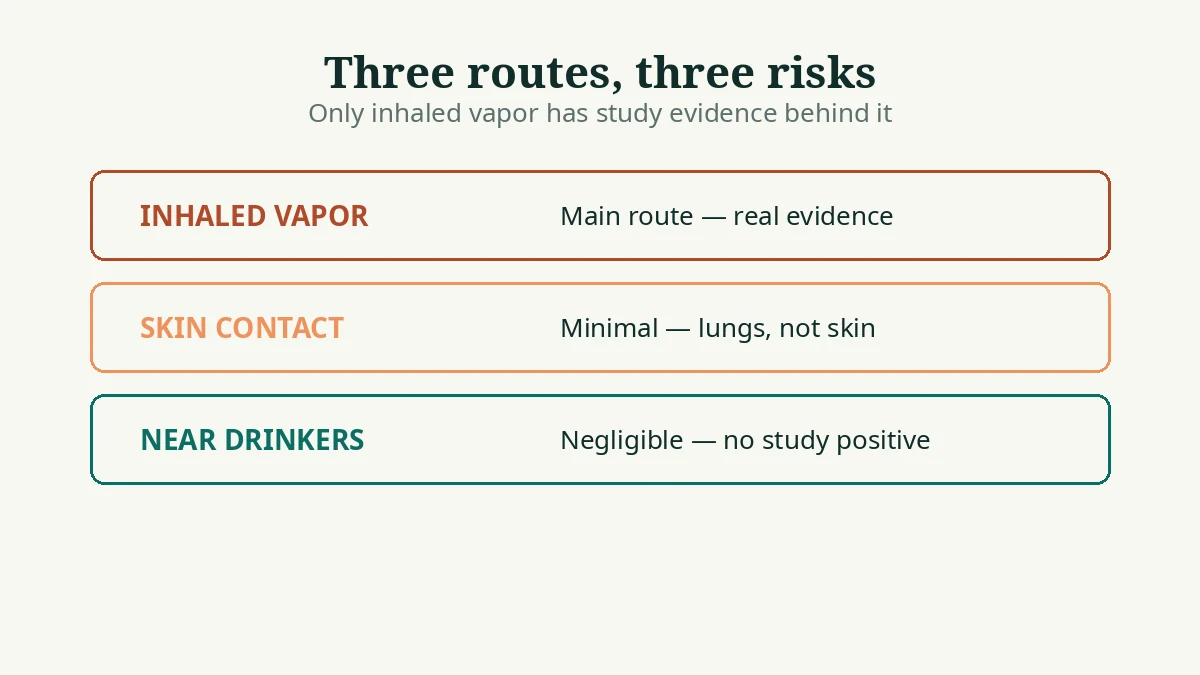
The phrase covers three very different situations, and studies treat them very differently.
Inhaled ethanol vapor. This is the route with real evidence behind it. When ethanol evaporates — from sanitizer rubbed between palms, a spray cleaner, or an open container in a small room — breathing that air carries ethanol into the lungs and then the bloodstream. Unlike swallowed alcohol, inhaled ethanol partly bypasses first-pass metabolism in the liver. A 2017 review found inhaled vapor repeatedly produced measurable biomarkers of acute exposure, most notably EtG, even though blood alcohol stayed far below impairment levels.
Skin contact. This route turns out to be nearly irrelevant for EtG. A 2014 study by Arndt and colleagues settled the question for ethanol-based sanitizer, and its title gives the conclusion away: inhalation, but not transdermal resorption, causes positive EtG findings. Volunteers who used sanitizer while inhalation was prevented did not produce the same results. Rubbing sanitizer on your hands is not the risk; breathing its fumes, repeatedly, in still air, is.
Simply being near drinkers. This is the situation people usually mean by "secondhand," by analogy with secondhand smoke — and it is the one with the least support. No published study has shown that standing near people who are drinking, or breathing air in a bar or at a party, produces a positive EtG result. The ethanol in a drinker's breath dilutes into a large volume of room air within seconds, and the dose a bystander inhales is orders of magnitude below the concentrated, repeated exposures that produced positives in experiments.
The evidence: what studies actually found
The single most relevant experiment for a bystander was presented by Dr. Michael Liepman at an addiction-medicine meeting. Twenty-four abstinent volunteers were divided into groups. One group washed their hands with a 62 percent ethanol sanitizer 15 times at four-minute intervals in a small enclosed room, breathing the fumes as they worked. A second group did not wash at all — they simply stood close by in the same room. A third group washed in an air-flow chamber that carried the vapor away, and a fourth served as controls.
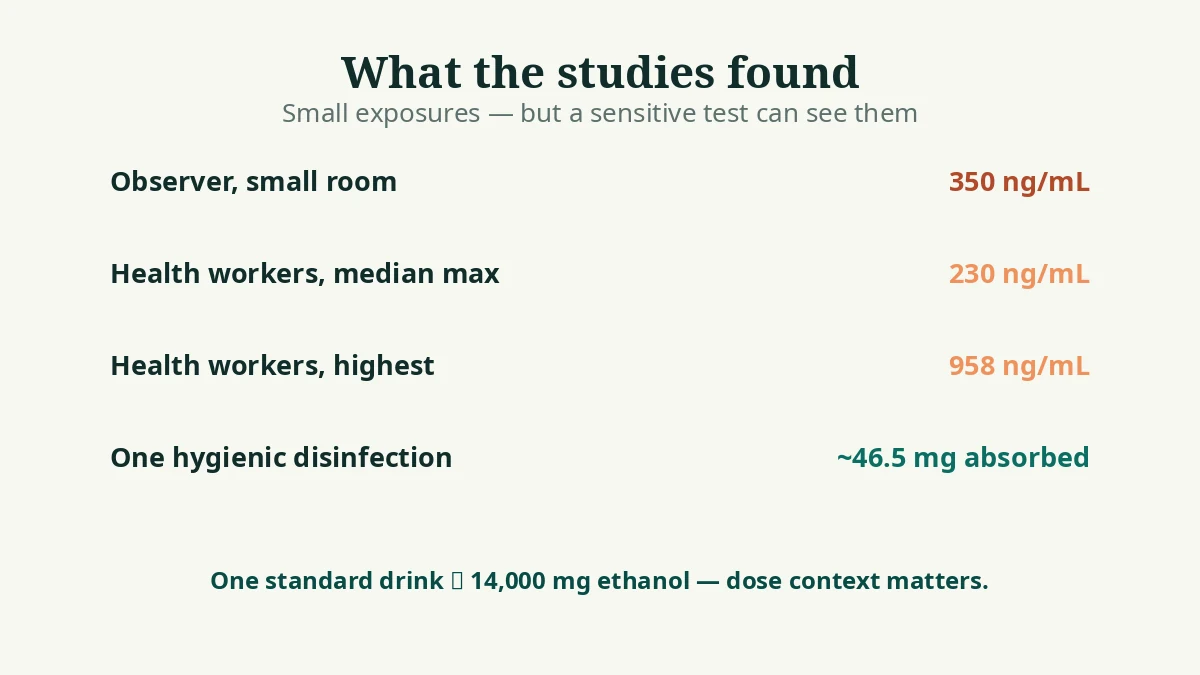
Three of the hand-washers who could inhale the sanitizer tested positive for EtG thirty minutes later, and so did one of the observers who had never touched the product. That observer's level was 350 ng/mL, against the 100 ng/mL cutoff used in the experiment. None of the airflow-chamber washers tested positive, though low levels were detectable, and breath tests showed no impairment in anyone. The experiment is small, and the exposure was extreme — fifteen applications in an hour in a small room — but it is the closest thing in the literature to a pure "secondhand" test, and the bystander crossed the line.
Workplace research points the same way at a larger scale. Gessner and colleagues followed health care workers averaging 32 ethanol-based hand antisepsis procedures per eight-hour shift. During an abstinence phase, the median of each worker's maximum EtG concentration was 230 ng/mL, and the highest reading reached 958 ng/mL; by the next morning, the median had fallen to 37.5 ng/mL. The authors urge caution: they found no significant correlation between sanitizer frequency and EtG level, and some workers arrived at shifts with EtG already present. Sustained occupational exposure can coincide with EtG in the hundreds of ng/mL — it does not prove each use adds a predictable amount.
Dose measurements explain why the numbers stay small compared with drinking. Bessoneau and colleagues calculated that one hygienic hand disinfection delivers an absorbed ethanol dose of about 46.5 milligrams through inhalation, and one surgical disinfection about 203.9 milligrams. A single standard drink contains roughly 14,000 milligrams of ethanol, so one hygienic disinfection is around 0.3 percent of one drink — and even thirty-two of them across a shift total roughly a tenth of a drink. EtG testing is simply sensitive enough that a tenth of a drink's worth of ethanol, inhaled in a concentrated setting, can sometimes register at a 100 ng/mL cutoff.
| Exposure | Route | Scale of dose | What studies found |
|---|---|---|---|
| Repeated sanitizer use in a small, enclosed room | Inhaled vapor | 15 applications in an hour | Observer who never touched the product: 350 ng/mL |
| Health care shift, ~32 hand antisepsis procedures | Inhaled vapor + skin | ~46.5 mg absorbed per hygienic use | Median maximum EtG 230 ng/mL; highest 958 ng/mL |
| Sanitizer used with ventilation carrying vapor away | Inhalation prevented | Same product, same hands | No positives in the airflow-chamber group |
| Standing near people drinking at a party | Diluted breath and room air | Far below experimental doses | No study showing a positive result |
Secondhand alcohol exposure EtG test results: why the cutoff decides
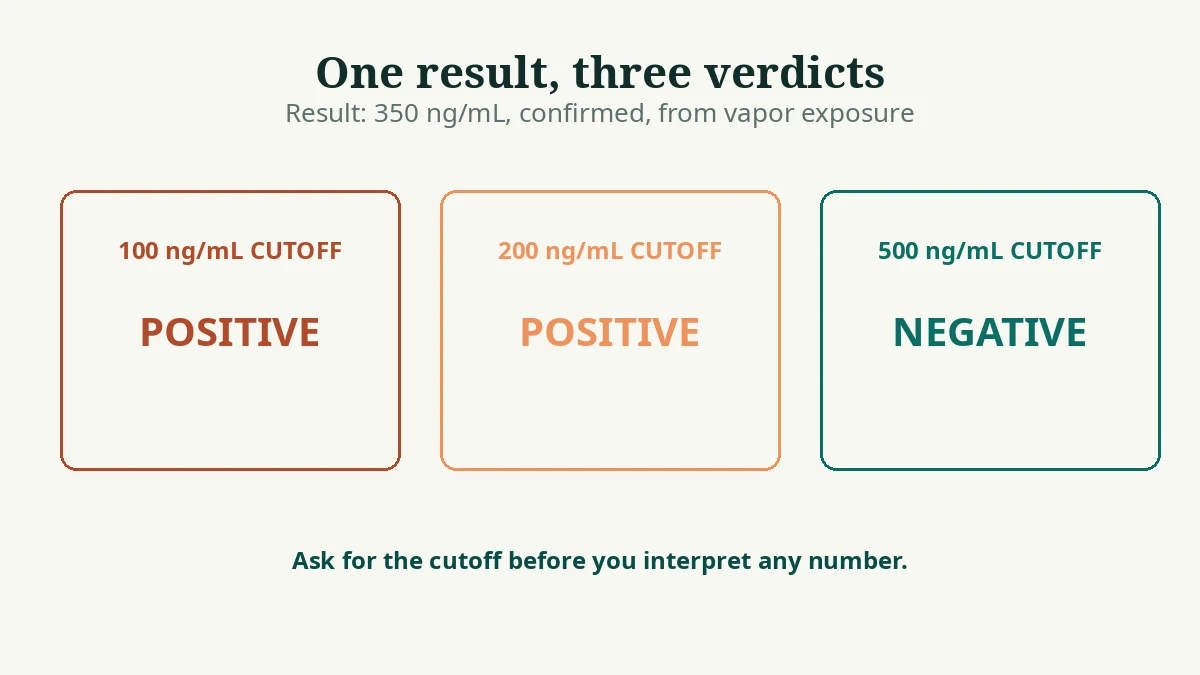
Take the observer's 350 ng/mL result and run it through the three cutoffs programs actually use. At 100 ng/mL, the sensitive threshold used by many monitoring programs, it is positive. At 200 ng/mL, it is still positive. At 500 ng/mL, the threshold SAMHSA's advisory associates with standard workplace screening, it is negative. Nothing about the person or the exposure changed — only the line the program drew.
This is why secondhand exposure is mainly a problem at low cutoffs. Programs that test at 500 ng/mL have, in effect, built a buffer against incidental exposure into their threshold. Programs that test at 100 ng/mL have chosen sensitivity over that buffer, and they accept — or should accept — that low positives need a second look. SAMHSA's advisory makes the same point in general terms: EtG results should be interpreted alongside a person's exposure history, and a positive result alone should not be treated as proof of drinking or as the sole basis for a legal or disciplinary decision.
| Program cutoff | 350 ng/mL result | What it means for secondhand exposure |
|---|---|---|
| 100 ng/mL | Positive | Repeated vapor exposure can cross this line |
| 200 ng/mL | Positive | Heavier repeated exposure can still cross it |
| 500 ng/mL | Negative | Typical incidental exposure stays below this line |
What does not count: five secondhand myths
Someone else's breath. A drinker's exhaled breath contains ethanol, but it disperses immediately into room air. No study has turned a bystander positive this way, and the dose is far below the enclosed-room experiments. An evening near drinkers is not a credible explanation for a high result, and a weak one even for a low result.
A single whiff. One pump of sanitizer or one spray of cleaner is a brief, low-dose event. The positives in the literature come from repetition — fifteen applications in an hour, thirty-two procedures a shift — not from single encounters.
Isopropyl alcohol products. Rubbing alcohol and many disinfectants use isopropanol, not ethanol, and isopropanol does not metabolize into EtG. There is a twist: Arndt's 2012 work showed propyl glucuronides — propanol metabolites — can cross-react by about 10 percent on some EtG immunoassay screens, producing false-positive screens up to 4 mg/L after heavy propanol sanitizer use, including after passive inhalation of its vapor. Mass-spectrometry confirmation found no EtG in those samples. A propanol product can fool a screen, but it cannot produce genuine EtG.
Secondhand smoke. Tobacco smoke contains no ethanol, so there is no mechanism by which it would produce EtG. The analogy breaks down: EtG risk comes only from ethanol molecules reaching your body in meaningful amounts.
Real-world scenario: a nurse's shift vs a wedding guest's evening
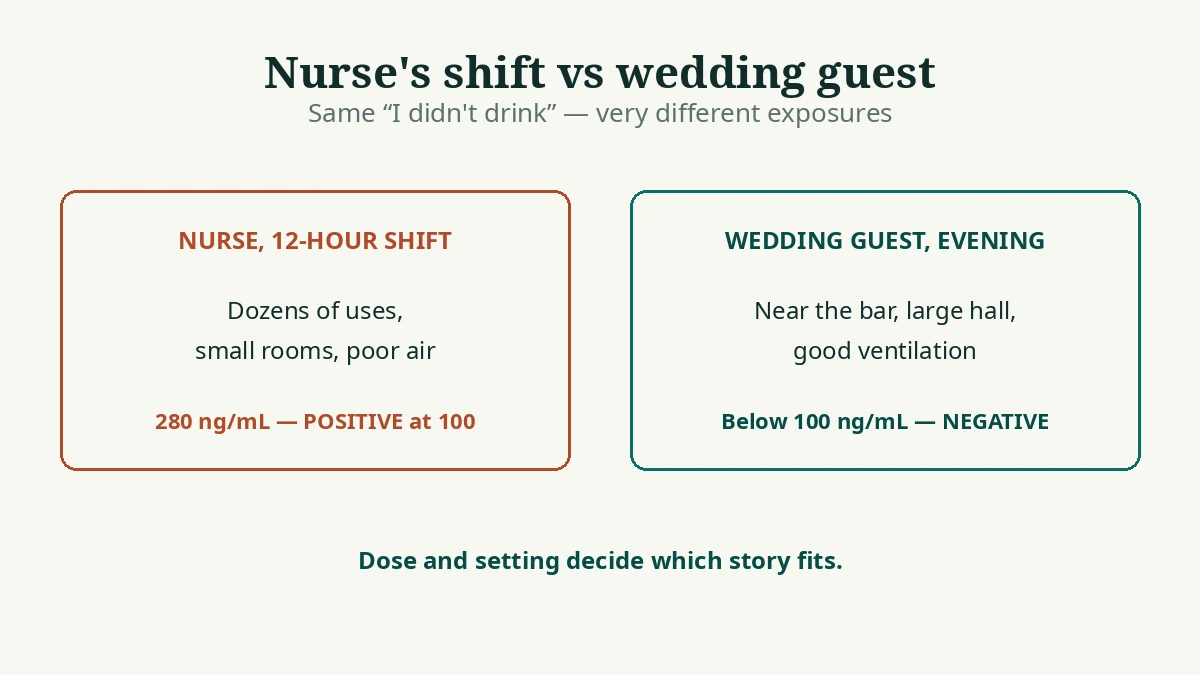
Consider two people, both tested the next morning at a 100 ng/mL cutoff. The first is a hospital nurse on a twelve-hour night shift who sanitizes her hands dozens of times, often in small rooms with poor ventilation. She drinks nothing. By morning, her urine EtG reads 280 ng/mL — positive at her program's cutoff, and a close match to the literature's pattern: repeated, concentrated, enclosed-space vapor over many hours.
The second is a wedding guest who spent the evening near the bar in a large ventilated hall. He drinks nothing, and his morning result is negative, below 100 ng/mL. If it had come back at 120 ng/mL, the wedding air would be a poor explanation — the dose does not fit the pattern, and his program should ask about sanitizer, mouthwash, medications, and foods first. Weigh exposures by dose and setting, not by whether alcohol was merely present nearby.
If you are in the nurse's position — tested at a low cutoff while working with ethanol products daily — work in ventilated spaces where you can, and note the products you use and roughly how often, so a low positive can be met with a specific, checkable exposure history rather than a vague claim. If a result comes back positive, ask for LC-MS/MS confirmation before any consequence is decided. None of this can promise a particular outcome, but it makes sure the decision rests on confirmed evidence and a complete history.
How this fits the rest of the incidental-exposure picture
Secondhand vapor is one corner of a cluster this site has covered piece by piece: mouthwash, hand sanitizer, drinking water and dilution, and now inhaled exposure. The pattern is consistent: incidental sources can produce real EtG, usually in the low hundreds of ng/mL, usually only at sensitive cutoffs, and usually only with repetition or concentration. Drinking produces EtG in the same range and far beyond it, which is why no cutoff cleanly separates "incidental" from "drank" — the ranges overlap at the low end, and only confirmation plus history can narrow the question.
For planning rather than interpretation, our EtG calculator models the typical detection window after drinking, and the EtG calculator chart shows how windows shift with drink count and cutoff. Neither tool models secondhand exposure — the doses are too variable and too small to model honestly. For the exposure side, our hand sanitizer guide, mouthwash guide, and false positives overview cover the neighboring sources, and the 100 vs 500 ng/mL cutoff guide explains the threshold that decides most of these cases.
Frequently asked questions
Can secondhand alcohol exposure cause a positive EtG test?+
Yes, in narrow conditions. Repeatedly breathing concentrated ethanol vapor in an enclosed space — for example, many hand-sanitizer uses in a small room — has produced EtG above a 100 ng/mL cutoff in studies, including in a non-drinking observer at 350 ng/mL. Casual contact, such as standing near people drinking, has no study behind it as a cause of a positive result.
Can being around people drinking make you fail an EtG test?+
There is no published evidence that it can. Ethanol in a drinker's breath disperses rapidly into room air, and the dose a bystander inhales is far below the concentrated, repeated exposures that produced positives in experiments. If you test positive, look first at repeated vapor, mouthwash, medications, and foods — not at an evening near drinkers.
Does breathing hand sanitizer fumes raise EtG?+
Yes, with repetition. Studies show inhalation — not skin contact — is the route by which sanitizer ethanol reaches the body and becomes EtG. Health care workers averaging about 32 hand antisepsis procedures per shift showed a median maximum EtG of 230 ng/mL during an abstinence phase, with a highest reading of 958 ng/mL. Ventilation that carries vapor away prevented positives in one experiment.
What EtG level can secondhand exposure produce?+
Published figures cluster in the low hundreds of ng/mL: 350 ng/mL for the observer in the small-room experiment, a median maximum of 230 ng/mL and a highest reading of 958 ng/mL among abstaining health care workers. That range crosses 100 and 200 ng/mL cutoffs but usually stays below 500 ng/mL. Individual results vary widely, and no figure predicts any one person's result.
Can isopropyl rubbing alcohol cause a positive EtG test?+
It cannot produce genuine EtG, because isopropanol is not ethanol and does not metabolize into EtG. However, its metabolites (propyl glucuronides) can cross-react on some immunoassay screens and produce false-positive screening results. LC-MS/MS confirmation finds no EtG in those samples, which is why a screening positive should always be confirmed before consequences follow.
How do I explain secondhand exposure if I test positive?+
Be specific and checkable: name the product, where and how often you were exposed, the room size and ventilation, and the dates. Ask for LC-MS/MS confirmation, and ask how your program treats low positives versus high ones. A vague claim that alcohol was nearby is weak evidence; a documented pattern of repeated, enclosed-space vapor exposure matches what the research actually shows.
Does a positive EtG result prove I drank alcohol?+
No. A positive result proves ethanol exposure within the detection window, not the source of that exposure and not impairment. Drinking is the most common source, and higher levels make drinking more likely, but incidental sources — including inhaled vapor — can produce low positives. That is why SAMHSA's advisory says EtG results should be interpreted with exposure history and should not be the sole basis for legal or disciplinary decisions.
Evidence and limitations
This article summarizes published research on inhaled ethanol, ethyl glucuronide formation, cutoffs, and confirmation testing. Group-level findings cannot predict one person's result, and this article is educational only — it is not medical or legal advice.
- SAMHSA Advisory: The Role of Biomarkers in the Treatment of Alcohol Use Disorders (2006, revised 2012)
- Liepman small-room sanitizer experiment (24 abstinent subjects; observer at 350 ng/mL) — as reported from the American Society of Addiction Medicine meeting
- Arndt et al. (2014) — inhalation but not transdermal resorption of hand sanitizer ethanol causes positive EtG findings (Forensic Sci Int 237:126–130), as reviewed
- Arndt et al. (2012) — false-positive EtG immunoassay screening caused by a propyl alcohol-based hand sanitizer (Forensic Sci Int 223:359–363)
- Gessner et al. — ethanol and EtG urine concentrations after ethanol-based hand antisepsis (median maximum 230 ng/mL, highest 958 ng/mL during abstinence)
- Bessoneau et al. (2012) — assessment of exposure to alcohol vapor from alcohol-based hand rubs (46.5 mg hygienic / 203.9 mg surgical absorbed dose)
- Inhalation of alcohol vapor: measurement and implications (2017 review — inhaled vapor produces measurable EtG without elevated blood alcohol)