The short answer: paramedic EtG testing is agency policy, not a national rule
An ETG test for paramedics is a urine test for ethyl glucuronide, a metabolite of alcohol, showing whether the paramedic drank in the past one to three days. The important fact is who orders the test — and the answer is almost always the agency, not the government.
About 278,000 people work as EMTs and paramedics in the United States — roughly 178,000 EMTs and 100,000 paramedics, according to federal workforce data. Yet no federal testing program covers the profession as a whole. The National Registry of Emergency Medical Technicians (NREMT) certifies competence; it does not drug-test candidates. State EMS authorities license and discipline providers but do not require a drug screen to earn or renew a certificate — California's EMS Authority, for example, requires none. Nearly every agency requires its own pre-employment screen and keeps testing after hire under a written policy. What decides whether you are tested, when, and at what cutoff lives in that policy, in your state's testing statute, and — only for CDL drivers — in federal DOT regulations.
When an EtG test for paramedics actually happens
Most paramedic and EMT testing falls into five triggers. Pre-employment screening is the near-universal one: virtually every agency requires a urine screen after a conditional offer and before the first shift, usually a 5- or 10-panel screen, with EtG added for a recent-alcohol check.
| Trigger | When it happens | What it usually involves |
|---|---|---|
| Pre-employment | After a conditional job offer, before the first shift | Urine panel, sometimes with EtG; a fail can withdraw the offer |
| Post-accident / post-incident | After a crash, a patient-care incident, or a medication error | Urine test, often with alcohol; crashes trigger it almost automatically |
| Reasonable suspicion | When a supervisor notes signs of impairment | Immediate test; slurred speech or erratic behavior are the usual triggers |
| Random (DOT/CDL) | Only for CDL ambulance drivers in a DOT pool | Truly random; zero times in a year or three times in a month |
| Return-to-duty / follow-up | After a positive test or a policy violation | Scheduled tests to show abstinence, often over months |
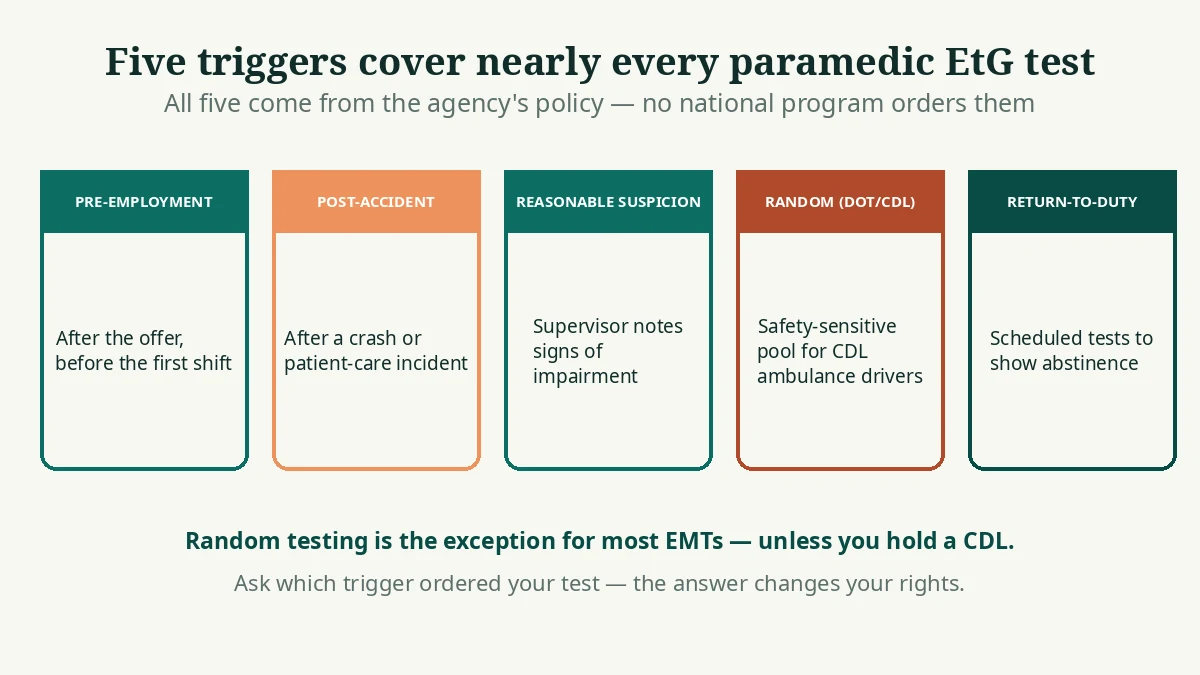
Random testing is the exception for most EMTs — the difference usually comes down to whether the agency's drivers hold commercial driver's licenses.
The DOT split: driving the ambulance vs treating the patient
Here is the distinction that confuses almost everyone in EMS. If your agency runs non-emergency interfacility transports and its drivers need a commercial driver's license, it falls under the DOT drug and alcohol program, 49 CFR Part 382. It requires six kinds of testing for CDL drivers: pre-employment, post-accident, random, reasonable suspicion, return-to-duty, and follow-up. The alcohol limit is 0.04, and no driver may work safety-sensitive duty within four hours of drinking.
But the DOT alcohol test is a breath test, not EtG urine. DOT procedures run under 49 CFR Part 40 — breath alcohol for alcohol, urine for drugs — and EtG is not part of the DOT panel at all. So when an ambulance service orders an EtG urine test, it is running its own agency-policy test, even if the same employee is also in a DOT random pool. The two programs answer different questions: the DOT test asks whether you are impaired around duty right now; the EtG test asks whether you drank at all in the past one to three days, including off duty.
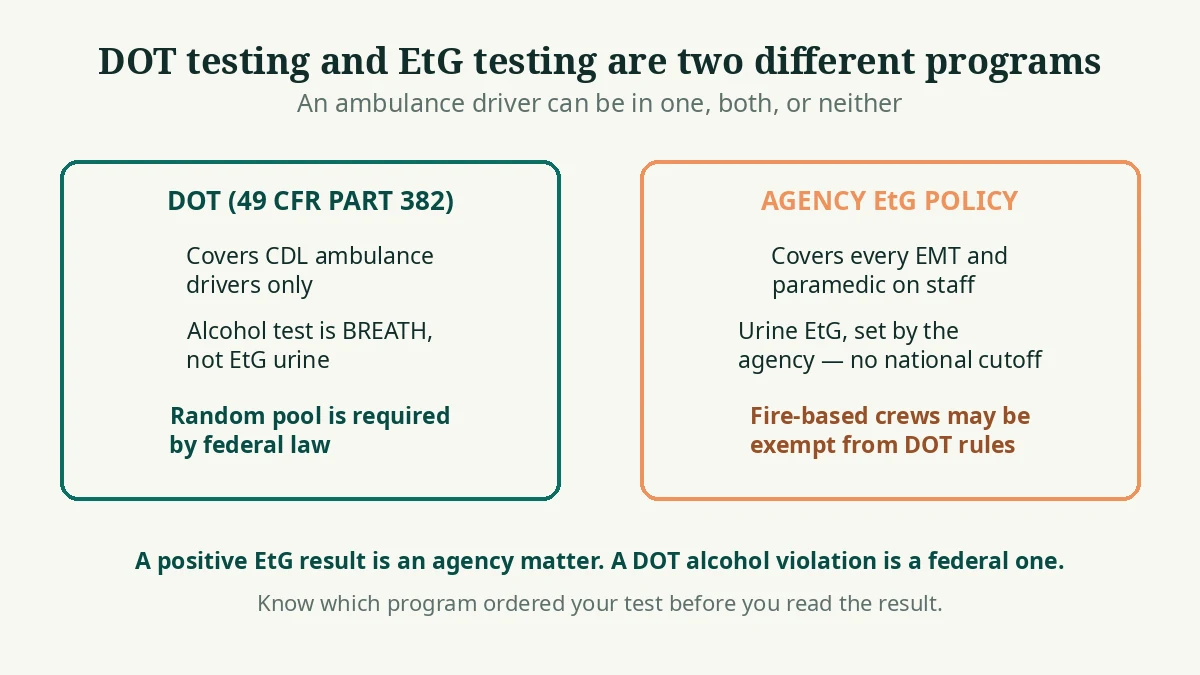
Part 382 also lets states exempt firefighters and other emergency responders who operate emergency vehicles with audible and visual signals. A fire-based paramedic on a 911 engine company may therefore never enter a DOT pool at all — while a paramedic doing the same clinical work for a private interfacility company is in one. Same uniform, same skills, different regime, decided by the vehicle and the employer.
Fire-based, private, and hospital-based: three different testing worlds
Fire-based EMS typically tests at hire and then under the department's drug-and-alcohol policy — usually pre-employment, random, post-accident, and reasonable-suspicion testing. The Washington, D.C. fire department, for example, classifies firefighter-paramedics as safety-sensitive and subjects them to mandatory pre-employment and random drug and alcohol testing. Union contracts shape the details: how random selection works and whether treatment is offered before discipline.
Private ambulance companies are the most variable. A large national provider may run a tight program — pre-employment screening for every hire, random screens for safety-sensitive roles, and immediate testing after any crash. A small rural service may test only at hire and after incidents. Job postings from private services routinely state the rule up front: pre-employment screening is required, the position is safety-sensitive, and safety-sensitive staff are subject to random drug screens.
Hospital-based EMS sits in the middle: the same drug-free-workplace policy as the nurses, with pre-employment screening and for-cause testing. A hospital paramedic who also holds a CDL for interfacility driving can end up in both worlds at once — the hospital's policy plus the DOT pool.
What the EtG test actually measures
EtG is a metabolite the body makes when it processes alcohol. It appears in urine within hours of drinking and can be detected for roughly 80 hours after heavy drinking — far longer than alcohol itself, which leaves the blood in hours. That long window is exactly why agencies like the test: it catches weekend drinking that a Monday breath test would miss. It is also why the test is controversial in EMS. A paramedic who drank four drinks on Saturday night is sober by Sunday morning, but their EtG can still be positive on Monday. The test shows past use, not impairment, and SAMHSA's advisory says EtG is "scientifically unsupportable as the sole basis for legal or disciplinary action" — worth knowing if a result ever lands in a disciplinary file.
The result also depends heavily on the cutoff, and there is no national EtG cutoff for paramedics. Agencies choose 100, 200, or 500 ng/mL, usually on the advice of their lab or their medical review officer. At 100 ng/mL the test is at its most sensitive; at 500 ng/mL, the SAMHSA-recommended screening level, it catches heavier or more recent drinking. The same urine sample can be positive at one agency and negative at another, purely because of the number the agency picked. Confirmation by LC-MS/MS is the standard second step: immunoassay screens can cross-react, while LC-MS/MS confirms the actual EtG molecule.
Detection windows by drinks and cutoff
The table below uses the same modeled ranges as the EtG calculator on this site. Treat them as ranges, not pass dates — body weight, hydration, drinking speed, and liver function all shift the real number.
| Drinks | 100 ng/mL | 200 ng/mL | 500 ng/mL |
|---|---|---|---|
| 1–2 drinks | 23–53 hours | 20–46 hours | 15–36 hours |
| 3–4 drinks | 30–68 hours | 26–59 hours | 20–46 hours |
| 5–7 drinks | 38–85 hours | 33–75 hours | 26–58 hours |

Two things stand out: the 100 ng/mL cutoff adds roughly a full day to every window over 500 ng/mL, and the windows overlap — a light drinker at 100 ng/mL can test positive longer than a heavy drinker at 500 ng/mL. The cutoff does as much work as the drinking.
Real-world scenario: four drinks Saturday, a shift test Monday
A paramedic on a 24-hour rotation has four drinks with friends on Saturday night, the last one at 9 p.m. Monday at 7 a.m. she reports for her shift — and the agency calls a random test, or a supervisor orders one after a minor backing accident with the ambulance. That is 34 hours after the last drink.
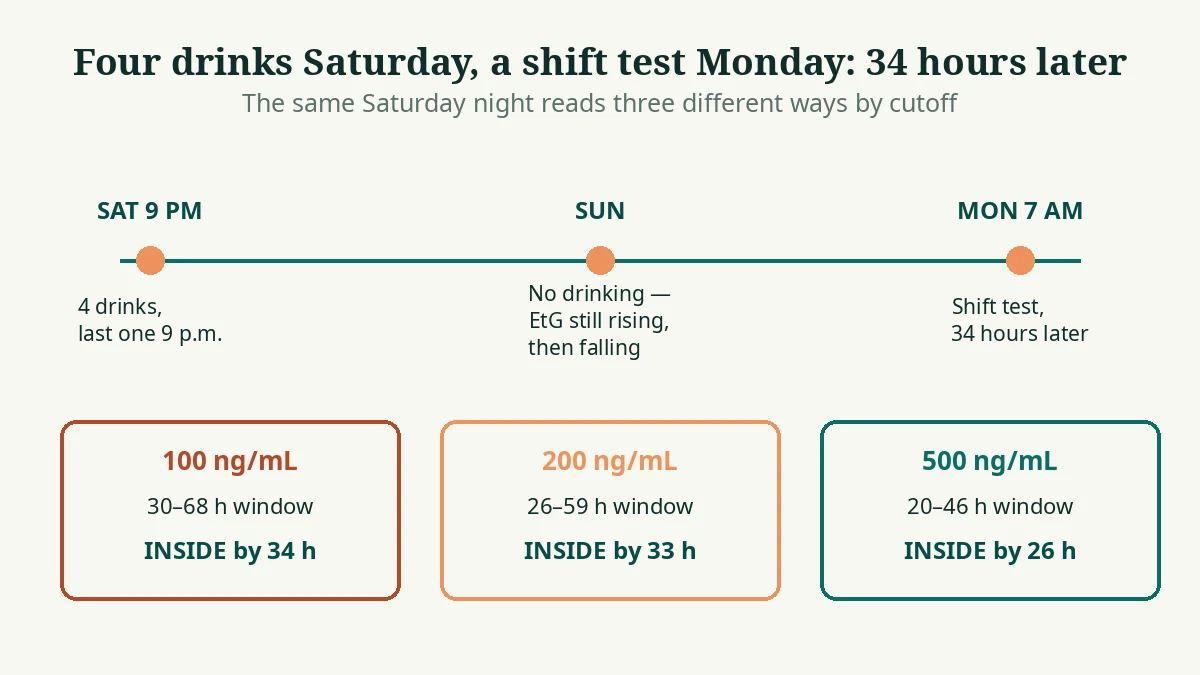
At a 100 ng/mL cutoff, the modeled window for three to four drinks is 30–68 hours — she is inside it by 34 hours, so the test is likely positive. At 200 ng/mL, the window is 26–59 hours — still inside, by 33 hours. At 500 ng/mL, the window is 20–46 hours — inside again, but only by 26 hours, and a test a few hours later would have flipped it. She was sober for more than a day before the shift, and no breath test would have found anything. The EtG test is not measuring her fitness for duty on Monday; it is measuring her Saturday night. Whether that costs her the job depends on the agency's policy, the cutoff, and whether the result was confirmed.
Certification and licensing: what a positive test can cost
A failed EtG test can cost a paramedic more than one job, because employment and certification are separate tracks. Your employer can fire you under its policy, and your state EMS authority can separately act on your certificate. In California, for example, the EMS Authority does not require a drug screen to get certified — but state law lists addiction to or misuse of controlled substances or dangerous drugs as a cause for denying, suspending, revoking, or placing a certificate on probation (California Health and Safety Code Section 1798.200). Other states have similar provisions, and agencies often report positive results to the state authority.
The NREMT itself does not test and does not revoke certifications over a single employer test result, but a state action against your license can end your National Registry standing, since Registry certification depends on a valid state license. Keep the paperwork — the cutoff, the lab report, the confirmation result, and the policy section that ordered the test — because a state licensing file, if one is ever opened, will want exactly those documents. And if you are in a union, tell your representative before you answer questions about the result; the contract usually sets the process, and the process is your protection.
What to do if you are facing a test
Respond the same day — a pre-employment test has a deadline, and a missed test counts as a refusal, which is treated as a positive. Check the policy first: which trigger ordered the test, which cutoff, which lab, whether the screen is confirmed by LC-MS/MS, and what the consequence is. Ask for the cutoff in writing before the test. If the test follows a crash or a patient-care incident, note what actually caused it — an EtG result cannot show whether drinking contributed, because it cannot show impairment at the time. Do not try to beat the test: water, supplements, and "detox" drinks do not reliably clear EtG, and a dilute sample can be flagged as cheating. If the result is positive, ask whether it was confirmed, request the lab report, and check whether your agency offers a treatment or return-to-duty path before discipline.
Using the EtG calculator before a test
The EtG calculator estimates the same windows as the tables — read it as a range, never a pass date. Run your numbers.
Frequently asked questions
Do paramedics and EMTs get EtG tested?+
Yes, almost universally at hire and often after. Nearly every ambulance service, fire department, and hospital system requires a pre-employment drug screen, and most keep testing after hire under a written policy — post-accident, reasonable suspicion, and, for CDL drivers, federally required random testing. EtG is added when the agency wants a recent-alcohol check, since a standard 5-panel screen does not detect alcohol use from days earlier.
Is EtG testing for paramedics required by federal law?+
No. There is no federal EtG testing program for paramedics or EMTs. The DOT program under 49 CFR Part 382 covers CDL ambulance drivers, but its alcohol test is a breath test, not EtG urine. An EtG test is ordered under the agency's own policy, and the cutoff — usually 100, 200, or 500 ng/mL — is set by the agency, not by any federal rule.
Does the DOT test ambulance drivers for alcohol?+
Yes, when the driver holds a commercial driver's license. Under 49 CFR Part 382, CDL drivers face pre-employment, post-accident, random, reasonable-suspicion, return-to-duty, and follow-up testing, with a 0.04 alcohol limit and no safety-sensitive work within four hours of drinking. Firefighters and emergency responders operating emergency vehicles may be exempt at the state's discretion.
How long after drinking can a paramedic test positive on EtG?+
It depends on how much was drunk and the cutoff. For three to four drinks, the modeled window is roughly 30–68 hours at a 100 ng/mL cutoff, 26–59 hours at 200 ng/mL, and 20–46 hours at 500 ng/mL. SAMHSA notes EtG can be detected for up to about 80 hours after heavy drinking. These are ranges, not pass dates — weight, hydration, and drinking speed all shift the real number.
Can an EtG test show I was impaired on duty?+
No. EtG shows that alcohol was consumed in the past one to three days; it cannot show impairment at the time of a shift, a crash, or a patient-care incident. A paramedic who drank off duty on Saturday can test positive on a Monday shift test while fully sober. SAMHSA's advisory says EtG is scientifically unsupportable as the sole basis for legal or disciplinary action.
Can a failed EtG test cost a paramedic their certification?+
It can. Employment and certification are separate tracks: the agency can fire you under its policy, and the state EMS authority can separately discipline your certificate or license. In California, for example, addiction to or misuse of controlled substances, narcotics, or dangerous drugs is a statutory cause for certificate denial, suspension, revocation, or probation. Keep the cutoff, the lab report, and the confirmation result if a file is ever opened.
What cutoff do EMS agencies use for EtG?+
There is no national EtG cutoff for paramedics. Agencies usually choose 100, 200, or 500 ng/mL on the advice of their lab or medical review officer. A 100 ng/mL cutoff is the most sensitive and catches the lightest drinking; 500 ng/mL is the SAMHSA-recommended screening level. The same urine sample can be positive at one agency and negative at another purely because of the number chosen.
Evidence and limitations
This article summarizes published guidance and research on EtG testing for paramedics and EMTs, plus the science of alcohol biomarkers. Group-level findings cannot predict one person’s result, and this article is educational only — it is not legal or medical advice. Testing rules vary by employer, agency, program, and state; talk to a local attorney about a live case or a termination.
- Daily EMT — Are EMTs Drug Tested? EMS Screening Policies Explained: pre-employment screening near-universal; DOT random pool for CDL drivers; reasonable suspicion and post-accident triggers
- LegalClarity — Do EMTs Get Drug Tested in California?: EMSA does not require drug screening for certification; Health and Safety Code Section 1798.200 discipline for substance misuse; DOT 5-panel and MRO review
- FMCSA — When does testing occur and what tests are required?: 49 CFR Part 382 six test types; 0.04 alcohol concentration; four-hour pre-duty rule; return-to-duty and follow-up testing
- FMCSA — Drug and alcohol testing program guidance: CDL carriers must test pre-employment, post-accident, reasonable suspicion, return-to-duty, and random; firefighters and emergency responders operating emergency vehicles exempt at state discretion
- Metropolitan Emergency Medical Services — Paramedic posting: pre-employment drug screening required; safety-sensitive positions including EMT, Paramedic, and Emergency Medical Dispatcher subject to random drug screens
- U.S. Bureau of Labor Statistics — Paramedics (29-2043): 98,770 paramedics employed; EMTs about 178,000 (CareerOneStop 2024: 177,980 EMTs, 99,530 paramedics)
- SAMHSA Advisory: The Role of Biomarkers in the Treatment of Alcohol Use Disorders (2006, revised 2012) — EtG detectable up to ~80 hours; EtG “scientifically unsupportable as the sole basis for legal or disciplinary action”
- McDonell et al. (2015) — EtG immunoassay cutoff sensitivity in alcohol-dependent outpatients (1,589 samples)
- Mackus et al. (2017) — EtG detection and elimination kinetics after controlled alcohol intake
- Jatlow et al. — EtG and EtS in urine after controlled alcohol administration
- EtG Calculator Pro — ETG Testing for Delivery Drivers: the DOT / non-DOT split for drivers
- EtG Calculator Pro — ETG Testing for Employment: consent and consequences in the workplace
- EtG Calculator Pro — ETG Testing for Firefighters: fire-service testing, unions, and return-to-duty