The short answer: corrections EtG testing is agency policy, not federal law
An ETG test for corrections officers is a urine test for ethyl glucuronide, an alcohol metabolite, showing whether the officer drank in the past one to three days. If you work in a prison or jail, you are almost certainly tested — but probably not with EtG, because there is no federal EtG mandate for corrections staff. Testing is set by the agency that employs you: a state department of corrections, a county sheriff's office, or a private prison operator. EtG appears only when that agency adds its own urine alcohol test on top of its standard drug testing.
About 365,380 correctional officers and jailers work in the United States, per CareerOneStop data drawn from the Bureau of Labor Statistics — the largest employers are Texas (about 39,150), California (about 37,760), New York (about 29,710), and Florida (about 22,390). Nearly all work under a drug-free workplace policy that includes testing. Whether any of those tests is an EtG test depends on the agency's written policy, the officer's role, and which of five triggers applies.
Who sets the rules — and why there is no single standard
Corrections officers are not covered by a federal testing rule the way railroad workers are under 49 CFR Part 219 or truck drivers under FMCSA rules. A corrections officer's testing comes from three sources, and they stack differently in every state.
| Rule-setter | What it controls | EtG role |
|---|---|---|
| State department of corrections | Prison officers: hiring, random, and for-cause testing | Policy decides — EtG is optional |
| County sheriff / jail administrator | Jail deputies and detention officers | County policy decides |
| State law | Some states authorize testing programs | Sets the framework, not the EtG cutoff |
That split is the most important fact in this article. A state prison officer in Kentucky, a county jail deputy in Florida, and a private-prison officer in Texas can all face EtG tests — or none of them can — because the decision is made agency by agency. There is no national EtG cutoff for corrections staff, and no published list of which agencies use EtG.
When corrections officers actually get tested
Across the state policies we reviewed, the same five triggers appear again and again — pre-employment, random, reasonable suspicion, post-incident, and return-to-duty.
| Trigger | When it happens | What it usually covers |
|---|---|---|
| Pre-employment | During hiring, before the first shift | Urine drug screen; EtG if added |
| Random | Unannounced, any shift, no reason needed | Drug screen; EtG if added |
| Reasonable suspicion | A supervisor documents specific signs | Drug and alcohol testing, often with EtG |
| Post-incident / critical incident | After a use of force, escape, or serious event | Drug and alcohol testing, often including EtG |
| Return-to-duty / follow-up | After a violation or treatment | Testing on a schedule set by the agency |
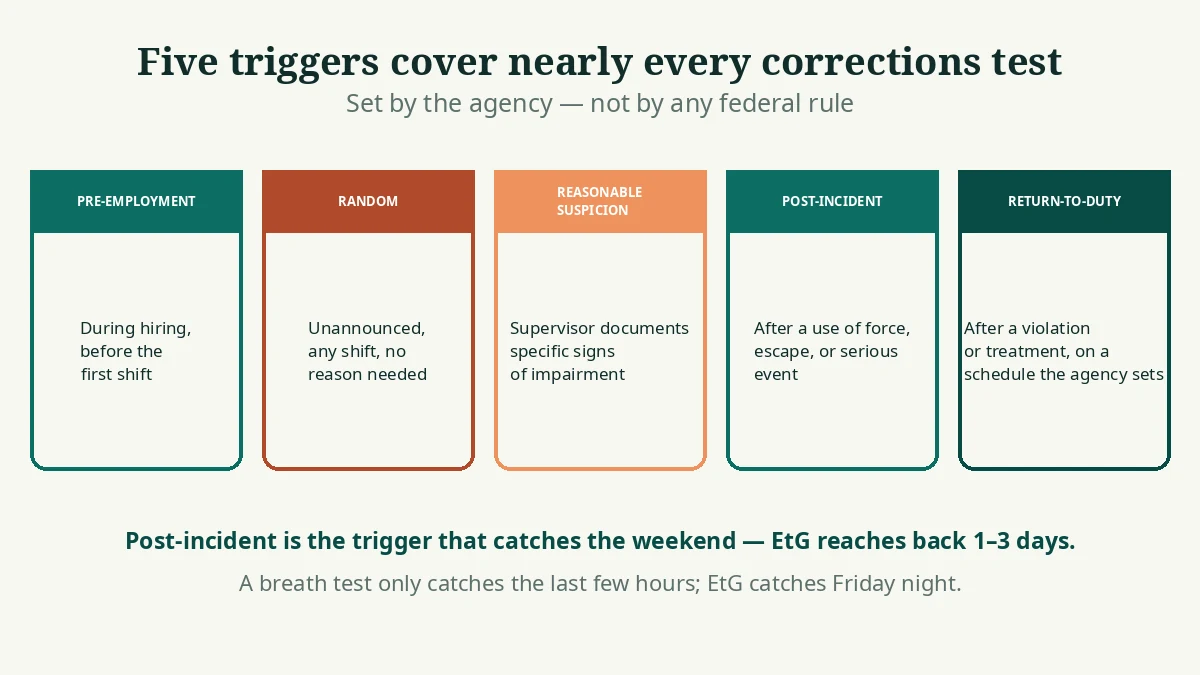
Pre-employment testing is the most universal. Colorado's Department of Corrections administers a pre-employment drug test at any point in the selection process, and applicants who test positive for any controlled substance — including marijuana — are disqualified; random screening then runs throughout employment. Reasonable suspicion testing follows a supervisor's specific, documented observations, and post-incident testing follows events such as a use of force, an escape, or a serious disturbance. Return-to-duty and follow-up testing apply after a violation or after treatment.
What real state policies say
Five state policies show how the same triggers are written into law — and how differently each agency handles alcohol.
| State / agency | Policy | Alcohol rule that stands out |
|---|---|---|
| Kentucky DOC | Corrections Policies and Procedures 3.11 (2023) | Urine test or alcohol screen pre-employment, on reasonable suspicion, and random for hazardous-duty staff |
| Virginia DOC | Operating Procedure 135.4 (2025) | Post-accident testing; urine and oral-fluid screens; voluntary treatment track |
| Utah DOC | Department Manual AE20 (2025) | Zero tolerance: any detectable alcohol at work is cause for termination |
| Florida DOC | Florida Statute §944.474 | Random drug tests for all employees; random alcohol evaluation |
| Colorado DOC | Hiring policy | Pre-employment test at any point in selection; random screening throughout employment |
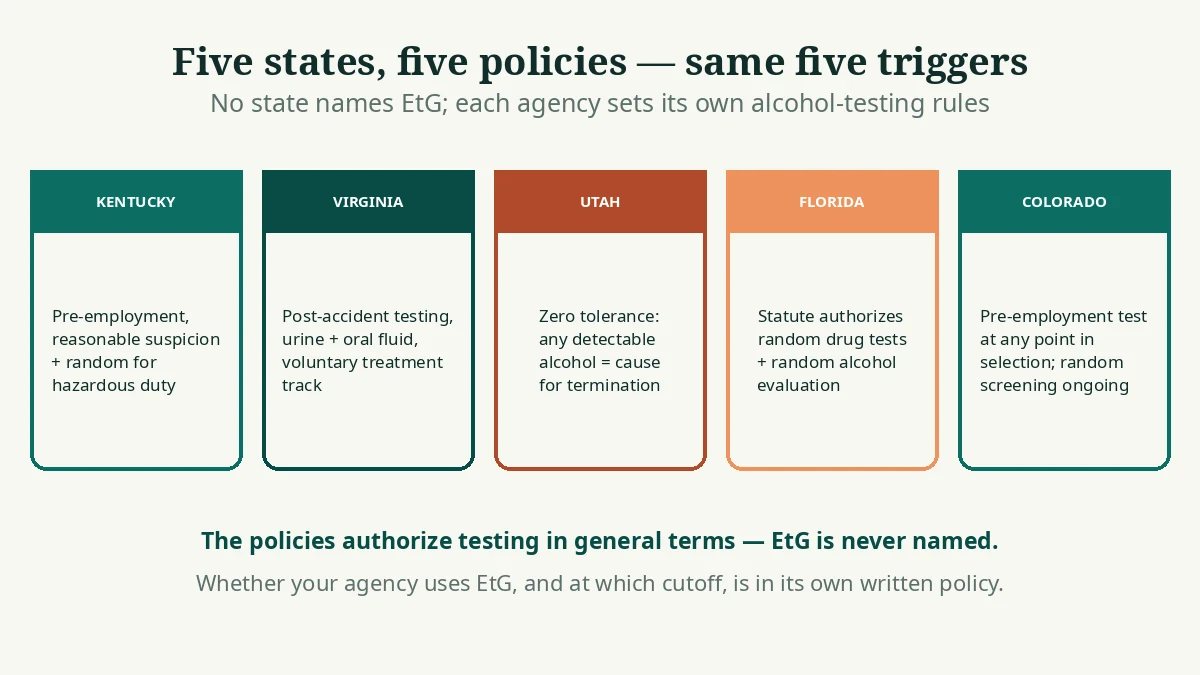
Kentucky's policy is the most detailed about triggers. It requires a urine drug test or alcohol screen before employment (after the initial interview, for hazardous or non-merit employees), for contract staff before beginning work, and at any time for reasonable suspicion, with management approval. Random testing applies to hazardous-duty staff, selected with equal probability — and management may not waive a selected employee's test.
Virginia's Operating Procedure 135.4, effective May 1, 2025, applies to every unit the Virginia Department of Corrections operates: post-accident drug and alcohol testing, commercial driver's license holder testing, probation and parole officers who carry a firearm, and a voluntary identification and treatment track. Utah's policy is the bluntest on alcohol: a zero-tolerance standard under which reporting to work with any detectable amount of alcohol is cause for termination. Florida puts the authority in statute: §944.474 lets the Department of Corrections drug-test all job applicants, randomly drug-test all employees, and randomly evaluate employees for the contemporaneous use or influence of alcohol.
Notice what none of these policies does: none names EtG, and none sets an EtG cutoff. The policies authorize drug and alcohol testing in general terms, and EtG is one tool an agency can use inside that authority. Whether your agency uses it, and at which cutoff, is a question only its written policy can answer.
What an EtG test for corrections officers actually measures
EtG, or ethyl glucuronide, is a direct metabolite of alcohol. When you drink, a small share of the alcohol is converted into EtG, which leaves the body in urine over the next one to three days. A breath test measures alcohol in your breath right now; an EtG test measures whether you drank recently. That is why a corrections agency adds EtG: a breath test at the start of a shift cannot see Friday night, but an EtG urine test on Sunday can.
EtG cannot show impairment. An officer who drank off duty on Friday can test positive on a Sunday post-incident test while fully sober. SAMHSA's advisory says EtG can be detected for up to about 80 hours after heavy drinking, and warns that disciplinary action based solely on a positive EtG is "inappropriate and scientifically unsupportable." A positive screen should always be confirmed by a laboratory test — confirmation is also the protection against false positives from hand sanitizer or mouthwash.
EtG also cannot prove when the drinking happened, or that it happened on duty. A result says "alcohol was consumed in the last one to three days" — it cannot say whether that was Friday evening at home or Saturday morning before a shift. In a post-incident test, that distinction matters, and it is exactly the distinction EtG cannot make.
Detection windows by drinks and cutoff
How long EtG stays detectable depends on how much was drunk and the cutoff used.
| Drinks | 100 ng/mL | 200 ng/mL | 500 ng/mL |
|---|---|---|---|
| 1–2 drinks | 23–53 hours | 20–46 hours | 15–36 hours |
| 3–4 drinks | 30–68 hours | 26–59 hours | 20–46 hours |
| 5–7 drinks | 38–85 hours | 33–75 hours | 26–58 hours |
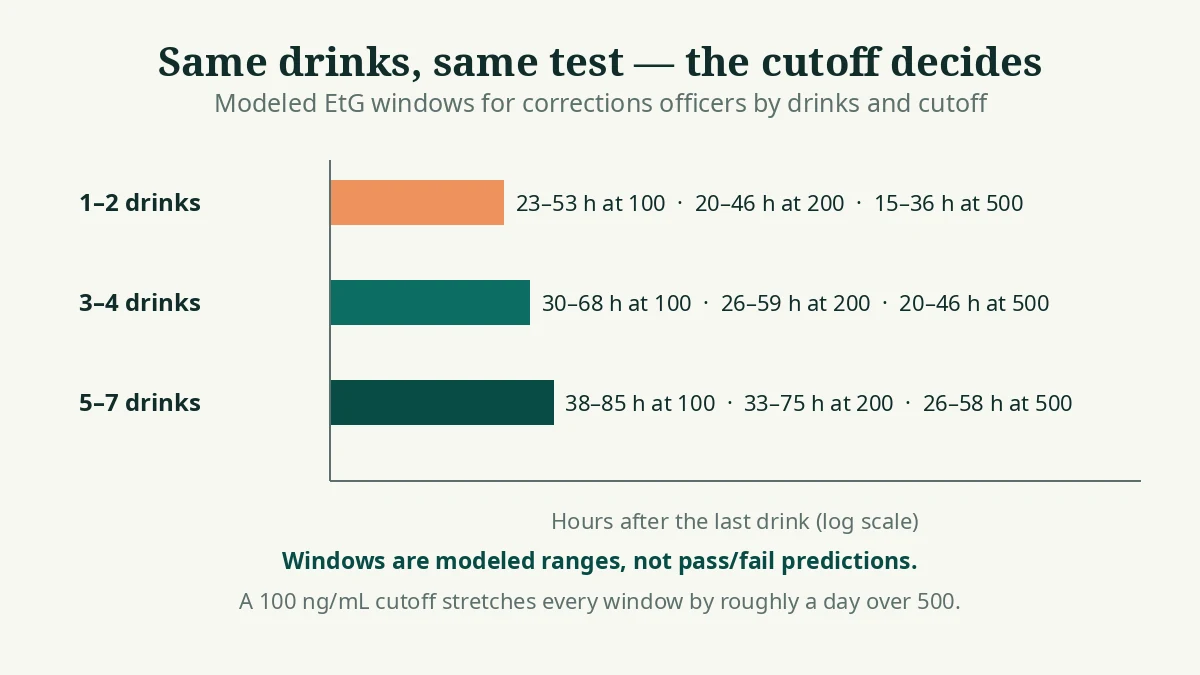
The gap between cutoffs is the pattern to remember. At 100 ng/mL, a moderate night can stay detectable for more than two days; at 500 ng/mL, the same night clears in about a day and a half. That is why the first question about any EtG test is which cutoff it uses. These are modeled ranges, not pass dates: weight, hydration, drinking speed, and duration all shift the real number.
Real-world scenario: two drinks Friday, a post-incident test Sunday
A corrections officer finishes a Friday shift and has two drinks, the last one at 11 p.m. He is sober by Saturday morning. On Sunday at 3 p.m., after a cell extraction injures a resident, the facility orders post-incident testing for every officer involved — 40 hours after the last drink.
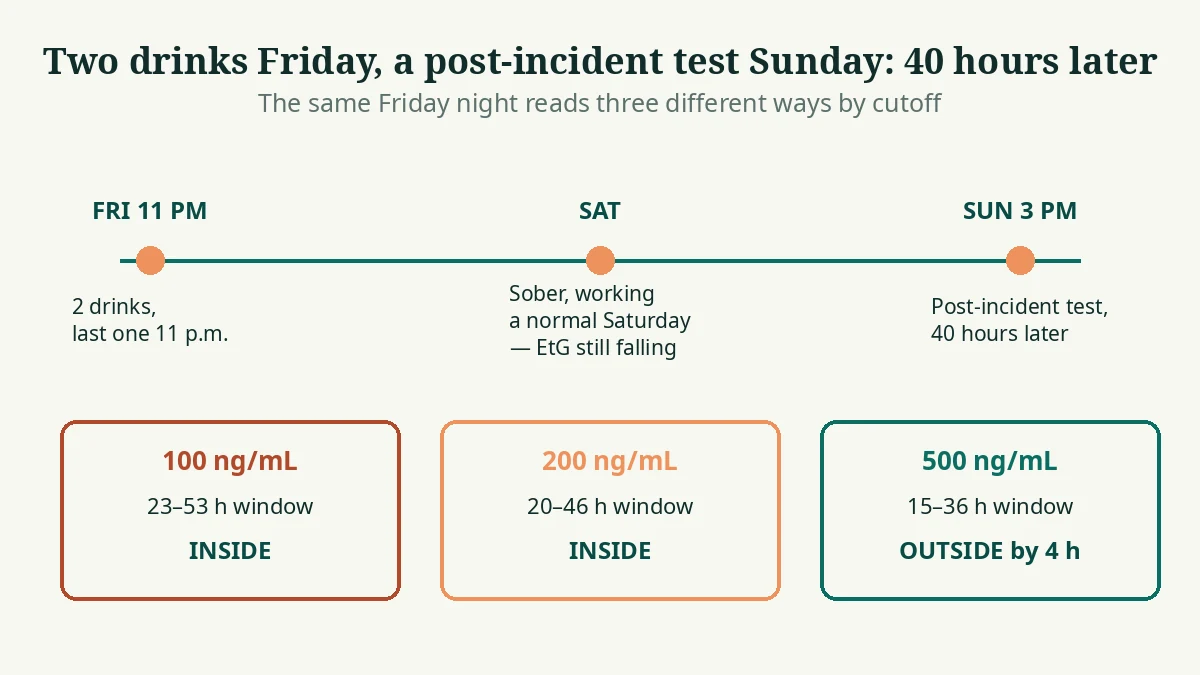
At a 100 ng/mL cutoff, the modeled window for two drinks is 23–53 hours, so 40 hours is inside it — a positive is likely. At 200 ng/mL, the window is 20–46 hours, so 40 hours is still inside. At 500 ng/mL, the window is 15–36 hours — a negative is likely. Same Friday night, same officer, same test: three different results, decided entirely by the cutoff. A breath test on Sunday afternoon would read zero in every case. And the EtG result cannot say whether the officer drank on duty — only that he drank within the last one to three days. That is why a positive screen after an incident deserves a confirmation test and a fair reading before any conclusion is drawn.
What a positive test can cost
The cost of a positive depends on the agency's policy. In Utah, the policy is explicit: consuming alcohol on duty or reporting to work with any detectable amount of alcohol is cause for termination. In Kentucky, a positive can mean discipline up to termination under the drug-free workplace policy, with the severity set by the violation and the employee's record.
Two things protect an officer before any of that happens. First, a positive screen should be confirmed by a laboratory test — a screening result alone is not a final result, and confirmation is the standard protection against false positives from incidental exposure such as hand sanitizer or mouthwash. Second, most corrections officers work under a union agreement, a civil-service system, or both, and those usually give the officer rights — a hearing, representation, and an appeal. A refusal is usually worse than a positive: most policies treat refusing a test as a positive result, and some treat it as grounds for immediate termination.
Corrections officers vs police officers: same idea, different employer
Corrections officers are often grouped with police officers, but the testing regimes are different. Police officers usually work for a municipal or county law-enforcement agency; corrections officers work for a state department of corrections, a county sheriff's jail division, or a private prison operator. The testing triggers are similar, but the employer, the policy document, and the appeal route are all different. If you are comparing the two, see our guide to EtG testing for police officers — the science is the same, the employer is not.
What to do if you are facing a test
If a test is coming, the useful steps are practical. Do not try to dilute the sample: drinking large amounts of water lowers EtG concentration but also lowers creatinine, and laboratories flag dilute samples. Do not use someone else's urine or a detox product; both are detectable and usually treated as a refusal.
Find out which cutoff the test uses, whether it is part of the agency's standard panel or an added EtG screen, whether the result will be confirmed by a laboratory, and what the agency's written policy says about a positive result. If you are in a treatment program, tell the medical review officer — not your supervisor — with documentation.
Using the EtG calculator before a test
To understand your own window, run the numbers. The EtG calculator takes the number of drinks, the hours since your last drink, and the cutoff, and returns a modeled detection window as a range — an estimate, not a pass/fail prediction. Also see our guide to EtG testing for employment and the 100 vs 500 ng/mL cutoff guide.
Frequently asked questions
Do corrections officers get EtG tested?+
Many do, but it depends on the agency. There is no federal EtG mandate for corrections staff — testing is set by each state department of corrections or county jail's own drug-free workplace policy. Most agencies test at pre-employment, random, reasonable-suspicion, post-incident, and return-to-duty triggers, and EtG is a urine alcohol test an agency may add to any of those. Ask your human-resources office whether your agency's panel includes EtG and at which cutoff.
What cutoff do corrections departments use for EtG tests?+
There is no national standard. The cutoff is set by the agency's policy — commonly 100, 200, or 500 ng/mL. A 100 ng/mL cutoff catches smaller amounts of drinking for longer than a 500 ng/mL cutoff, so the same night of drinking can read positive at one cutoff and negative at another. Your agency's written policy, or the testing laboratory's requisition form, should state the cutoff.
Can a corrections officer be fired for a positive EtG test?+
Yes — in many agencies a positive test can lead to discipline up to termination. Utah's Department of Corrections policy, for example, treats reporting to work with any detectable amount of alcohol as cause for termination. But a screening positive should be confirmed by a laboratory test first, and most officers have appeal rights through a union agreement or civil-service system. Check your agency's written policy and your agreement before assuming the outcome.
Does an EtG test show that a corrections officer drank on duty?+
No. EtG shows that alcohol was consumed in the last one to three days — it cannot say when the drinking happened, and it cannot show impairment. An officer who drank off duty on Friday can test positive on a Sunday post-incident test while fully sober. SAMHSA's advisory warns that disciplinary action based solely on a positive EtG is 'inappropriate and scientifically unsupportable.'
How long after drinking can EtG be detected for a corrections officer?+
It depends on how much was drunk and the cutoff. As a modeled range, one to two drinks is detectable for roughly 23–53 hours at 100 ng/mL, 20–46 hours at 200 ng/mL, and 15–36 hours at 500 ng/mL; five to seven drinks extends to roughly 38–85 hours at 100 ng/mL. SAMHSA notes EtG can be detected for up to about 80 hours after heavy drinking. Weight, hydration, and drinking speed all shift the real number.
Do county jail officers face the same testing as state prison officers?+
The triggers are similar — pre-employment, random, reasonable suspicion, post-incident, and return-to-duty — but the employer and the policy document are different. State prison officers are tested under a state department of corrections policy; county jail officers under a sheriff's office or county jail policy; private-prison officers under the operator's policy. Some states also authorize testing by statute, such as Florida's §944.474. Always check your own agency's written policy.
What happens if a corrections officer refuses an EtG test?+
Refusing a test is usually treated as a positive result under most agency policies, and in some agencies it is grounds for immediate termination — often worse than a positive result would have been. If you have a medical or treatment-related reason to discuss the test, raise it with the medical review officer, not your supervisor, and bring documentation. Never substitute a sample or use a detox product: both are detectable and are usually treated as a refusal.
Evidence and limitations
This article summarizes published guidance and research on EtG testing for corrections officers, plus the science of alcohol biomarkers. Group-level findings cannot predict one person’s result, and this article is educational only — it is not legal or medical advice. Testing rules vary by agency, state, and program; talk to a local attorney about a live case or a termination.
- Kentucky Department of Corrections, Corrections Policies and Procedures 3.11 — Drug Free Workplace (effective 17 Jul 2023): pre-employment, reasonable-suspicion, and random testing for hazardous-duty classifications
- Virginia Department of Corrections, Human Resources Operating Procedure 135.4 — Alcohol and Drug Testing (effective 1 May 2025, amended 1 Jul 2025): post-accident testing, CDL drivers, firearm-carrying officers, urine and oral-fluid screens
- Utah Department of Corrections, Department Manual AE20 — Drug & Alcohol-Free Workplace (reviewed 29 Sep 2025): zero-tolerance standard; pre-employment, random, reasonable-suspicion, critical-incident, post-accident, return-to-duty, and follow-up testing
- Florida Statute §944.474 — Department of Corrections drug testing of applicants and random drug testing of employees; random alcohol evaluation by test and observation
- Colorado Department of Corrections job posting — pre-employment drug test at any point in the selection process; random drug screening throughout employment
- Correctional Facility Drug Testing Services — ETG alcohol test up to 80 hours; pre-employment, random, and post-incident staff testing; GC/MS confirmation and Medical Review Officer verification
- CareerOneStop (BLS OEWS data) — Correctional Officers and Jailers: 365,380 employed in the United States in 2024; Texas 39,150, California 37,760, New York 29,710, Florida 22,390
- SAMHSA Advisory: The Role of Biomarkers in the Treatment of Alcohol Use Disorders (2006, revised 2012, SMA 12-4686) — EtG detectable up to ~80 hours; legal or disciplinary action based solely on a positive EtG “inappropriate and scientifically unsupportable”
- McDonell et al. (2015) — EtG immunoassay cutoff sensitivity in alcohol-dependent outpatients (1,589 samples)
- Mackus et al. (2017) — EtG detection and elimination kinetics after controlled alcohol intake
- Jatlow et al. (2014) — EtG and EtS assays: interpretation and limitations by dose and cutoff
- EtG Calculator Pro — ETG Testing for Police Officers: the municipal-police version of the same five-trigger system
- EtG Calculator Pro — ETG Testing for Employment: workplace testing, cutoffs, and detection windows