The short answer: childcare EtG testing is employer policy, not a federal rule
An ETG test for childcare workers is a urine test for ethyl glucuronide, a metabolite of alcohol, showing whether the worker drank in the past one to three days. The important fact is who orders the test — almost always the employer, not the government.
About 1.0 million people work in childcare in the United States, according to the Bureau of Labor Statistics. Yet no federal law requires a daycare worker to take a drug test, let alone an EtG test. What federal law does require is a criminal background check — FBI fingerprinting, National Crime Information Center and National Sex Offender Registry searches, and state child abuse and neglect registry checks, repeated at least every five years. Drug and alcohol testing is left to the states and the centers themselves.
When an EtG test for childcare workers actually happens
Most childcare testing falls into four triggers. Pre-employment screening is the most common where it exists: a urine panel after a conditional offer and before the first shift, sometimes with EtG added for a recent-alcohol check. A standard drug panel does not detect alcohol use from days earlier — that needs a separate breath test or an EtG test.
| Trigger | When it happens | What it usually involves |
|---|---|---|
| Pre-employment | After a conditional job offer, before the first shift | Urine panel, sometimes with EtG |
| Reasonable suspicion | When a director notes signs of impairment | Immediate test on observed signs of impairment |
| Post-incident | After an injury, a child-safety incident, or a complaint | Urine test, often with alcohol |
| Random | Only where a state or employer policy requires it | Truly random; rare in childcare |

Random testing is the exception in childcare: a daycare teacher is in no federally required random pool. It shows up mainly where a state mandates it — Indiana's model policy allows testing "at any time" — or where a large employer runs a drug-free workplace program. For most centers, testing is reactive: at hire, or after something is observed.
The federal floor: background checks, not drug tests
The Child Care and Development Block Grant Act of 2014 requires every state receiving federal childcare funds to run comprehensive criminal background checks on all childcare staff — licensed, regulated, registered, and license-exempt providers alike, relatives excepted. Each check must include an FBI fingerprint check, National Crime Information Center and National Sex Offender Registry searches, state criminal and sex-offender registry searches in every state lived in during the past five years, and state child abuse and neglect registry searches for the same states. Checks repeat at least every five years, and a felony drug conviction within the past five years makes a staff member ineligible, subject to a state review process.
What the statute does not contain is any drug-testing requirement. The federal health-and-safety standards list no substance-use testing element at all. The federal floor is a criminal-history check; everything about drugs and alcohol is delegated downward.
The states that actually require drug testing
Only a few states mandate drug testing for childcare staff, and none mandate EtG or alcohol testing.
| State | What the law requires | Scope |
|---|---|---|
| Indiana | Pre-employment drug test before licensing or hire; SAMHSA lab + medical review officer; positive or refusal means suspension or termination | All licensed centers, homes, and CCDF providers |
| Tennessee | Written drug-testing policy; testing on reasonable suspicion; results kept five years | All licensed agencies; no pre-employment screen |
| Texas | Drug-testing policy with pre-employment, random, and allegation-based testing | Residential facilities only, not daycares |
| Delaware | Pre-employment, random, and reasonable-suspicion testing | State employees only, not private centers |

Indiana is the model mandate. Its law requires drug-test results showing no illegal controlled substances for the provider, every household resident over 18, and any employee or volunteer caregiver — obtained before licensing or employment. The panel — amphetamines, cocaine, opiates, PCP, THC — runs through a SAMHSA-certified lab with a medical review officer. Alcohol is not in the panel, and EtG is not mentioned in the statute.
Tennessee requires every child care agency to have a drug-testing policy and to test on reasonable suspicion, keeping results for five years — a policy mandate, not a universal screen. Texas requires a drug-testing policy only for residential child-care facilities such as foster and group homes, not ordinary daycare centers. Delaware's mandate covers the state Department's own employees in child-care positions, not private centers. The bills that would go further have stalled: New Jersey's S2788, which would have required pre-employment, random, and reasonable-suspicion testing for licensed centers, was never enacted, and a 2026 Washington amendment that would merely have allowed licensees to require drug testing was not adopted. Even New Jersey's enacted mandate — drug testing for developmental-disability direct-care staff — expressly excludes alcohol testing.
What the EtG test actually measures
EtG is a metabolite the body makes when it processes alcohol. It appears in urine within hours of drinking and can be detected for roughly 80 hours after heavy drinking — far longer than alcohol itself, which leaves the blood in hours. That long window is why an employer might order the test: it catches weekend drinking that a Monday breath test would miss. It is also why the test is controversial. A teacher who drank three drinks on Friday night is sober by Saturday morning, but their EtG can still be positive on Monday. The test shows past use, not impairment: a 2017 study found urine EtG elevated the day after drinking but uncorrelated with hangover severity or drink count — EtG marks consumption, not impairment at work.
The result also depends heavily on the cutoff, and there is no national EtG cutoff for childcare workers. Employers choose 100, 200, or 500 ng/mL, usually on the advice of their lab. At 100 ng/mL the test is at its most sensitive; at 500 ng/mL, the SAMHSA-recommended screening level, it catches heavier or more recent drinking. The same urine sample can be positive at one center and negative at another, purely because of the number the employer picked. Research backs the trade-off: in a study of 1,589 samples, a 100 ng/mL cutoff had the highest sensitivity but the lowest specificity, and the authors recommended 200 ng/mL for detecting drinking more than a day earlier. SAMHSA's advisory puts the fairness point bluntly: legal or disciplinary action based solely on a positive EtG is "inappropriate and scientifically unsupportable," because EtG cannot distinguish beverage alcohol from incidental exposure such as hand sanitizer or mouthwash. Confirmation by LC-MS/MS is the standard second step.
Detection windows by drinks and cutoff
The table below uses the same modeled ranges as the EtG calculator on this site — ranges, not pass dates: weight, hydration, drinking speed, and liver function all shift the real number.
| Drinks | 100 ng/mL | 200 ng/mL | 500 ng/mL |
|---|---|---|---|
| 1–2 drinks | 23–53 hours | 20–46 hours | 15–36 hours |
| 3–4 drinks | 30–68 hours | 26–59 hours | 20–46 hours |
| 5–7 drinks | 38–85 hours | 33–75 hours | 26–58 hours |
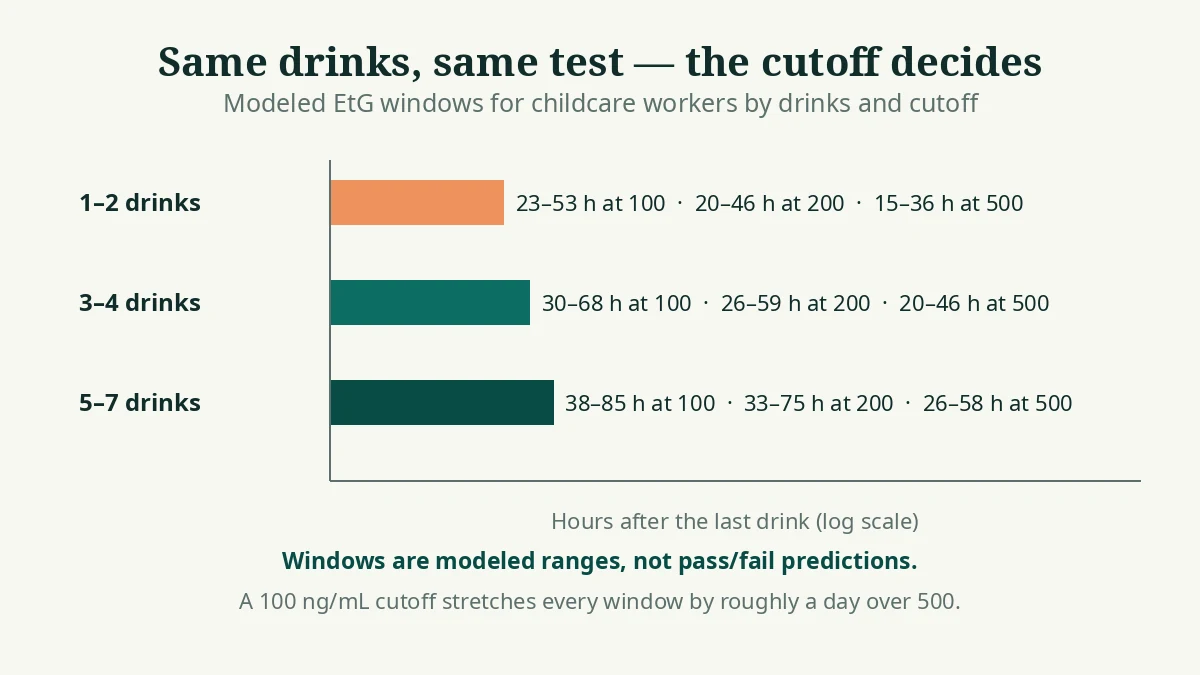
The 100 ng/mL cutoff adds roughly a full day to every window over 500 ng/mL. The "up to 80 hours" figure is a heavy-drinking ceiling, not a promise.
Real-world scenario: three drinks Friday, a test Monday
A preschool teacher has three drinks with friends on Friday night, the last one at 10 p.m. Monday at 8 a.m. she reports for her shift — and the center calls a test, because a parent complained about a Friday classroom incident, or because her center runs random screens. That is 58 hours after the last drink.
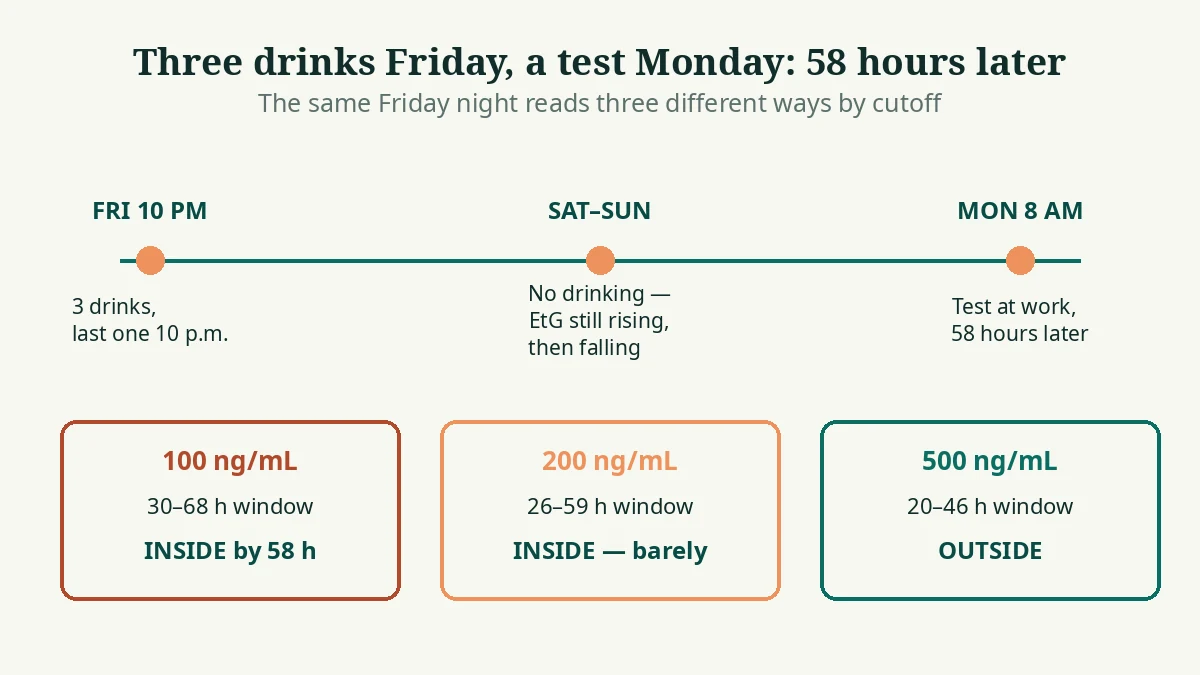
At a 100 ng/mL cutoff, the modeled window for three to four drinks is 30–68 hours — she is inside it by 58 hours, so the test is likely positive. At 200 ng/mL, the window is 26–59 hours — still inside, but only just; a test an hour later would have flipped it. At 500 ng/mL, the window is 20–46 hours — she is outside it, and the test is likely negative. The EtG test is not measuring her fitness for duty on Monday; it is measuring her Friday night.
What a positive test can cost
A failed test can cost a childcare worker more than one job, because employment and licensing are separate tracks. The center can fire you under its policy, and the state licensing agency can separately act on your license. Iowa's licensing rule requires that all owners, personnel, and volunteers "shall be free of the use of illegal drugs and shall not be under the influence of alcohol" — a conduct standard enforced in licensing inspections, not by a test mandate.
The risk is not theoretical. In February 2026, a daycare aide in Plymouth, Minnesota, was charged with child endangerment after allegedly returning from lunch intoxicated, falling on a child in a classroom of 12- to 16-month-olds, and registering a preliminary breath test reading of 0.356. She was fired immediately, and the center stated a zero-tolerance policy for alcohol or drug use. No EtG test was involved — the field response was observation plus a breath test — and that is worth stating plainly: in all the research for this article, no documented case was found of an EtG test being used on a childcare worker. EtG testing of daycare staff is a plausible and emerging practice, not a documented standard one. Keep the paperwork if a test ever happens — the cutoff, the lab report, the confirmation result, and the policy section that ordered the test. A licensing file will want exactly those documents.
What to do if you are facing a test
Respond the same day — a pre-employment test has a deadline, and a missed test counts as a refusal, which is treated as a positive. Check the policy first: which trigger ordered the test, which cutoff, which lab, whether the screen is confirmed by LC-MS/MS, and what the consequence is. Do not try to beat the test: water, supplements, and "detox" drinks do not reliably clear EtG, and a dilute sample can be flagged as cheating. If the result is positive, ask whether it was confirmed, request the lab report, and check whether your center offers a treatment or return-to-duty path before discipline.
Using the EtG calculator before a test
The EtG calculator estimates the same windows as the tables — read it as a range, never a pass date. Run your numbers.
Frequently asked questions
Do childcare workers get EtG tested?+
Sometimes, but it is the employer's decision, not a federal requirement. A center may order an EtG test at hire, on reasonable suspicion, or after an incident — usually as an add-on to a standard urine drug panel, which does not detect alcohol use from days earlier. No federal law requires drug testing for daycare staff, and most centers test only at hire or after something is observed.
Is drug testing required by federal law for daycare workers?+
No. Federal law requires criminal background checks for childcare staff under the 2014 Child Care and Development Block Grant Act — FBI fingerprinting, National Crime Information Center and National Sex Offender Registry searches, and state child abuse and neglect registry checks, repeated at least every five years. There is no federal drug-testing requirement; testing is left to the states and the centers.
Which states require drug testing for childcare workers?+
Indiana is the only state with a broad pre-employment drug-testing mandate covering ordinary licensed daycare centers and homes — and its panel covers drugs only (amphetamines, cocaine, opiates, PCP, THC), not alcohol. Tennessee requires a written policy and testing on reasonable suspicion. Texas covers residential child-care facilities only, and Delaware covers state-agency employees only. No state requires EtG or alcohol testing for childcare workers.
How long after drinking can a childcare worker test positive on EtG?+
It depends on how much was drunk and the cutoff. For three to four drinks, the modeled window is roughly 30–68 hours at a 100 ng/mL cutoff, 26–59 hours at 200 ng/mL, and 20–46 hours at 500 ng/mL. SAMHSA notes EtG can be detected for up to about 80 hours after heavy drinking. These are ranges, not pass dates — weight, hydration, and drinking speed all shift the real number.
Can an EtG test show I was drunk at work?+
No. EtG shows that alcohol was consumed in the past one to three days; it cannot show impairment at the time of a shift or an incident. A worker who drank off duty on Friday can test positive on a Monday test while fully sober. Research found EtG elevated the day after drinking but uncorrelated with hangover severity or drink count, and SAMHSA's advisory says EtG is scientifically unsupportable as the sole basis for legal or disciplinary action.
What cutoff do daycare employers use for EtG?+
There is no national EtG cutoff for childcare workers. Employers usually choose 100, 200, or 500 ng/mL on the advice of their lab. A 100 ng/mL cutoff is the most sensitive and catches the lightest drinking; 500 ng/mL is the SAMHSA-recommended screening level. The same urine sample can be positive at one center and negative at another purely because of the number chosen.
What happens if a childcare worker fails an EtG test?+
Employment and licensing are separate tracks: the center can fire you under its policy, and the state licensing agency can separately act on your license. Iowa's licensing rule, for example, requires staff to be free of illegal drugs and not under the influence of alcohol at work. Keep the cutoff, the lab report, and the confirmation result — and ask whether the screen was confirmed by LC-MS/MS, since a positive EtG alone is not a reliable basis for discipline.
Evidence and limitations
This article summarizes published guidance and research on EtG testing for childcare workers, plus the science of alcohol biomarkers. Group-level findings cannot predict one person’s result, and this article is educational only — it is not legal or medical advice. Testing rules vary by employer, state, and program; talk to a local attorney about a live case or a termination.
- 42 U.S.C. § 9858f — Child Care and Development Block Grant Act background-check requirements: FBI fingerprint, NCIC, National Sex Offender Registry, state criminal and child abuse registries; five-year felony drug-conviction disqualifier; no drug-testing requirement
- Indiana FSSA — Child Care and Development Fund Drug Testing Guidelines: pre-employment drug testing for licensed centers, homes, and CCDF providers; SAMHSA lab, DOT chain of custody, medical review officer; drugs-only panel
- Tennessee Code § 71-3-514 — Child care agencies must maintain a drug-testing policy and test on reasonable suspicion; results kept five years
- Texas Human Resources Code § 42.057 — Drug-testing policy required for residential child-care facilities only
- Iowa Admin. Code r. 441-109.6(5) — Childcare staff “shall be free of the use of illegal drugs and shall not be under the influence of alcohol”
- SAMHSA Advisory: The Role of Biomarkers in the Treatment of Alcohol Use Disorders (2006, revised 2012, SMA 12-4686) — EtG detectable up to ~80 hours; legal or disciplinary action based solely on a positive EtG “inappropriate and scientifically unsupportable”
- McDonell et al. (2015) — EtG immunoassay cutoff sensitivity in alcohol-dependent outpatients (1,589 samples)
- Mackus et al. (2017) — EtG detection and elimination kinetics after controlled alcohol intake
- U.S. Bureau of Labor Statistics — Childcare Workers: about 1.0 million jobs in 2025
- FOX 9 — Plymouth, Minnesota daycare aide charged after allegedly returning from lunch intoxicated; preliminary breath test 0.356; no EtG test reported
- Health Street — Child care industry drug testing: federal law does not require drug testing for most private employers; alcohol needs a separate breath or EtG test
- LegalClarity — What do you need to work in a daycare: no federal drug-testing requirement for daycare workers
- EtG Calculator Pro — ETG Testing for Employment: consent and consequences in the workplace
- EtG Calculator Pro — ETG Testing for Teachers: District Rules and Your Credential
- EtG Calculator Pro — EtG Testing in Indiana: probation, courts, and state programs